





Strategic planning training: the plan is the easy part
Strategic planning training explained honestly: what the frameworks cover, why plans die in decision discipline and follow-through, and what to train instead.
Strategic planning training is one of L&D’s most reliably purchased offerings, because the artifact it produces — the plan — is what boards ask for and off-sites exist to build. The frameworks it teaches are genuinely useful and genuinely teachable. The honest problem is that framework knowledge was rarely the binding constraint: organizations don’t fail at strategy for want of a SWOT — they fail at the decisions the plan requires and the follow-through the plan assumes. Good training covers both layers; most training covers one. Here’s the whole territory, so you can train — or buy — the part your organization actually lacks.
What the standard curriculum covers, fairly
The planning canon is a stable arc, whatever the vendor’s labels: position (mission and vision clarified; SWOT and its relatives run honestly — the analysis is only as good as the candor feeding it), direction (the genuine choice of where to compete and what to decline), the plan itself (goals with measures — SMART or OKR flavored — resources matched to priorities, owners named), execution design (cascade, cadence, accountability), and review (the scheduled revisiting that separates a plan from a commemorative document). Training that walks teams through this arc on their real strategic questions — not case studies — delivers real value: shared vocabulary, a common process, and a first supervised rep. The program-design standards apply as everywhere: practice on live material, not slideware about planning.
The layer underneath: plans are bundles of decisions
Here’s the reframe that predicts which plans survive: a strategic plan is a bundle of decisions — what to pursue, what to decline, where resources move — and it inherits every pathology of the organization’s decision-making. The three classic plan-killers are all decision failures wearing strategy costumes:
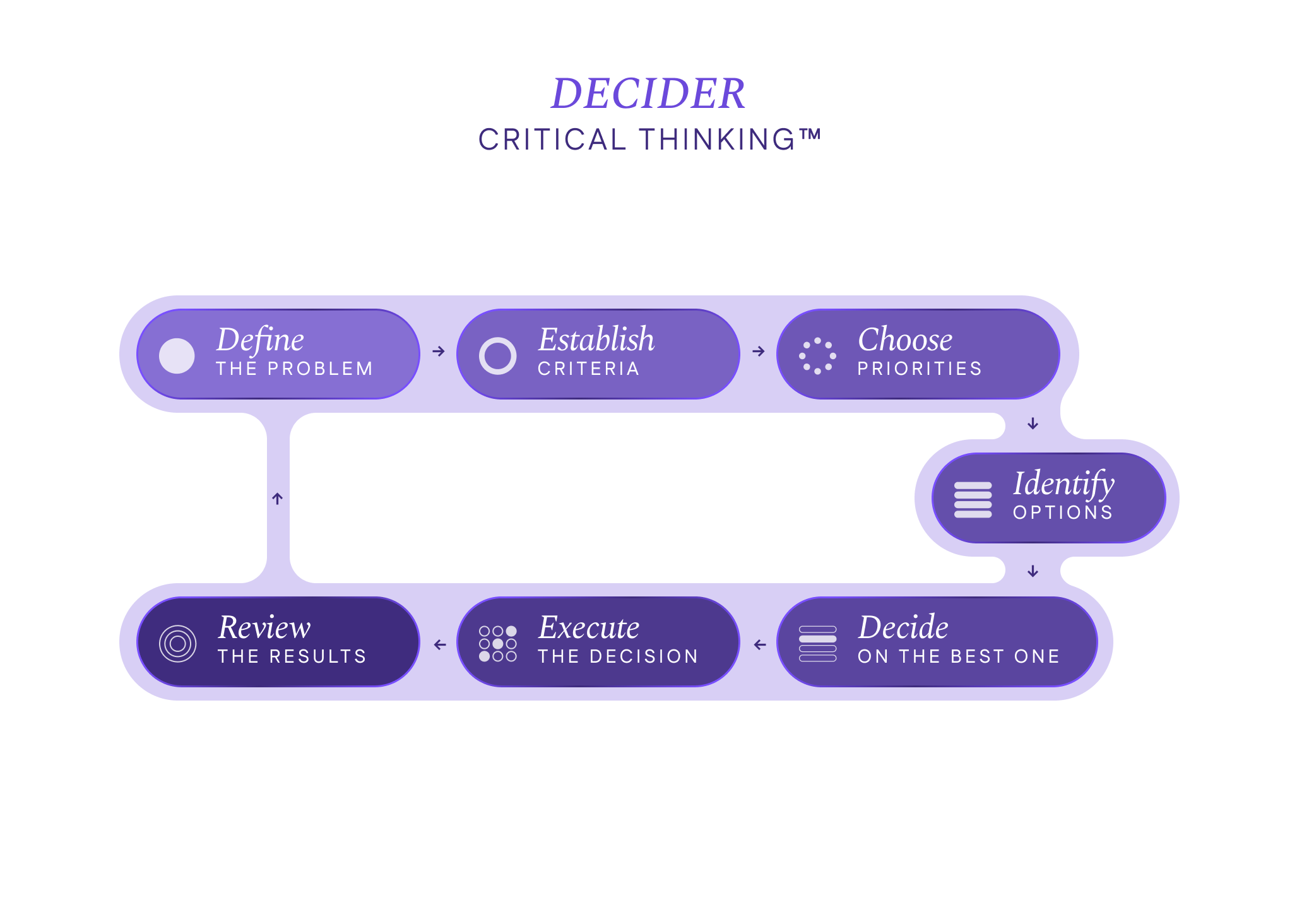
Priorities that were never actually chosen. The plan lists five priorities because the room couldn’t make the trade-off; operationally, five priorities is a tie, and ties get broken later by politics and loudness. The fix is trained choosing: criteria, weights, and a genuine call — the discipline strategic planning borrows from decision-making or does without.
Choices that don’t stay chosen. The declined market resurfaces in Q2; the sunset product finds a sponsor. Undocumented strategic decisions get relitigated at the first friction, and the plan bleeds authority each time. The fix costs a paragraph per decision: what was decided, why, what was rejected.
Review cadence as first casualty. The quarterly strategy review dies under operational pressure precisely because nobody decided, in advance, what would trigger real revision versus noise-riding. Trained review discipline — process evaluated separately from outcomes, thresholds set beforehand — is what makes “living document” a practice instead of a eulogy.
This is also the honest boundary with strategic thinking: thinking is the standing capability, planning the periodic ritual that converts it into commitments. Training the ritual without the underlying decision capability produces beautiful bundles of unmade choices.
Buying or building it
Vet with the usual questions plus three category filters: Does practice run on your real strategic questions (the only material that transfers)? Does the curriculum name the decision layer explicitly — trade-off methods, documentation, review thresholds — or stop at analysis frameworks? And does it address candor conditions — since a SWOT built in a room where threats to the CEO’s strategy go unsaid is a wish list with quadrants? A half-day of framework orientation plus sustained decision-discipline practice beats three days of framework immersion every time it’s tried.
It’s a Monday in January at a regional bank holding company in Boise, and the strategy director is auditing why last year’s meticulously trained planning process produced a plan nobody can find evidence of following. The forensics are quick: seven “priorities” (no trade-offs survived the off-site), zero documented decision rationales (three priorities have already been quietly re-expanded), and a quarterly review that met once. This year’s redesign spends one day on the familiar frameworks and four sessions on the unfamiliar layer — forced-choice priority weighting, a one-page decision record per strategic call, and revision thresholds agreed in advance. The plan that emerges is half the length of last year’s. It’s also, by June, the first one still steering anything.
Run the same audit on your last plan before buying any training: count the real choices in it, the documented rationales, and the reviews that happened. The layer that’s empty is the layer to train.
Frequently asked questions
- What is strategic planning training?
- Training that builds the planning craft: clarifying mission and vision, analyzing position (SWOT and its relatives), setting goals and measures, formulating strategy, and designing execution and review cadence. The strong versions also train the decision discipline that determines whether the plan survives contact with the year.
- What are the five steps of strategic planning?
- The common sequence: establish position (where are we), set direction (where are we going), develop the plan (how we'll get there), execute, and review and adjust. Frameworks vary in labels, but the underlying arc — analyze, decide, cascade, execute, revisit — is stable across them.
- Why do strategic plans fail?
- Rarely at the analysis stage. Plans fail as decisions: priorities that never got genuinely chosen resurface as everything-is-priority-one; choices nobody documented get relitigated; and the review cadence dies first under operational pressure. Training that only teaches frameworks leaves those failure points untouched.
- What is the difference between strategic planning and strategic thinking?
- Thinking is the ongoing capability — reading the landscape, generating options, weighing trade-offs. Planning is the periodic discipline that converts thinking into committed direction, resources, and cadence. Organizations need both; training programs usually sell the planning ritual and assume the thinking.