







Psychological Safety
The 10 outcomes psychological safety sets in motion.
Peer-reviewed research links psychological safety to 10 outcomes, from inclusion to innovation. This report by Dr. Timothy R. Clark gives each outcome a page with its correlation coefficient and the studies behind it, and an appendix explains how to read the statistics.
What’s inside
Peer-reviewed research links psychological safety to 10 outcomes, from inclusion to innovation. This report by Dr. Timothy R. Clark gives each outcome a page with its correlation coefficient and the studies behind it, and an appendix explains how to read the statistics.
What’s inside
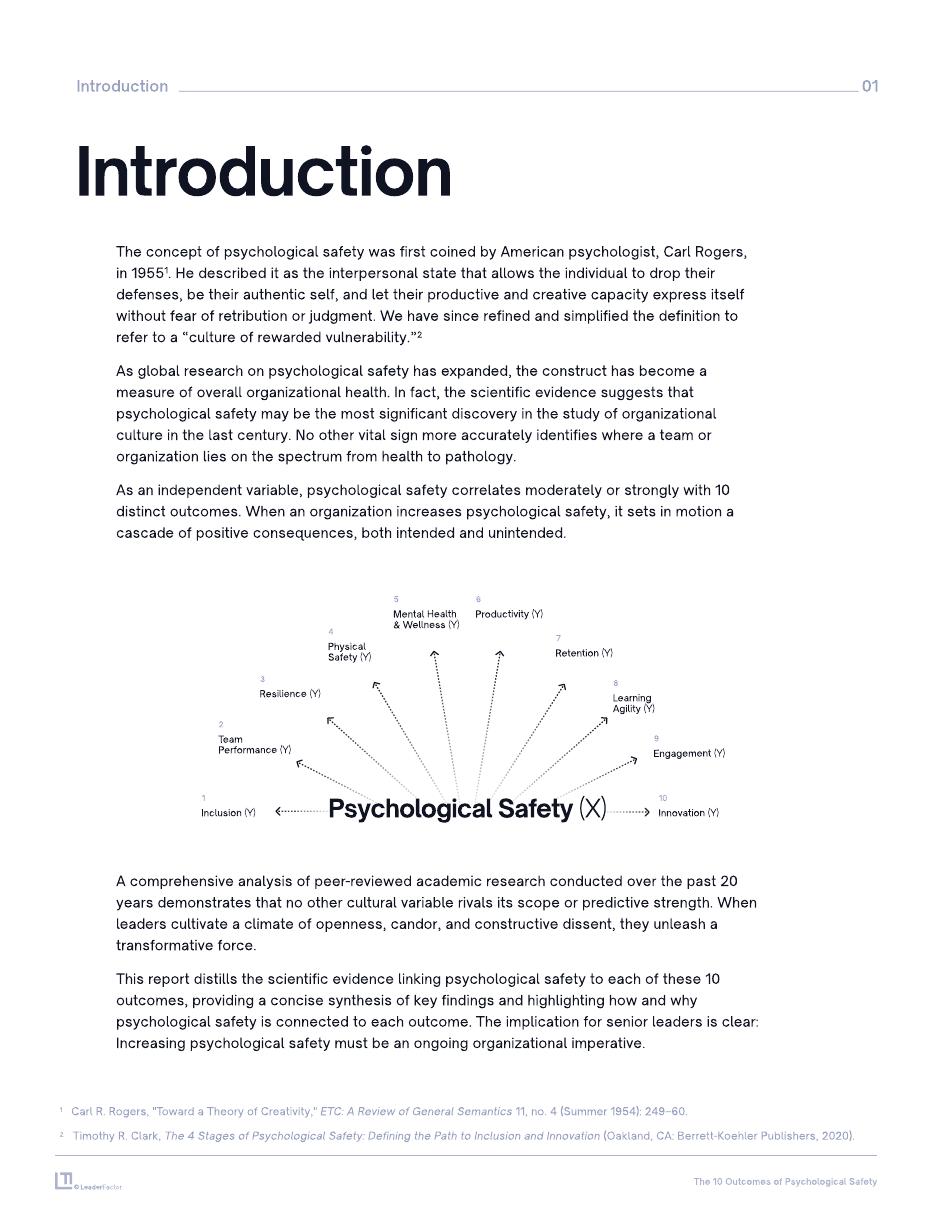
- The outcome map. A diagram sets psychological safety as the independent variable and the 10 dependent outcomes around it: inclusion, team performance, resilience, physical safety, mental health and wellness, productivity, retention, learning agility, engagement, and innovation.
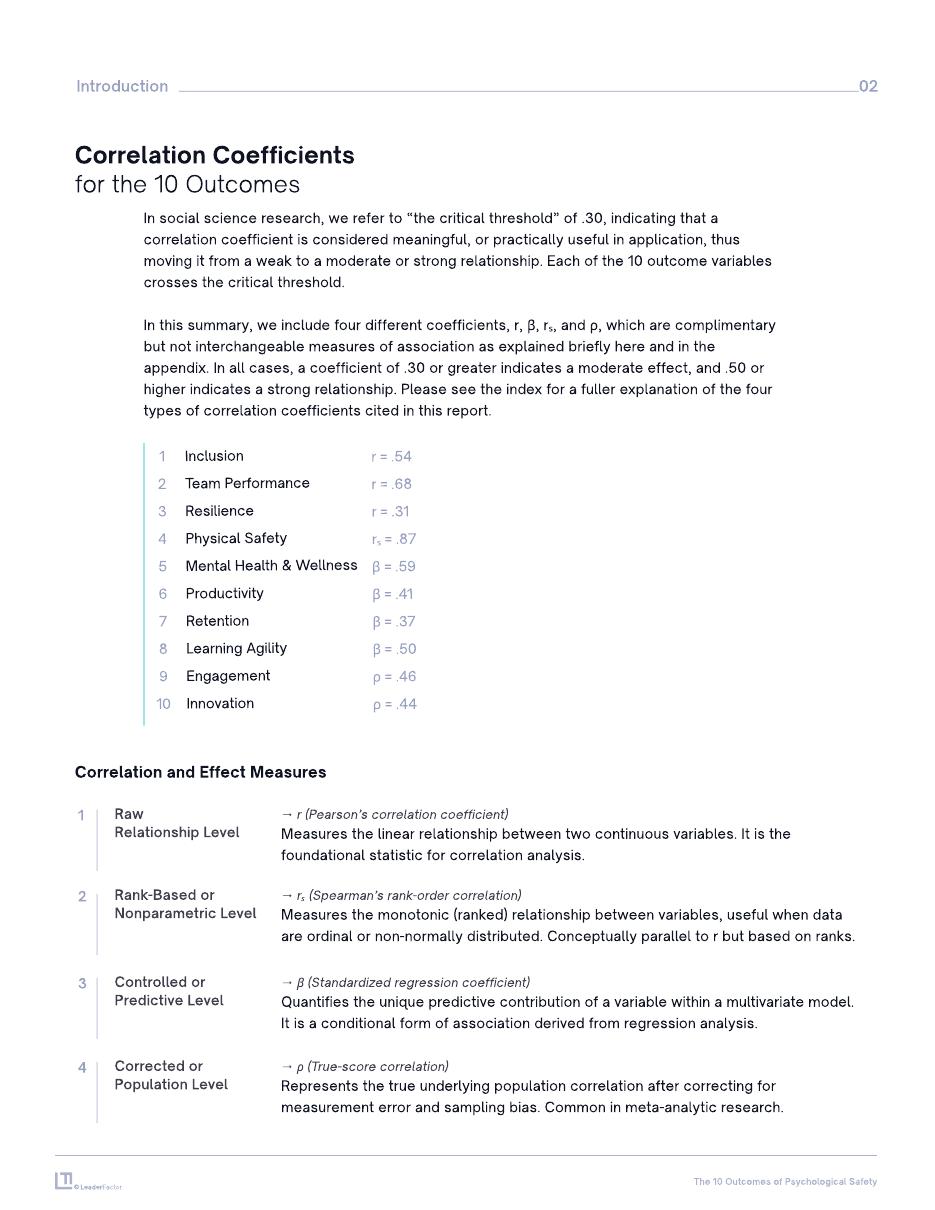
- A coefficient table. One page lists the measured correlation for every outcome, from r = .31 for resilience to rₛ = .87 for physical safety, and explains the .30 threshold that makes a relationship moderate and the .50 threshold that makes it strong.
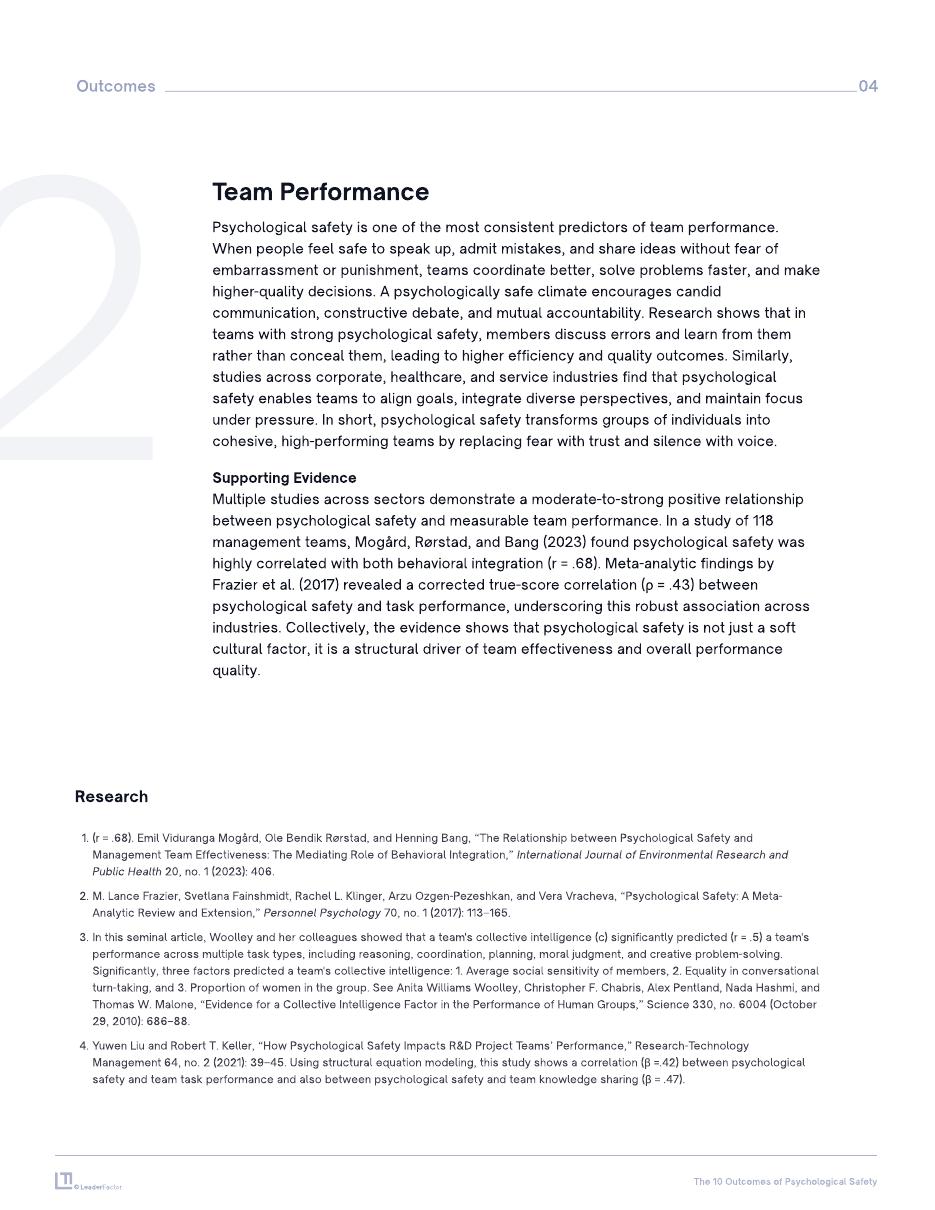
- Ten one-page briefs. Each outcome gets a plain summary of how psychological safety produces it, followed by a “Supporting Evidence” section that names the studies.
- Figures you can cite. Among them: productivity gains of 10–12%, turnover reduced by as much as 27%, retention four to six times higher for underrepresented groups in high-safety workplaces, and workplace safety incidents reduced by as much as 40%.
- Where the definition comes from. The introduction traces the term to Carl Rogers in 1955 and restates it as “a culture of rewarded vulnerability.”
- The conclusion for senior leaders. Psychological safety framed as a strategic investment, with the point that the 10 outcomes reinforce each other rather than arriving one at a time.
- An appendix on the statistics. Plain-language definitions of r, rₛ, β, and ρ, a comparison table, and Cohen’s conventions for reading effect size.
Free guide · 18 pages
Get the guide.
The 10 Outcomes of Psychological Safety