
Name the owner first.
When the team starts debating, I will state who owns the call before we weigh options.
How consistently did you name the owner first this week?
11/30 days complete 2/5 active weeks Checked in

 The 4 Stages of Psychological Safety™
  The 6 Domains of Emotional Intelligence™
  Coaching & Accountability Matrix™
  EPIC Change & Transformation™
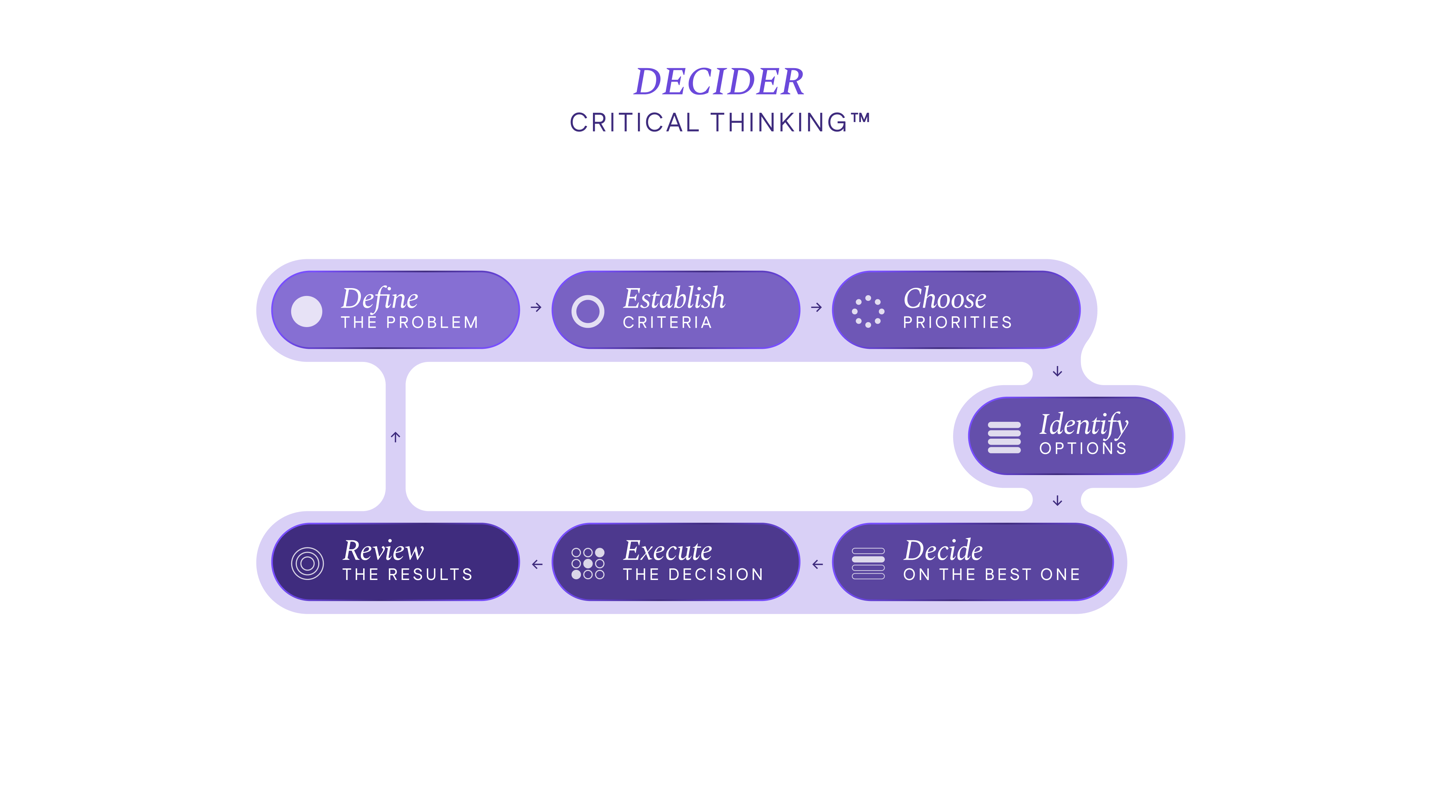
  DECIDER Critical Thinking™
  Team Cohesion & Performance™
  Leading Through AI™
Critical Thinking · DECIDER Critical Thinking™
Remade calls, meetings with sequels, momentum dying in the queue. DECIDER™ builds decision velocity — speed with direction: frame the problem once, weigh real options, make the call, review it so it stays made — and the next one comes faster.
Before you scroll
Eight questions and we’ll tell you. You’ll get a read on where your team is stuck, why, and the format we’d recommend. Skip it if you want; the full page is below.
Define the problem
Before we debate, we agree on what decision we’re actually making — and who owns the call.
Establish criteria
We name the criteria — and the trade-offs — before anyone falls in love with an option.
Identify options
We generate real alternatives instead of validating the obvious one.
Review the results
After the call, we review how it turned out — and keep the lesson.
Your goal
Why are you interested in Critical Thinking?
Scope
Who is this for?
Delivery
How do you picture it running?
Fit
How custom to your organization does this need to be?
Your read
Your format
Off the shelf fits you.
The Critical Thinking course as it ships — the same curriculum, assessment, and tools you can see in the demo below.
Preview the course →Off the shelf, tuned to your needs.
The standard program with tuning — cohorts, sequencing, and delivery matched to how your org actually runs. That’s a conversation, not a form.
Talk with us →A custom build.
Your content and brand on our instructional system and platform — see how custom courses come together.
See custom builds →Start with the free resources.
For your own development, the free path goes deep — field guides, the podcast, and course previews, no purchase required. When you’re ready to bring it to a team, we’re here.
See the free resources →Certifying your own facilitators? See how certification works.
Improve both the quality and the velocity of every decision you make. The model is the diagnosis, the curriculum, and the shared language.
DECIDERCritical Thinking™
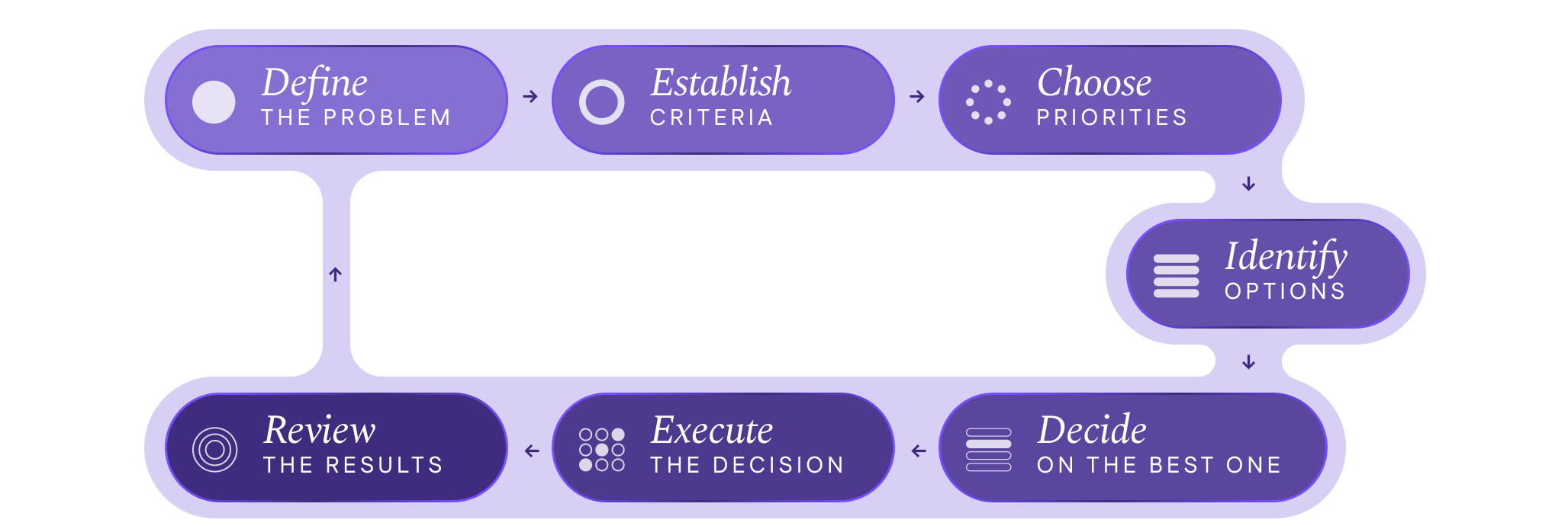
Define the Problem
Clearly articulate what decision actually has to be made.
Establish Criteria
Name the standards every option will be judged against.
Choose Priorities
Decide which criteria matter most, and what you'll trade off.
Identify Options
Generate and explore real alternatives, not just the obvious one.
Decide on the Best One
Score the options against your criteria and make the call.
Execute the Decision
Implement the choice with clarity and alignment.
Review the Results
Assess the outcome and extract the learning for next time.
DECIDERindex™ baseline (prework)
Each participant completes the DECIDERindex™ before the cohort begins, generating a personal baseline of their decision-making patterns.
Foundations: how we actually decide
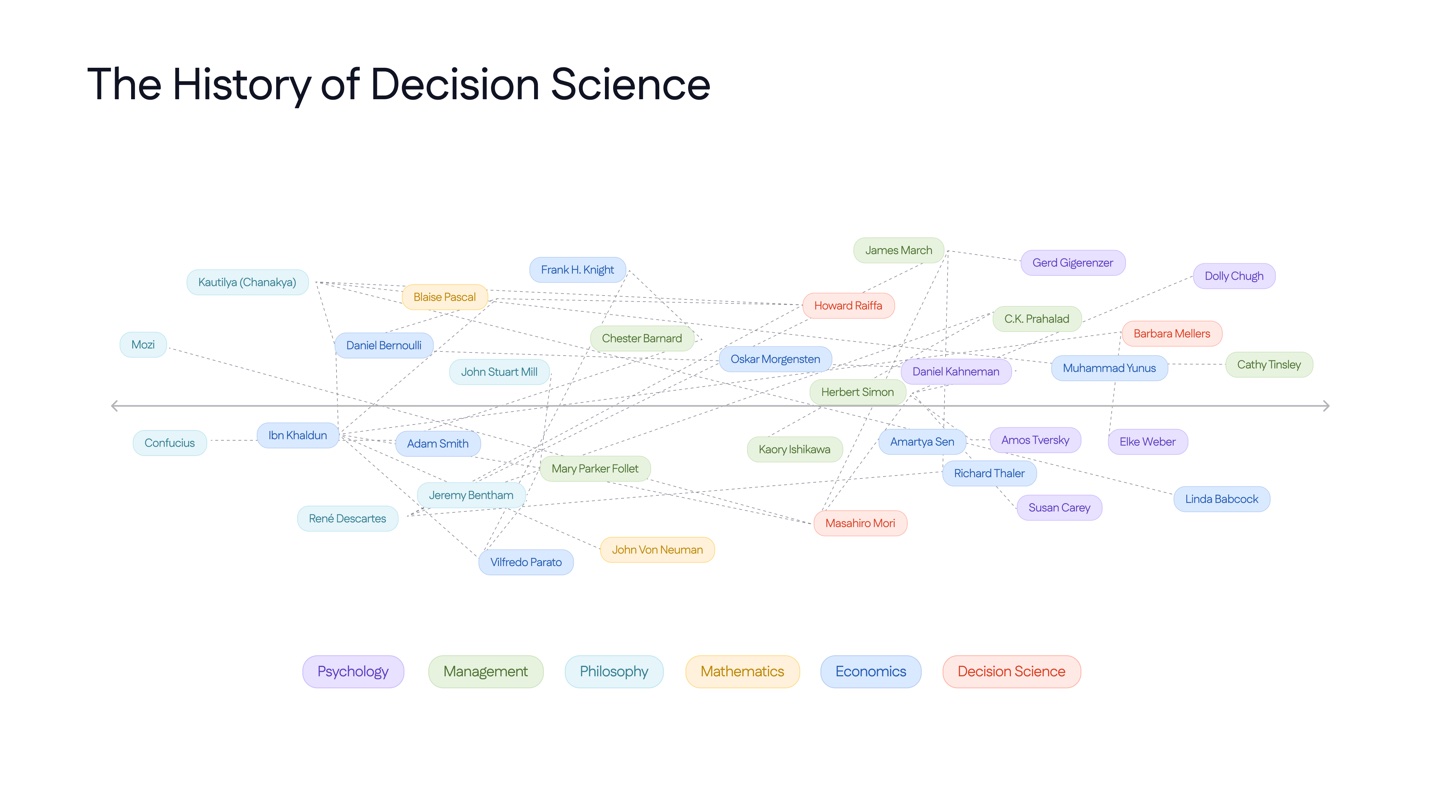
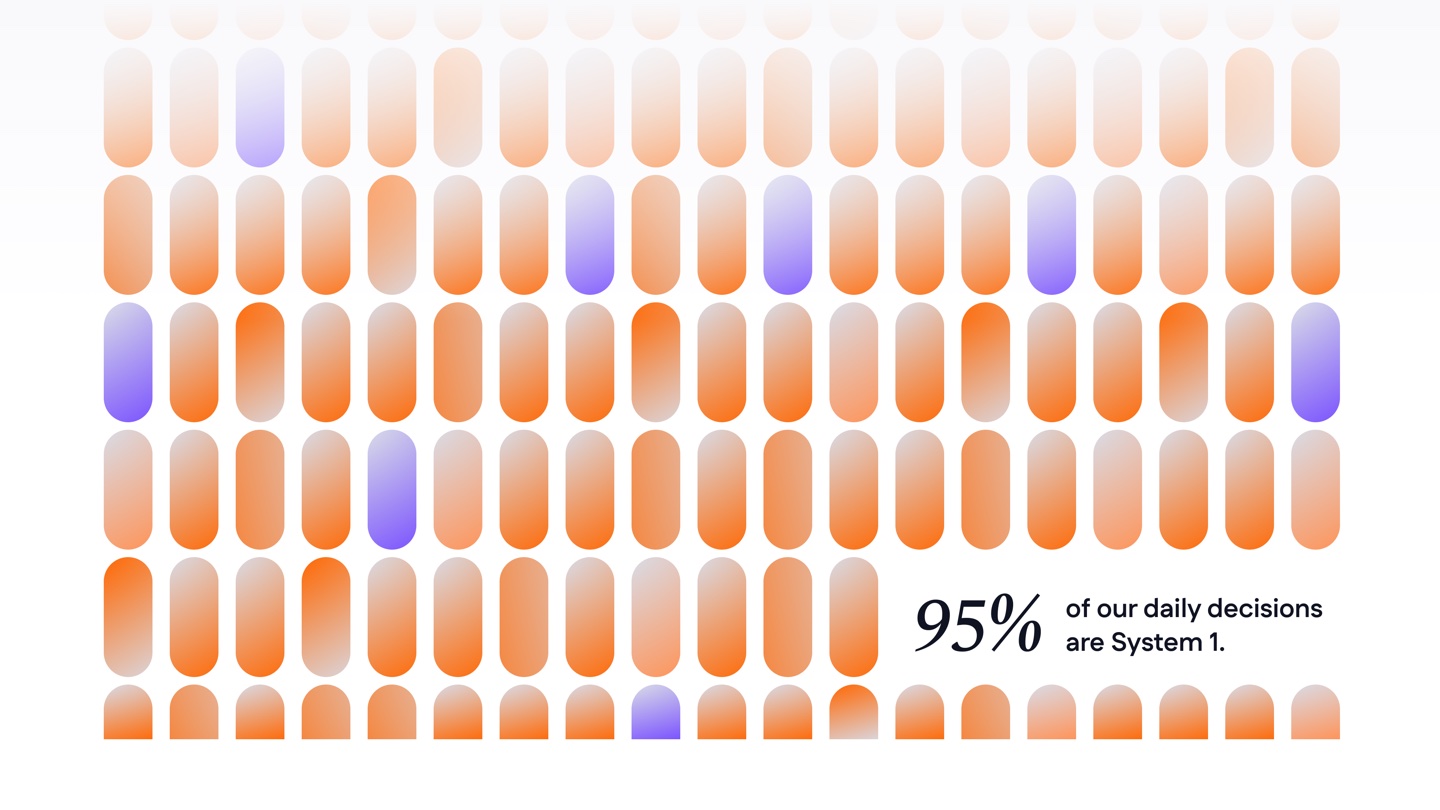
Bounded rationality, System 1 and System 2 thinking, and the heuristics and biases that quietly distort everyday calls.
The DECIDER™ model, step by step
Work through all seven steps — define, establish, choose, identify, decide, execute, review — with an activity at each one.
Apply DECIDER™ to a live decision
Run the seven steps on a real decision you're currently facing and produce a DECIDER™ Report you can take to stakeholders.
Action plan and next steps
Turn your DECIDERindex™ results into a personal action plan and a path to scale the method across your team.
The course isn’t content — it’s a sequence. Each stage does something the next one depends on.
Assess
See it before you change it.
Development starts from the truth, not a hunch. Every learner baselines with DECIDERindex™ — where they’re strong, where they’re stuck — so the course lands on a real gap instead of a generic lesson.
Learn
Learn it against your own results.
Lessons tie the framework to the learner’s own scores, and built-in reflection does the encoding — people remember what they connect to their own team, not what they’re told.
Commit
Practice until it’s habit.
Knowing doesn’t change behavior — practice does. Learners leave with “when X, I will Y” commitments and a weekly consistency check-in, thirty days at a time, until it’s habit.
Toolkit
Keep the skill in the flow of work.
The Learner Toolkit turns the framework into a tool learners reuse on real decisions — interactive and repeatable, so the skill compounds after the course instead of fading.
Built for L&D and HR leaders evaluating for their organization: a one-hour live session with our team, plus a free Access Pass to experience the real thing yourself — your actual results, not a sample.
Click through what a learner experiences — and what your facilitators and admins run.
Day 0 Take DECIDERindex™ — your self-assessment baseline. Truth first, not a hunch.
Before we debate, we agree on what decision we’re actually making — and who owns the call.
Facilitator certification
Keep going to complete your certification.
Program roadmap · FY26
Upcoming
Also scheduled: People leaders · wave 2 (140 · live-virtual · Q3) and All teams (900 · on-demand · Q4).
Delivery · people leaders, wave 1
Live-virtual
Next session Thu · 32 enrolled
Facilitated by your certified team
In person
On-site workshop · Oct 12
Your facilitators or LeaderFactor experts
On-demand
210 active learners
Self-paced, same curriculum and assessment
Presenter mode
Presenting · live-virtual

The DECIDER™ Model · Lesson 2
Half the speed you’re missing is here
A debate without a defined decision is an opinion contest with a calendar invite.
Which recurring debate on your team is really an undefined decision?
Our quarterly roadmap fight. We argue rankings for two weeks because no one has said whether it’s the PM’s call or a vote.
Open your next decision meeting by stating the decision and its owner in one sentence.
Frame · 6 quick prompts
Your problem statement
Here’s what we built.
Edit it directly — it’s yours to refine.
Our team-lead seat has been open for six weeks and coverage is slipping. We need a lead in place this quarter — without stalling the team’s current momentum or losing our strongest people.
Value Benefits & gains
Capability lift for the team 30%
Cost Financial & resource costs
Total comp and ramp cost 20%
Risk Uncertainty & downsides
Ramp and retention risk 25%
Time Speed & urgency
Time to full coverage 25%
Decide · score the options
Promote from within 7.7
Commit · execution plan
Promote from within 7.7
Promote from within
Next steps
✎ EditName interim coverage for the team
Draft the internal posting and criteria
Problem statement
✎ EditOur team-lead seat has been open for six weeks and coverage is slipping. We need a lead in place this quarter — without stalling the team’s current momentum or losing our strongest people.
Saved to your toolkit — every decision stays open to revisit and edit.
DECIDERindex™ · individual
Dimension breakdown
Do I define the real problem, not the symptom?
Your self-baseline — the re-take at 90 days shows the movement.
Do I name standards before options?
Your self-baseline — the re-take at 90 days shows the movement.
Do I make the trade-offs explicit?
Your self-baseline — the re-take at 90 days shows the movement.
Do I generate real alternatives?
Your self-baseline — the re-take at 90 days shows the movement.
Do I select rigorously, with clear rationale?
Your self-baseline — the re-take at 90 days shows the movement.
Do decisions land with owners and timelines?
Your self-baseline — the re-take at 90 days shows the movement.
Do I close the loop and keep the lesson?
Your self-baseline — the re-take at 90 days shows the movement.
In their words · qualitative
“What happens after I make a decision?”
Honestly — it depends who didn’t like it. Some of my calls get re-made twice a month.
Once something is truly decided we move fast. The wobble is what counts as decided.
“What’s working that I should keep?”
Writing the decision down with who owns it. The one-pager habit killed half our re-litigating.
Illustrative sample data, normalized to 0–100 for display — each instrument reports on its own scale.
In the flow of work
Name the owner first.
When the team starts debating, I will state who owns the call before we weigh options.
How consistently did you name the owner first this week?
Three options minimum.
When we face a real decision, I will require three genuine alternatives before we choose.
How consistently did you force real options this week?
Start working on a new commitment
You have 12 planned skills — time to get started.
Planned commitments
Saved for later. When you're ready, move one to your plan. Critical Thinking 61/100 Change Management 59/100 DECIDERindex™ · aggregate reporting
Pre / post by stage
Baseline 90-day BenchmarkBenchmark = the DECIDERindex™ research base across participating organizations.
Participation & engagement
474 invitedBy cohort
4 cohorts · 3 modalitiesIllustrative sample data, normalized to 0–100 for display — each instrument reports on its own scale.

Certification
Certify your own people once, and deliver it to every Access Pass cohort on your own cadence — same curriculum, decks, and facilitator resources our experts use.
One pass per learner covers the whole system for this skill — assessment, course, tools, and reporting. Certification and delivery options layer on top.
Full Access Pass details
Field guide
Simple Tools for Smarter Decisions
Practical tools that upgrade everyday decisions without slowing them down.
Read the guide
Podcast
The Leader Factor
Dr. Tim Clark and Junior on the frameworks behind the work — weekly, candid, and free.
Listen inLibrary
All field guides
Every downloadable guide across the seven skills — no email wall on the reading.
Browse the libraryIt depends which problem you mean. In operations, problem solving training usually means root-cause analysis for production lines. This is the other kind — decision-making training for leaders, a repeatable method for defining the problem, weighing options against explicit criteria, making the call, and reviewing the outcome. If you need Six Sigma for engineers, this isn't it; if you need managers who make better calls faster, it is.
DECIDER™ is a seven-step decision-making method — Define the problem, Establish criteria, Choose priorities, Identify options, Decide on the best one, Execute, and Review the results. It's grounded in the decision science of Kahneman, Tversky, and Simon — bounded rationality, System 1 and System 2 thinking, and the biases that quietly distort everyday calls — turned into a discipline teams can run the same way every time.
It's a system, not an event. Participants learn the proprietary DECIDER™ framework, get measured on the DECIDERindex™, and apply the seven steps to a real decision — so what you scale is a shared method and a behavior change, not a one-off slide deck.
Every participant takes the DECIDERindex™ before and after, and applies the method to a decision they're actually facing during the course. Re-measuring the DECIDERindex™ later shows the behavior change against each person's own baseline — the measurement is the proof.
It runs live-virtual, on-demand, or in-person, and it's delivered on leaderfactor.app — so administration, enrollment, the DECIDERindex™, and org-level reporting all live in one place as you roll it out across teams.
Custom builds
Your frameworks, your language, your brand — built into a custom course on the same instructional system, assessment engine, and platform that runs DECIDER Critical Thinking™.
Ninety seconds tells you where to start. A conversation tells you how fast you can get there.
or take the ninety-second intake ↑