







Critical thinking training for managers.
Teams don't just make bad decisions. They make slow ones, and then relitigate them at the first sign of friction. This program teaches managers a seven-step method they can run the same way every time, on a real decision they're facing now, and measures the change with the DECIDERindex™.
 DECIDERindex™ results in the LeaderFactor platform
The learning platform at leaderfactor.app, sample data.
- Format
- Cohort-based with self-paced modules, applied to a live decision during the course.
- Length
- Five weeks.
- Instrument
- DECIDERindex™ baseline and re-measure, with an optional multi-rater view.
- Built for
- Managers who need to make better calls faster. Not a Six Sigma or root-cause program for engineers.
Critical thinking training for managers teaches a repeatable way to reason from evidence to a decision, and then to make that decision stick. A decision is a commitment to a chosen course of action among alternatives. The training question is whether your managers reach that commitment by a method they can run the same way every time, or by whichever reflex the meeting happened to reward.
This page covers what a program should teach, why most of them never reach the Tuesday meeting, which format fits which rollout, and how to tell before you buy whether it will change anything.
Why most decision-making training doesn’t reach the Tuesday meeting
The usual program teaches cognitive biases. Managers learn about anchoring and confirmation bias, nod at the examples, and feel sharper for a day. Then the next decision arrives the way decisions always do, half-framed, under time pressure, with the loudest option already on the table, and the reflexes win. Knowing the names of your biases does not slow them down. Roughly 35,000 decisions a day run on autopilot, and System 2, the manual override, only engages when something forces it.
The misconception is that critical thinking is a trait, something the smart people in the room have and the rest need to develop. On a team it behaves like a process. A room of very bright people with private opinions produces the same first-idea decisions as any other room, because nobody wrote the problem down, nobody named the criteria, and nobody generated a second option before the first one was adopted. Paul Nutt’s research found fewer than one manager in five explored more than one alternative. That is a process failure, and process is trainable.
So the program has to install a structure that forces the override, and then make managers run it on something real.
What the training should teach: a method with named steps
LeaderFactor’s program is built on DECIDER Critical Thinking™, a seven-step method grounded in the decision science of Kahneman, Tversky, and Simon: bounded rationality, System 1 and System 2 thinking, and the biases that quietly distort everyday calls, turned into a discipline teams can run the same way every time.
The method acknowledges what rational decision making actually looks like for a manager. You rarely optimize. You satisfice, choosing the option that is good enough under the circumstances, and the point of structure is to make “good enough” a conscious call rather than an accident. Great decisions start wide and end narrow: diverge first, then converge, generate before you judge. The scale of a decision changes the depth of each step, not the structure.
Beyond the seven steps, look for three things in any curriculum. It should name the ten biases that show up most, from confirmation and anchoring to sunk cost and groupthink, and tie each to a step where it bites. It should teach the difference between participation rights and decision rights, so a team knows the difference between having a say and having a vote. And it should separate one-way doors from two-way doors, so managers stop deliberating reversible calls as if they were irreversible.
It only works on a real decision
A case study teaches the method. A live decision teaches the manager. During the course each participant takes a decision they are actually facing, works it through the seven steps, and produces a DECIDER™ Report they can take to stakeholders. The report is the deliverable, and it is also the practice: a manager who has written down the criteria, scored three options against them, and documented who decided and why has done something they can repeat next quarter without the cohort.
Consider a regional operations director in a logistics company deciding whether to consolidate two distribution centers. The decision has been “under review” for five months, through four meetings with sequels. In the course she defines it in one sentence, sorts the criteria into must-haves and nice-to-haves, generates a third option nobody had tabled (phase one site, keep the other as overflow), scores all three against value, cost, time, and risk, and writes down that the call is hers, consultative, due Friday. The decision gets made in week three. The method did not make her smarter. It made the decision legible, and legible decisions get made.
Which format fits your rollout
- A manager cohort of twenty to sixty is the default. Managers work their own decisions in parallel, pressure-test each other’s criteria, and build a shared vocabulary so that “what’s the D on this?” means the same thing on every team.
- Self-paced modules carry the method between sessions and work as pre-work. On their own they teach the vocabulary and leave the reflexes alone.
- Facilitator certification lets an internal L&D team run the cohort at its own cadence, keeping the method and the instrument intact.
The scope ruling is worth stating plainly, because it saves everyone a sales call. If you need Six Sigma or root-cause analysis for engineers, this isn’t it. If you need managers who make better calls faster, it is.
How you’ll know it worked
Measure the manager before and after. The DECIDERindex™ generates a personal baseline of each participant’s decision-making patterns before the cohort begins, scored per step and overall. Participants retake it after the course, and the measurement is the proof. The optional multi-rater view invites a supervisor, peers, or direct reports to rate the same behaviors, and once at least three respond, the report surfaces hidden strengths and blind spots the self-rating missed.
Two questions settle most provider comparisons. What decision will my managers have made differently by week three? And what will the retest show that the baseline didn’t?
Where to start
Start with the layer where decisions pile up. In most organizations that is middle management, where calls arrive from above half-framed and from below half-escalated. Put those managers in the first cohort, have each bring the decision that has been sitting longest, and let the DECIDER™ Reports be the first proof the program produces. Then read the retest against the baseline and decide the second cohort the way the course taught you to.
What the program covers
Seven steps, run on a decision you're actually facing.
DECIDER Critical Thinking™ breaks rational decision making into seven linear steps that apply to any decision at any level. Each participant works the steps on a live decision and leaves with a DECIDER™ Report they can take to stakeholders.
-
Define the problem
Articulate what decision actually has to be made, in one sentence, before anyone discusses solutions. If you misdefine the problem, you misdirect the solution.
-
Establish criteria
Name the standards every option will be judged against, sorted into must-haves and nice-to-haves. Criteria are the guardrails of good decisions.
-
Choose priorities
Decide which criteria matter most and what you'll trade off, using the four universal categories: value, cost, time, and risk.
-
Identify options
Generate real alternatives, including doing nothing or delaying. Diverge before you converge. More options mean better choices.
-
Decide on the best one
Score the options against the criteria, make the call, and document who decided, when, and why.
-
Execute the decision
Implement with clarity and alignment, and cascade it as shared understanding, not forwarded information. A good decision fails without good execution.
-
Review the results
Evaluate the quality of the process separately from the outcome, and extract the learning for next time. You can't improve what you don't review.
-
Your DECIDER™ Report
The decision you worked during the course, written up step by step, ready for the stakeholders who have to live with it.
Assess, learn, apply, prove. One platform.
The program runs on leaderfactor.app: the baseline, the cohort and self-paced modules, the application tools, and the re-measure, with org-level reporting for the people who bought it.
DECIDERindex™ baseline 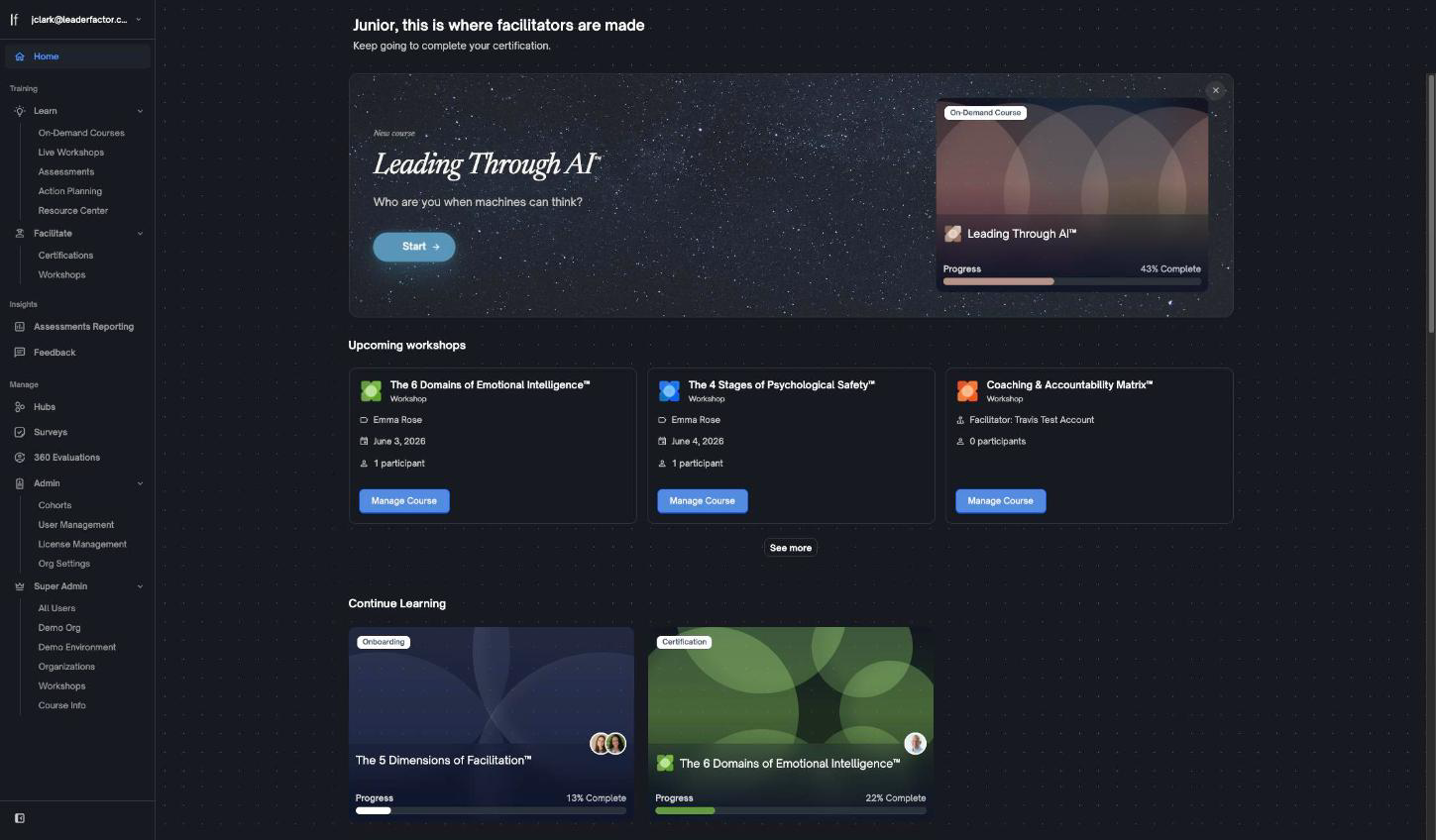 The learner home in the LeaderFactor platform
 DECIDERindex™ re-measure
Screens from leaderfactor.app with sample data. Not client results.
Not sure this is the skill you need?
If decisions get made and then die in the rollout, that is Change Management, not critical thinking. If the room never pushes back on the first idea, the constraint is Psychological Safety. This program is for managers whose decisions drag, or don't stay decided.
See the Change Management programFrequently asked questions
- What is critical thinking training for managers?
- Critical thinking training for managers teaches a structured way to define a problem, set criteria, weigh real options, make the call, execute it, and review it, so decisions get made faster and stay made under friction. Good programs run the method on a live decision during the course and measure the manager's decision-making patterns before and after.
- What is the difference between critical thinking training and decision-making training?
- In practice they are one skill. Critical thinking is the discipline of reasoning from evidence rather than reflex; decision making is where that reasoning becomes a commitment to a course of action. LeaderFactor's DECIDER Critical Thinking™ teaches both as a single seven-step method, grounded in the decision science of Kahneman, Tversky, and Simon.
- What should decision-making training cover?
- A repeatable method with named steps, the common biases that distort everyday calls, a way to separate must-have criteria from nice-to-haves, the discipline to generate options before judging them, clarity about who holds the decision, and a review that judges the process apart from the outcome. It should be practiced on a real decision, not a case study.
- How long does critical thinking training take?
- LeaderFactor's program runs five weeks, cohort-based with self-paced modules. Each manager takes the DECIDERindex™ before the cohort begins, works the seven steps on a decision they are currently facing, produces a DECIDER™ Report for their stakeholders, and retakes the instrument at the end so the movement is measured.
- How do you know if decision-making training worked?
- Measure the manager's decision-making patterns before and after. The DECIDERindex™ builds a personal baseline across the seven steps, the course applies the method to a live decision, and the retest shows which behaviors moved. The optional multi-rater view adds how the people around the manager experience their decisions, which surfaces the blind spots a self-rating can't.
Build your team's decision velocity.
See the program run in a free one-hour Skill Preview, assessment included. Or talk with us about a cohort for your leaders.
or start with the free guide, Simple tools for smarter decisions →