





Cognitive bias in decision making: where each one attacks
Cognitive bias in decision making, mapped to the process: the 10 common biases, which decision step each one distorts, and the countermeasure that fits there.
Cognitive bias in decision making isn’t a character flaw or a knowledge gap; it’s the operating cost of a brain built for speed. A heuristic is a mental shortcut, a rule of thumb, and most daily decisions run on them, automatically and well. A bias is a systematic distortion: what the shortcut produces when it fires outside its competence. Daniel Kahneman’s System 1 and System 2 describe the machinery — fast associative thinking as the default, slow deliberate thinking as the manual override — and the practical problem in one sentence: the override doesn’t engage just because the decision is important.
Most bias content stops at the catalog. The catalog is the easy half. The useful half is knowing where in the decision process each bias attacks, because that’s what tells you which countermeasure to install and when.
The 10 common biases, mapped to the step they attack
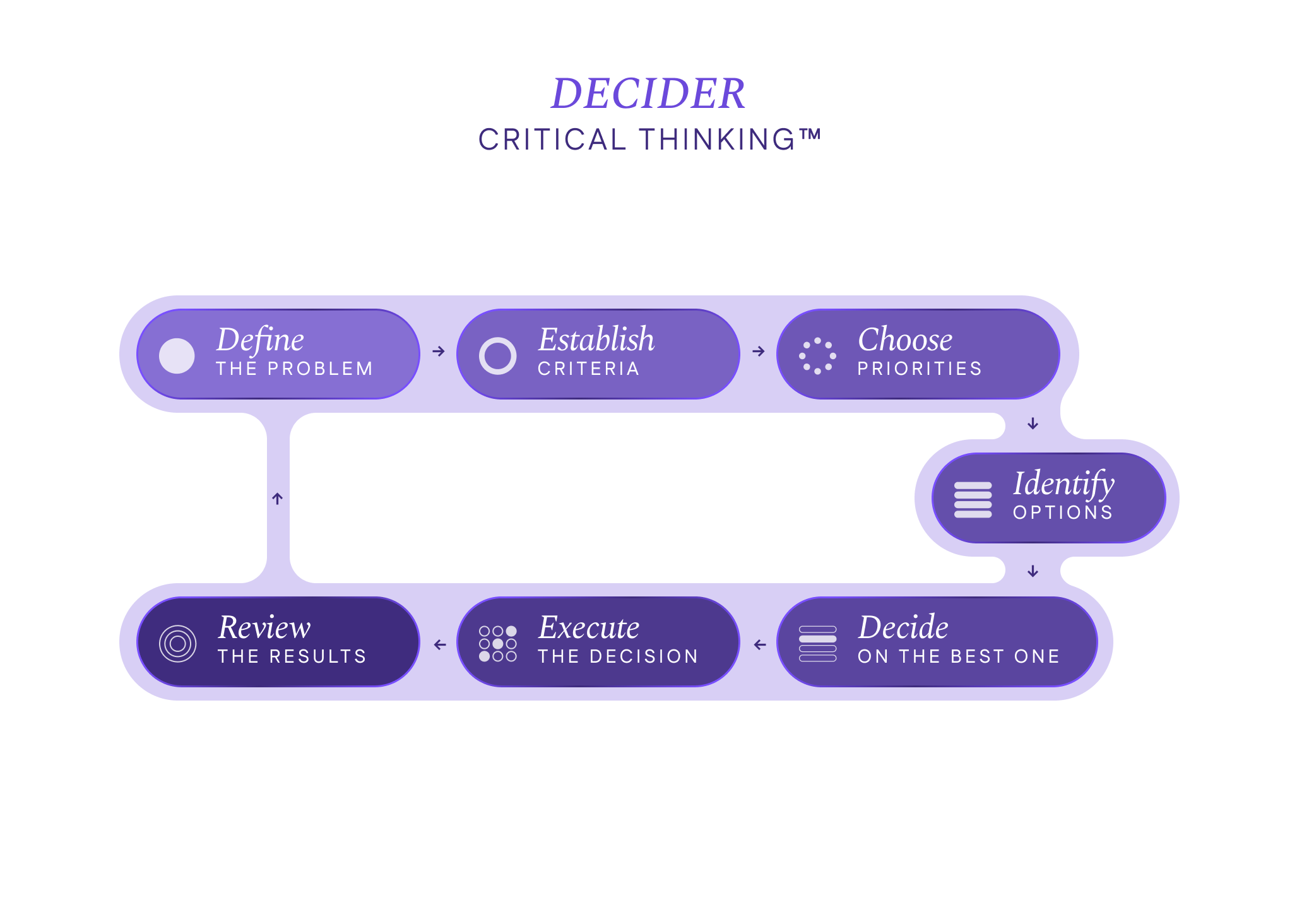
LeaderFactor’s DECIDER Critical Thinking™ framework names 10 common biases and runs decisions through 7 steps. Put them together and the map looks like this:
| Bias | What it does | Attacks at | The structural counter |
|---|---|---|---|
| Framing effect | The presentation of the question steers the answer | Define the problem | Write the problem statement two ways (gain-framed, loss-framed) before starting |
| Confirmation | Collects evidence for the existing belief | Criteria & evidence-gathering | Set criteria before viewing options; assign someone the disconfirming case |
| Anchoring | First number heard becomes the reference point | Criteria & priorities | Independent written estimates before any number is spoken |
| Availability | Vivid, recent examples masquerade as base rates | Identify options | Ask what the boring, unmemorable cases look like; check actual frequencies |
| Status quo | The current state gets an unearned home-field advantage | Identify options | Make “do nothing” an explicit option that must be argued for, not defaulted to |
| Groupthink | The room converges to protect harmony | Decide (in groups) | Positions in writing first; senior voice last; dissent as an assignment |
| Overconfidence | Certainty outruns accuracy | Decide | Pre-mortem: “it failed — what happened?”; ask what evidence would change the call |
| Sunk cost | Past investment argues for future investment | Execute & persist | Evaluate the next dollar on its own; separate intelligent persistence from escalation |
| Hindsight | ”I knew it all along” rewrites the record | Review the results | Document predictions and reasoning at decision time, then review against the record |
| Self-serving | Successes are skill, failures are circumstance | Review the results | Review process quality separately from outcomes, for wins as well as losses |
The mapping is the point. Bias training fails when it produces people who can name twenty biases and still run the same meetings, because names don’t fire in the moment. Steps do. If your process forces criteria before options, confirmation bias has nowhere to stand. If positions arrive in writing before discussion, anchoring and groupthink lose their opening move. The process remembers what your brain, mid-decision, won’t.
Why smart doesn’t help
The misconception that keeps bias expensive: “we’re an experienced, analytical team — we’d notice.” Noticing is precisely what biases prevent; each one operates as a feeling of being right, not as a detectable error message. Expertise narrows some biases and feeds others — overconfidence scales with seniority, and anchoring works fine on statisticians. There’s even a bias about bias (the blind spot: everyone rates themselves less biased than average), which is why the replacement idea is structural humility: assume the distortions are present, in you, on your best day, and build the sequence so it doesn’t matter.
What it looks like when it bites
It’s a Monday in November at a consumer-apps company in San Diego, and the product VP is defending a feature that’s missed three launch windows. The original business case anchored the room at a revenue number nobody remembers deriving; every review since has surfaced confirming signals and explained away the rest; and the strongest argument in today’s meeting is eighteen months of sunk engineering time. Four biases deep, and every person in the room is experienced, analytical, and sincere. The DECIDERindex™ profile that eventually breaks the pattern doesn’t diagnose the feature — it shows the VP he never generates alternatives and never reviews process, which is the personal signature that let all four distortions compound unchecked.
Installing the countermeasures
Notice that nothing in the counters column requires vigilance, genius, or a workshop afterglow. It requires a process with the rules built in, run consistently — which is the design intent of LeaderFactor’s DECIDER™ model: 7 steps that sequence criteria before options and review after outcomes, so the debiasing is ambient. The decision-making process walks the steps; team decision making covers the group defenses in depth; the Critical Thinking skill trains it all on live decisions, with the DECIDERindex™ profiling which steps you skip — and therefore which biases you’re personally subsidizing.
Start with the map above and your last contested decision: find the step where it went sideways, and install that one counter this week. Debiasing a whole team starts with un-skipping one step.
Frequently asked questions
- What is cognitive bias in decision making?
- A cognitive bias is a systematic distortion in thinking — a predictable way judgment departs from evidence and logic. Biases grow out of heuristics, the mental shortcuts that make fast thinking possible. The shortcuts are usually useful; biases are what they become when the shortcut fires in a situation it doesn't fit.
- What are five cognitive biases that influence decision making?
- Five with the largest workplace footprint: confirmation bias (seeking evidence for what you already believe), anchoring (over-weighting the first number heard), sunk cost (continuing because of past investment), overconfidence (certainty outrunning accuracy), and groupthink (a room converging to preserve harmony rather than find truth).
- What is an example of cognitive bias in the workplace?
- A hiring panel reads the first interviewer's enthusiastic notes before meeting the candidate, then unconsciously collects confirming impressions all day — anchoring feeding confirmation bias. The structural fix is independent written evaluations submitted before anyone shares a verdict, which is why disciplined panels sequence it that way.
- How do you overcome cognitive biases in decision making?
- Not by willpower — knowing a bias's name doesn't stop it firing. Biases are beaten structurally: criteria set before options are viewed, independent positions collected before discussion, a mandatory alternative before converging, pre-mortems before committing, and process reviews afterward. The process carries the discipline your in-the-moment brain can't.
- What is the difference between a heuristic and a bias?
- A heuristic is a mental shortcut, a rule of thumb that trades precision for speed, and most of the time it serves you well. A bias is a systematic distortion — the predictable error pattern a heuristic produces when it's applied outside the conditions it evolved for. Heuristics are tools; biases are their misfires.