





Team decision making: who really holds the D?
Team decision making fails on vague ownership, not bad intentions. The five decision models, participation vs. decision rights, and how to keep calls made.
Team decision making has a reputation for being slow, political, and exhausting, and the reputation is earned — but not for the reason usually given. The problem is rarely that people can’t agree. It’s that nobody established what agreement was for: who holds the decision, what kind of input everyone else is giving, and which model the team is running. Get those explicit and a team outperforms any individual. Leave them vague and every significant call becomes a negotiation about how to negotiate.
The distinction that prevents most of the pain
Participation rights are not decision rights. Participation rights determine who gets heard; decision rights determine who holds the D — who actually decides. Rosabeth Moss Kanter’s line is the whole doctrine in a sentence: everyone may have a say, but not everyone has a vote.
The misconception that wrecks team decisions lives exactly here: “we’re a collaborative team, so we decide together.” It sounds like a culture statement and functions as an ambiguity. When “together” is undefined, every participant supplies their own definition, most assume consultation was a ballot, and the leader’s eventual call lands as betrayal instead of process. The fix costs one sentence at the start of the discussion: here’s who’s deciding, and here’s what your input is for. Collaboration survives clarity fine. It’s ambiguity it doesn’t survive.
The five models, and what each one costs
| Model | Who decides | Best for | The cost |
|---|---|---|---|
| Unilateral | The leader, alone | Emergencies, trivial calls, decisions only the leader can own | Zero buy-in beyond compliance; wasted team judgment if overused |
| Consultative | The leader, after real input | Most significant team decisions | Input must be genuine, or it’s unilateral with extra meetings |
| Delegated | A named person who isn’t the leader | Decisions inside someone’s earned ownership; capability-building | The leader must live with the answer, or the delegation was fake |
| Democratic | The majority | Preference questions with roughly equal stakes | Produces losers; poor for decisions needing expertise weighting |
| Consensus | Everyone, until all can commit | Decisions that fail without full ownership | The most expensive model; degrades into mush when it’s the default |
Two patterns in the table deserve pulling out. First, consultative is the workhorse: it captures the team’s judgment while keeping the D singular, which is why skilled leaders live there. Second, consensus is a specialty tool being widely misused as a virtue. Teams that consense on everything aren’t more collaborative; they’re slower, and their decisions come pre-softened — shaped to be agreeable rather than right.
Matching model to decision is a two-question exercise: how much does quality depend on expertise, and how much does execution depend on ownership? High expertise, low ownership-need: delegate to the expert. High ownership-need: spend the consultative or consensus time. Neither: stop scheduling meetings about it.
The room is a bias amplifier
Groups don’t just aggregate judgment; they synchronize it, and that’s the mechanism of groupthink — one of the classic distortions cataloged in cognitive bias in decision making. Cohesion plus hierarchy plus time pressure will converge a room on the first confident opinion, then generate supporting arguments retroactively, with every participant sincerely experiencing it as agreement.
The defenses are structural, and they’re all cheap: collect written positions before discussion opens, so first-speaker anchoring can’t set the frame. Senior person speaks last, every time. Someone owns the opposing case as an assignment, not a personality. And no convergence until a genuine alternative has been on the table — a rule that does double duty, since generating before judging is what the diverge-then-converge discipline requires anyway. Techniques like Delphi rounds and nominal group work are these same defenses, formalized.
None of this functions in a room where dissent is expensive. A team whose members privately calculate that challenging the plan will cost them standing doesn’t have a decision-making problem; it has a psychological safety problem wearing one.
Decide, record, cascade
It’s a Friday in August at a hospital network in Ohio, and the analytics steering group has just made the same vendor decision for the third time in a year — each version undocumented, each reopened by whoever missed the meeting. The new operating rule costs one paragraph per decision: who decided, what, when, why, and the alternatives rejected. Two months later a department head emails to relitigate, and the reply is a link. The decision infrastructure isn’t sophisticated. It’s written down, which turns out to be the sophistication.
After the record comes the cascade, and it’s where team decisions quietly die. Cascading a decision means transferring understanding, not passing information down: the teams executing need the why and the trade-offs, not just the verdict, because alignment is shared understanding plus shared commitment. A decision that arrives as pure instruction gets compliance, and compliance can’t improvise when reality diverges from the plan.
Making it your team’s normal
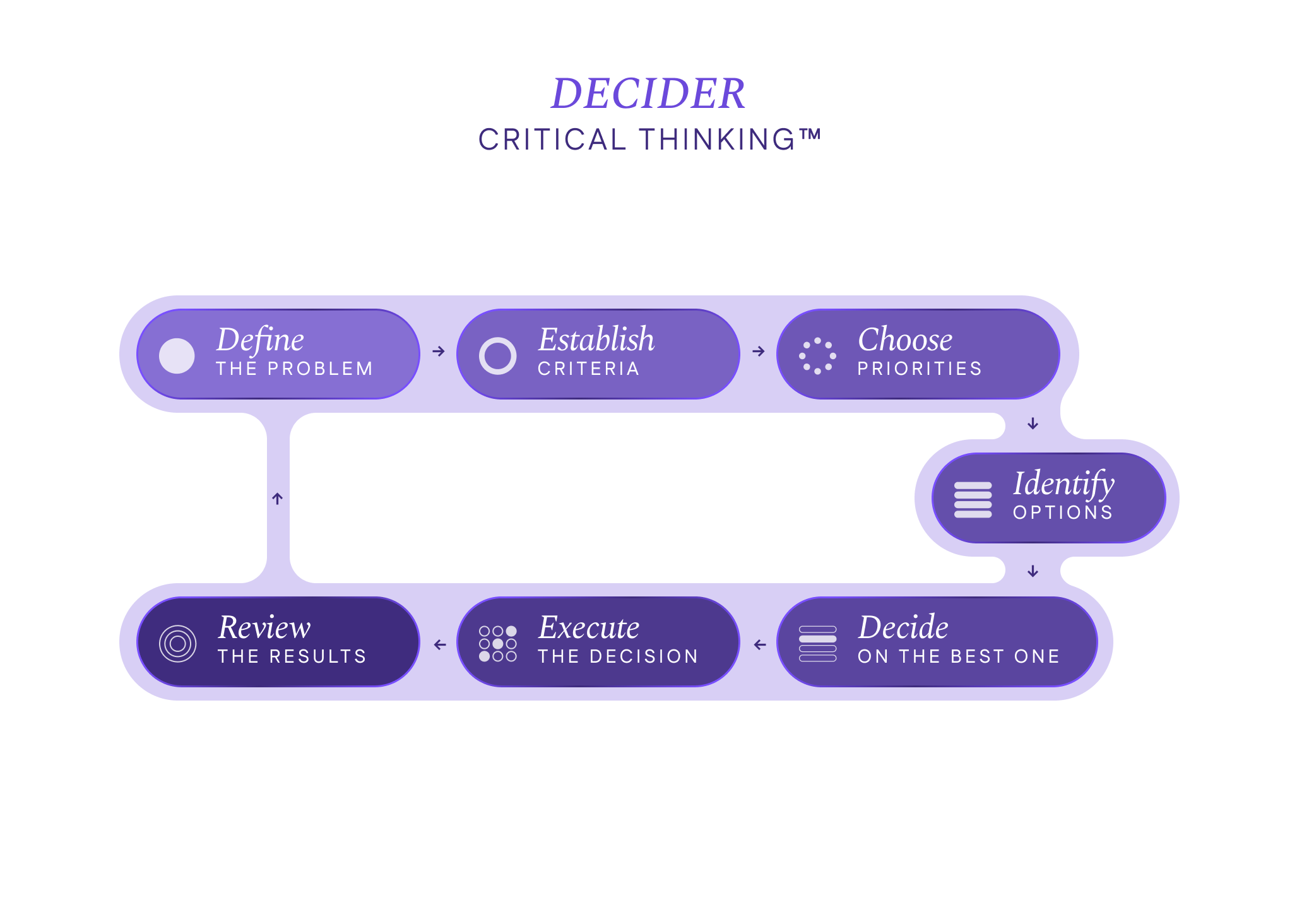
Install the vocabulary before the next contested call, not during it: the five models, the D, the one-paragraph record. Then run one real decision visibly through a full sequence — LeaderFactor’s DECIDER™ model supplies the steps, and the decision-making process walks them — with the model named at the start and the record published at the end. The Critical Thinking skill trains the whole discipline, group mechanics included, on decisions your team is actually facing.
Start with the sentence, though. Whatever’s on the agenda this week, open it with “here’s who holds this decision, and here’s what I need from everyone else.” You’ll feel the room relax. Ambiguity was the exhausting part.
Frequently asked questions
- What is the best decision-making model for teams?
- There's no single best model — there are five, and the skill is matching one to the decision. Unilateral suits emergencies and trivial calls, consultative fits most significant decisions, delegated builds capability, democratic resolves preference questions, and consensus is reserved for decisions needing full ownership, because it's the most expensive.
- What is the difference between participation rights and decision rights?
- Participation rights determine who gets heard; decision rights determine who decides. Most team decision conflict comes from blurring them: people assume being consulted meant sharing the vote. Naming who holds the D before the discussion starts prevents the relitigation that follows discovering afterward that input wasn't a ballot.
- How do you avoid groupthink in team decisions?
- Structurally, not aspirationally. Collect independent positions before anyone speaks, have the senior voice go last, assign genuine devil's advocacy, and require a real alternative before converging. Groupthink is a bias that thrives on cohesion and hierarchy, so the defenses have to interrupt both, every time, by design.
- Should team decisions be made by consensus?
- Sometimes, knowingly, and less often than teams default to. Consensus produces the deepest ownership and costs the most time, and pursued universally it degrades into softened decisions nobody believes in. Everyone may have a say, but not everyone has a vote — reserving consensus for the decisions that genuinely need it keeps it meaningful.
- How should teams document decisions?
- Minimally and always: who decided, what was decided, when, why, and which alternatives were rejected. One paragraph is enough. The record turns 'let's revisit this' from an ambush into a citation, and reviewing the process later — separately from the outcome — is how the team's decision-making actually improves.