





Psychological safety in groups: how group dynamics decide who speaks
Psychological safety in groups is a property of the group itself — shaped by norms, participation, hierarchy, and conflict. Here's how those dynamics work.
Psychological safety in groups is a property of the group, not of the people in it. It is the shared belief among members that this particular group is safe for interpersonal risk — that you can ask a question, admit you are lost, or disagree with whoever is running the meeting without being punished, embarrassed, or quietly written off. LeaderFactor defines psychological safety in five words: a culture of rewarded vulnerability. The word doing the work is culture, because safety is not something an individual carries from room to room. It is manufactured by the group’s dynamics — its norms, its hierarchy, who talks and who does not, how it handles disagreement — which is why the same person can be candid in one group and silent in another an hour later.
This page is about those dynamics — how safety forms inside any group, from a project team to a committee to a board. If you want the step-by-step leader playbook for your own work team, start with how to build psychological safety in a team. What follows is the layer underneath it.
What is psychological safety in a group?
Psychological safety in a group is the members’ shared expectation that taking an interpersonal risk in front of each other will be met with a rewarding response rather than a punishing one. It is a belief about the group — about what it means to be a member here — not a belief about any one colleague. That distinction separates it from trust, which is a prediction one person makes about another; the two are related but not interchangeable, as psychological safety vs. trust unpacks.
The group-level framing is not a flourish. Amy Edmondson’s foundational 1999 study in Administrative Science Quarterly examined 51 work teams inside a single manufacturing company and found that psychological safety varied meaningfully from team to team within the same organization, and that it predicted each team’s learning behavior, which in turn predicted performance. Same company, same policies — wildly different levels of safety, because safety is made locally, in the interaction patterns of each group. It also exists as a matter of degree and is rarely uniform across members: a group can be high on belonging and low on candor, and its tenured member often experiences a completely different room than the newest person in it.
The reason it belongs to the group is that the evidence people use to decide whether they are safe is social. Human beings run constant threat detection in any social setting, watching for two things: acts of vulnerability, and what the group does in response. Someone admits a mistake — does the room lean in or pounce? Each moment is a data point, and every member is watching the same one at the same time, which is how a shared belief forms out of individual observations. It is also why LeaderFactor measures safety at the intact team level, the smallest divisible unit of culture, rather than averaging it into a company-wide number that hides exactly the information that would help. The corollary: everyone shapes it — the peer who rolls their eyes at a naive question is setting a norm just as surely as the manager who thanks the person for asking it.
How do group norms create — or destroy — psychological safety?
Group norms are the unwritten rules about how members treat each other, and they are the direct mechanism by which safety rises or falls. A norm locks in the moment a group sees a risky act meet a consistent response, and it takes remarkably few repetitions:
- Rewarded vulnerability produces a performance response. When risk is met with appreciation, curiosity, and protection, people stop self-censoring and release their discretionary effort into the work.
- Punished vulnerability produces a fear response. When risk is met with criticism, ridicule, or silence, people withdraw into threat management: hedging, waiting to be asked, saying the safe version of what they think.
The trap is that most group norms are tacit. Nobody voted on them; they accumulated. New members read them off the pattern and comply long before anyone explains anything — which is how a group ends up with an unspoken rule like you have to listen for a year before this group will listen to you, a barrier to entry that silences the newest members exactly when their outside perspective is most valuable. Making norms explicit is the fastest way to change them.
How does a group move from exclusion to innovation?
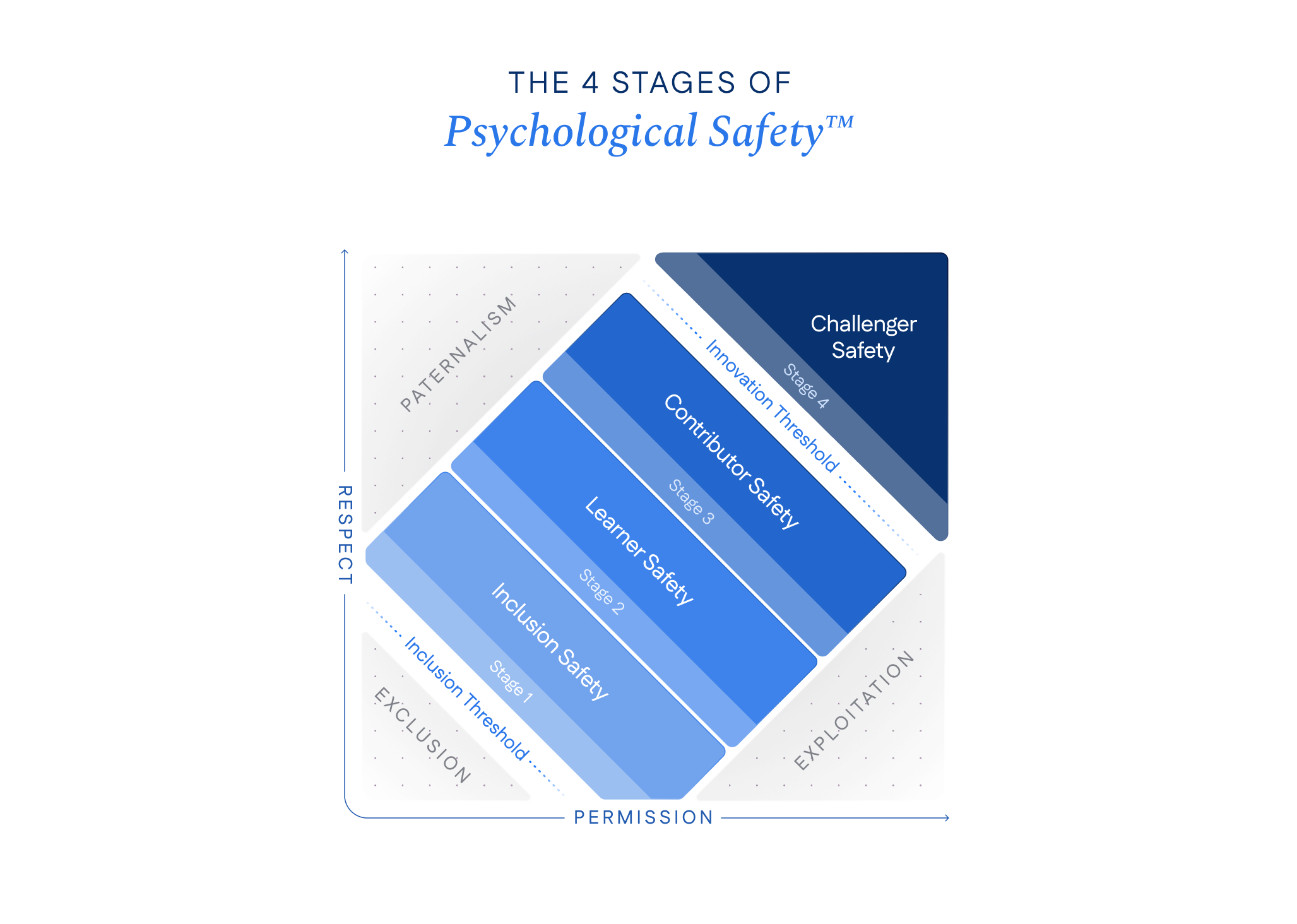
Groups do not become safe all at once. They progress through The 4 Stages of Psychological Safety™ — inclusion, learner, contributor, and Challenger Safety — the framework from LeaderFactor founder Dr. Timothy R. Clark, as respect and permission increase together. The two thresholds that matter most for a group are the inclusion threshold into membership and the innovation threshold into stage four, where a group stops merely executing and starts improving things. Most groups clear the first and stall well short of the second.
The sequence is not a stylistic preference. In LeaderFactor’s PSindex® research, 3,366 employees across more than twenty organizations were asked what they would do first on joining a new team, with the four options shown in randomized order. The progression was strikingly orderly: 65 percent put getting to know the team first, 63 percent learning their role second, 81 percent contributing third, and 86 percent challenging the way things are done last (Kendall’s W = .73, a strong level of agreement). A group that tries to install a “challenge everything” norm before it has established inclusion is asking for a behavior its members are not yet safe enough to produce.
Who actually speaks in a group — and why does everyone else stay quiet?
Airtime is the most visible signal of psychological safety in groups, and it is rarely distributed by who has the best information — it is distributed by perceived status. Authority bias, the tendency to overvalue opinions from the top of a hierarchy and undervalue those from the bottom, means groups credit ideas by their source rather than their substance. The greater the power distance in the room, the higher the perceived risk of speaking — an expensive pattern: the more senior you are, the less candid feedback you receive.
The scale of the silence is easy to underestimate. Gallup’s 2025 U.S. research found that only around three in ten employees strongly agree that their opinions seem to count at work — not a motivation problem, but a group-dynamics problem at population scale.
Three moves change the distribution of voice more than anything else:
- Separate participation rights from decision rights. Participation rights are the right to weigh in; decision rights are the authority to settle it. Groups conflate the two, then ration participation by seniority to protect the decision. Grant participation rights to everyone as an irrevocable condition of membership, and the decision structure stays exactly as it was.
- Have the highest-authority person weigh in last. When the most powerful view lands first, it anchors the room and quietly censors everyone with a different one. Cultural flatness — where structure does not restrict the flow of information — is created largely by sequencing.
- Watch the talk-to-listen ratio. Where a leader dominates airtime, members learn there is no room for them; a ratio closer to fifty-fifty signals the opposite. Meetings are where this gets decided in real time — see psychological safety in meetings for the facilitation specifics, and speak-up culture for what makes voice durable.
Does group size change psychological safety?
Yes — size works against safety through several mechanisms at once. Larger groups dilute individual responsibility, so the cost of staying quiet drops and silence becomes easy to hide. They increase the number of people who could react badly to a risky comment, raising the perceived stakes of speaking. They sharpen status differences, because in a big room the fastest way to decide whose view matters is to fall back on rank. And they fragment into subgroups and cliques, leaving some members feeling included while others face a room full of people who already know each other.
None of this makes large groups hopeless; it means they need more deliberate structure to produce the same amount of voice — explicit norms, direct invitations, smaller breakouts. It is also the practical reason safety is measured at the intact team level: at that size, interaction patterns are dense enough that a shared belief actually forms.
How does psychological safety protect a group from groupthink?
This is where the concept is most often misread. Psychological safety is frequently mistaken for harmony, when in fact the group most at risk of groupthink is the one that has confused niceness for safety — a thin layer of politeness spread over a thick layer of fear. The social expectation to be agreeable produces exactly the echo chamber that safety is supposed to prevent. Irving Janis made the point in his work on groupthink: the more amiable and cohesive a decision-making in-group becomes, the greater the danger that critical thinking gets replaced by the pursuit of unanimity.
The symptoms are recognizable: the meeting that is not the meeting, followed by the back-channel where people say what they actually think; ideas filtered for likability rather than merit; decisions that stall because no one will challenge an assumption.
Real Challenger Safety is the antidote, and groups build it structurally rather than by exhortation:
- Formally assign dissent at the start. Give named people the explicit job of arguing against the plan before a decision is made. NASA used “tiger teams” to hunt for failure modes; security teams use white-hat hackers; companies run red teams and premortems. What matters is that dissent becomes an assignment rather than an act of deviance, which removes the personal risk that normally keeps it unsaid.
- Celebrate the first dissent publicly. The moment a member takes a visible interpersonal risk is the moment the group’s norms get set. Responding with genuine interest, then asking for more, does more to flatten a culture than any policy.
- Run exploratory inquiry on purpose. A three-question sequence — Why do we do it this way? What if we tried this instead? How might we do it differently? — makes questioning the status quo a routine activity instead of a confrontation.
How should a group handle conflict without losing psychological safety?
By raising the right kind of friction and lowering the wrong kind. LeaderFactor frames it as keeping intellectual friction high and social friction low: intellectual friction is the hard-hitting debate that problem-solving requires, while social friction is the emotional damage that happens when people feel personally attacked. The productive combination is the counterintuitive one — be hard on ideas, soft on people.
In practice that means three things for a group. First, disagreement gets attached to the idea, never to the person’s competence, motives, or standing. Second, dissent is expected before decisions rather than surfaced after, so people are not choosing between candor and loyalty. Third, the group treats empathy as an analytical tool: dissent is usually an intellectual clash between people who reached different conclusions from the same data, so the useful question is what data they have and what assumptions they made. Curiosity about someone’s route to their conclusion is what turns confrontation into collaboration.
How do you sustain psychological safety in a group over time?
Treat it as perishable, because it is. Norms decay when they stop being reinforced, and any change in membership, leadership, or pressure resets them — a group that was safe last quarter can quietly slide after a reorganization and one badly handled piece of bad news. Sustaining safety means reinforcing the norms out loud, continuing to reward risky contributions, and paying particular attention to whoever joined most recently, since they are reading the pattern from scratch.
It also means measuring rather than assuming. Leaders consistently rate their groups safer than members experience them, which makes self-assessment unreliable. LeaderFactor’s PSindex® is a twelve-item, psychometrically validated survey administered at the intact team level that breaks a group’s score out by stage — so a group strong on inclusion but weak on Challenger Safety knows exactly which dynamic to work on next. The rhythm is simple: pick one behavior, practice it for four to six weeks, then re-measure at roughly 90 days to confirm the climate actually moved. The full leader-side method lives in how to build psychological safety in a team, and the model itself on the 4 Stages skill page.
Frequently asked questions
- Is psychological safety an individual feeling or a group property?
- It is a group property. Psychological safety is a shared belief that forms inside a specific group about what happens to people who take an interpersonal risk there. The same person can speak freely in one group and go silent in another an hour later, because the norms changed, not their personality.
- Does group size affect psychological safety?
- Yes. Larger groups dilute participation, sharpen status differences, and make silence easier to hide, so the same norms produce less voice. That is why LeaderFactor measures psychological safety at the intact team level, the smallest divisible unit of culture, rather than averaging it across a whole department or organization.
- How do you encourage open communication in a group?
- Make participation an explicit norm rather than an implied one. Grant everyone participation rights, invite specific people in by name, and have whoever holds the most authority speak last so their view does not anchor the room. Then reward the first risky comment visibly, because the group is watching what happens to it.
- How should a group handle conflict without losing psychological safety?
- Keep intellectual friction high and social friction low: be hard on ideas and soft on people. Assign dissent before a decision so disagreement is expected rather than deviant, separate the idea from the person proposing it, and use empathy to understand how someone reached a different conclusion from the same data.
- How do you sustain psychological safety in a group over time?
- Treat it as perishable. Norms decay when they are not reinforced, and any change in membership, leadership, or pressure resets them. Groups sustain safety by reinforcing norms out loud, continuing to reward risky contributions, and re-measuring at roughly 90-day intervals to confirm the climate actually held.