





Barriers to psychological safety and how to remove them
Barriers to psychological safety are structural, not accidental — paternalism, exploitation, hierarchy, and false niceness. Here's how leaders remove them.
The barriers to psychological safety are the conditions that make it expensive for people to speak up, ask a question, admit a mistake, or challenge a decision. Almost none of them are deliberate. No leader designs a culture where vulnerability gets punished. Yet unexamined hierarchy, a few ordinary leadership habits, and passive acceptance of bad norms build those barriers anyway. LeaderFactor defines psychological safety as a culture of rewarded vulnerability, which makes the barriers easy to identify: anything that raises the perceived cost of an act of vulnerability, or lowers the perceived reward for taking one.
This page is about causes and their removal. If you want the lived experience of absence — what it actually feels like day to day when safety is gone — see no psychological safety at work. If you want to understand safety as a matter of degree rather than a switch, see low psychological safety.
What are the most common barriers to psychological safety at work?
The most common barriers are hierarchy and authority bias, authoritarian or punishing leader behavior, fear of appearing incompetent, a history of dissent being ignored, and inherited norms of silence. A 2021 qualitative study of primary care teams published in BMC Health Services Research narrowed the field to four: hierarchy, perceived lack of knowledge, personality, and authoritarian leadership.
In practice, they cluster at four levels:
- Structural. Steep hierarchy and power distance, siloed decision-making, performance systems that punish error, no forum or time for candid conversation, and physical or remote distance from the people with authority.
- Leader behavior. Micromanagement, defensiveness when challenged, advocating a position before inviting input, perfectionism at the top, and reserving participation rights for seniority.
- Interpersonal norms. Ridicule and put-downs, cliques, dominance by the loudest voices, and the tacit rule that newcomers listen for a year before the organization listens to them.
- Belief. The private conclusions people draw — it’s not my place to say, I’ll look like I should already know this, I’ll be labeled a troublemaker, it won’t make a difference anyway. Futility is one of the most common reasons people stay quiet, and it is entirely learned.
Why do barriers form when nobody intends them?
Because culture is the accumulated residue of daily interactions, and interactions replicate faster than anyone corrects them. Timothy R. Clark describes working with an organization where insulting each other had been normalized as humor. New hires didn’t resist the norm — they adopted and perpetuated it within weeks. That is how quickly a barrier becomes self-sustaining.
The implication is uncomfortable and useful: you are never neutral. Every leader and every team member is either building psychological safety or eroding it. Culture happens by design or by default, and default reliably produces barriers, because self-protection is the cheaper strategy for everyone in the room.
What are the two structural barriers inside every organization?
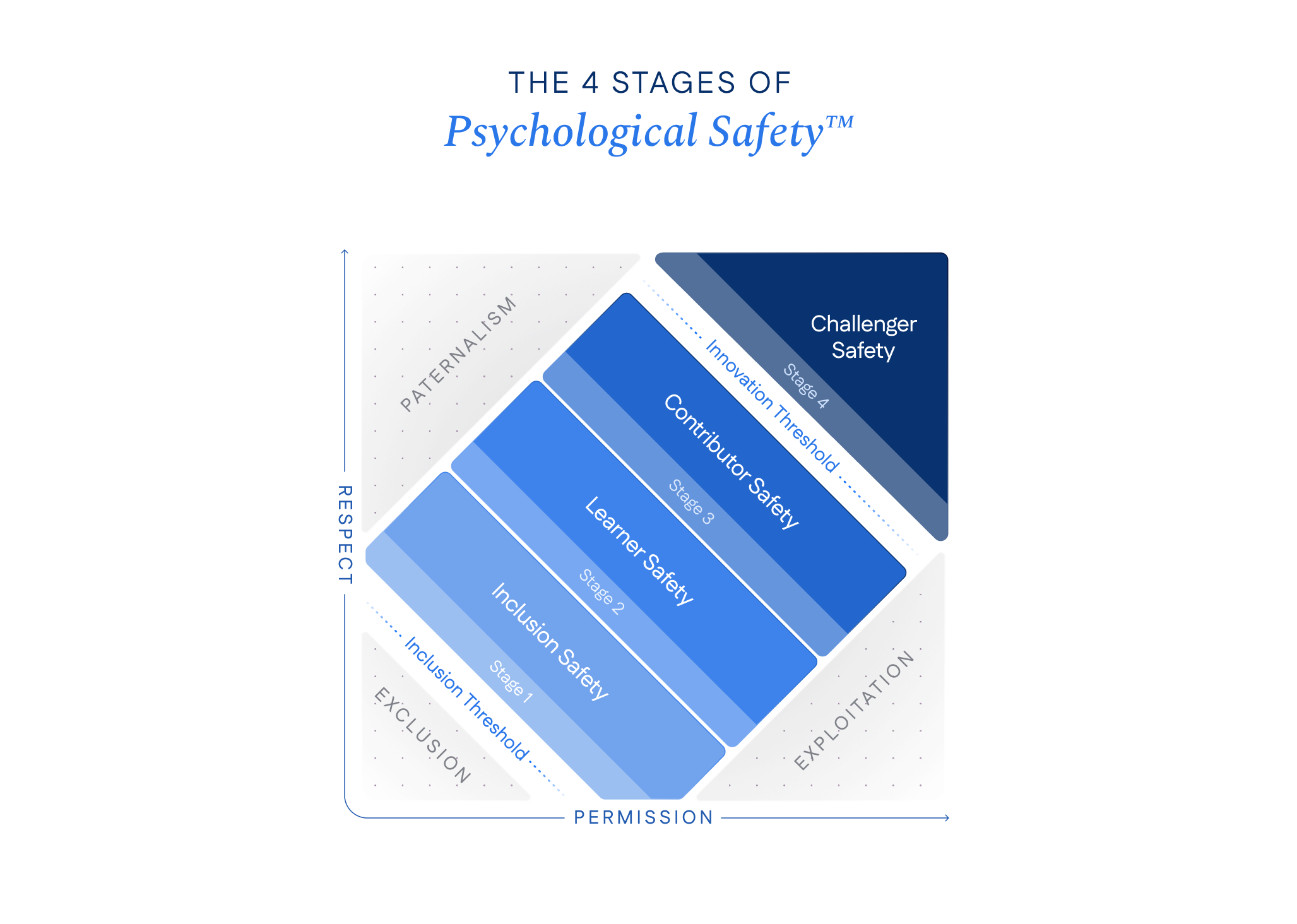
Psychological safety is built from two variables — respect and permission. Plot them against each other and you get four environments. Low respect with low permission is exclusion. High respect with high permission is psychological safety. The two off-diagonals are the failure patterns, and they are the deepest structural barriers most organizations carry:
- Paternalism — high respect, low permission. Interfering with someone’s autonomy under the cover of promoting their good. It looks caring. It is the leader’s failure to transfer accountability and critical thinking, and it teaches dependence and learned helplessness. Michelangelo captured the mechanism in a 1525 letter to Pope Clement VII: “I do not feel that I can be guilty where I have no authority.” No authority, no accountability.
- Exploitation — low respect, high permission. Treating someone unfairly in order to benefit from their work. People are permitted to contribute, but their contribution is extracted rather than exchanged.
Both pathologies are universal and both sit on a spectrum. The productive diagnostic question is never do we have exploitation or paternalism? It’s to what degree, and in what forms? Asked honestly, that question surfaces barriers no engagement survey will find.
How does hierarchy become a barrier to psychological safety?
Through authority bias — the tendency to overvalue opinions from the top of the hierarchy and undervalue opinions from the bottom. Source becomes a proxy for substance, because we reasonably expect more competence as we move up. Over time that hardens into exaggerated deference to the chain of command. The greater the power distance, the higher the perceived risk of speaking up. As Clark puts it, the grander the perch, the rarer the feedback.
The costs are measurable. In a well-known study of employee silence, 85% of participants reported having felt unable to raise a concern with their boss at least once. Add the HiPPO effect — where the highest-paid person’s opinion quietly settles the discussion — and a leader can suppress dissent without ever intending to.
The critical distinction is between authority and psychological permission. They are not the same thing. A worker can hold formal stop-work authority in writing and still lack the felt permission to use it. When hierarchy goes unchecked, the chain of command becomes a chain of silence.
The antidote is cultural flatness — an atmosphere where people become close to agnostic about title, position, and authority, and evaluate an idea by its substance rather than its source. Leaders create it with small structural moves: assign someone else to run the meeting, don’t sit at the head of the table, ask exploratory questions before advocating a position, and adopt a leader-speaks-last rule.
Which stage of psychological safety erodes first?
Challenger safety. The 4 Stages of Psychological Safety™ progress from inclusion to learner to contributor to challenger safety, and each stage asks for a larger act of vulnerability than the last. Challenging the status quo carries the highest social risk, so it is the first thing to disappear when barriers go up and the last thing to return when they come down. A team can look perfectly functional — included, learning, contributing — while its capacity for dissent is already gone.
What kills it is small and fast. Shutdown statements like “bad idea,” “nice try,” or “I told you so” trigger the self-censoring instinct instantly, and so do their nonverbal versions: a sigh, a glance at another leader, a phone check while someone is still talking. Ridicule is worse. If you scoff at an idea once for every ten times you don’t, it’s the scoff people remember.
Which barriers masquerade as psychological safety?
Some of the most durable barriers look like the solution. Four are worth naming:
- Verbal reassurance. You cannot speak psychological safety into existence. Clark describes a CEO who called an all-hands meeting to declare the organization psychologically safe; it only made him look tone-deaf. If people speak up and then get ignored or subtly penalized, false reassurance is more damaging than saying nothing, because it sets an expectation that is then dramatically unmet.
- Niceness. Many cultures spread a thin layer of politeness over a thick layer of fear. It produces choked innovation, problems that surface only as crises, high performers who quietly exit, slow decisions, and learned helplessness. Kindness and candor build safety. Niceness substitutes for it.
- Wellness programs. Meditation apps and counseling benefits help individuals cope. They do nothing about an interpersonal climate where admitting a mistake is dangerous.
- The one-time initiative. Psychological safety is perishable. A workshop last year is not a barrier removed; one serious breach can undo months of progress.
For the full myth-versus-reality breakdown, see what psychological safety is not.
How do you find the real barriers on your own team?
You ask, anonymously, and you compare perspectives. LeaderFactor’s PSindex® measures twelve items across the four stages, then adds four open-ended questions written specifically to surface barriers in employees’ own words:
- What is one thing that prevents you from feeling included on your team?
- What is one thing that prevents you from learning on your team?
- What is one thing that prevents you from contributing on your team?
- What is one thing that prevents you from challenging the status quo on your team?
Those four responses are usually more actionable than the scores, because they name the specific behavior, policy, or person standing in the way.
The second finding worth looking for is the gap between rater groups. Because the instrument is multi-rater, it consistently shows the same pattern: leaders rate themselves higher on psychological safety than their teams rate them. That gap isn’t an embarrassment — it’s the most motivating number on the report, and it usually points straight at the barrier the leader can’t see.
How do leaders remove barriers to psychological safety?
Barrier removal is behavioral, and it maps to the stage where the barrier lives:
- Separate worth from worthiness. Inclusion isn’t a performance test. When acceptance is conditional, no one risks the further rejection that speaking up invites.
- Go first. Model the act of vulnerability you want to see — admit what you don’t know, name a past mistake, ask for help. Perfectionism at the top is the fastest way to teach a team to hide.
- Transfer accountability and critical thinking. This is the direct antidote to paternalism. Grant autonomy at the task, process, or outcome level based on track record, then get out of the way.
- Assign dissent formally, before the work starts. Red teams, premortems, and a named loyal opposition remove the personal risk from challenging an idea. Clark calls this the single most effective mechanism a leader has for shifting culture.
- Separate loyalty from agreement, status from opinion, and permission from adoption. Disagreement is not disloyalty, ideas compete on merit rather than rank, and being heard is not the same as being heeded — but say so explicitly, and thank people whose suggestions you decline.
- Respond well in the moment. People judge whether it’s safe to speak by watching what happened to the last person who did. Hug the messenger, publicly.
- Repair breaches out loud. When a leader shuts someone down and then owns it in front of the team, the climate ends up stronger than before.
Sustained long enough, top-down pressure converts into peer-based accountability — the point at which the team enforces its own norms and new entrants hit a wall of we don’t do that here. Until then, every barrier you remove will try to grow back.
Where to go next
- The 4 Stages of Psychological Safety — the model, the assessment, and the behaviors that remove barriers stage by stage.
- No psychological safety at work — what the absence looks and feels like on the ground.
- Low psychological safety — the signs and the degrees between unsafe and safe.
Frequently asked questions
- What are the most common barriers to psychological safety at work?
- The most common barriers are hierarchy and authority bias, authoritarian or punishing leader behavior, fear of looking incompetent, a track record of dissent being ignored, and norms of silence. A qualitative study of primary care teams named four: hierarchy, perceived lack of knowledge, personality, and authoritarian leadership. Almost none are deliberate — they install themselves by default.
- How do leaders break down barriers to psychological safety on their teams?
- Leaders remove barriers by lowering the cost of vulnerability and raising its reward. Go first by admitting a mistake, hand the meeting to someone else, ask before advocating, formally assign dissent, and thank the first person who disagrees. Then respond well every time someone speaks up, because people judge safety by watching what happens to whoever went first.
- Why does a lack of psychological safety hurt a team so much?
- Without psychological safety, people stop admitting mistakes, asking questions, and challenging bad plans — so problems stay hidden until they become crises. Innovation requires dissent, learning requires error, and both get suppressed. High performers leave first because they cannot make an impact, and what remains is compliance rather than commitment.
- Is hierarchy a barrier to psychological safety?
- Hierarchy is a tool, not a defect — but unchecked, it becomes a barrier through authority bias, the tendency to weigh an idea by its source rather than its substance. The greater the power distance, the higher the perceived risk of speaking up. The fix is cultural flatness, where people become close to agnostic about title and position.
- What is the difference between paternalism and exploitation?
- They are the two failure patterns produced by respect and permission. Paternalism is high respect with low permission — interfering with someone's autonomy under the cover of protecting them, which breeds dependence. Exploitation is low respect with high permission — permitting someone to work while treating them unfairly to benefit from it. Both are matters of degree.