





Low psychological safety: signs, causes, and how to fix it
Low psychological safety is a workplace where vulnerability is punished, not rewarded. Learn the signs, what causes it, and how to measure and rebuild it.
Low psychological safety is a work environment where people don’t feel safe to speak up, because the team punishes vulnerability more often than it rewards it. LeaderFactor defines psychological safety as a culture of rewarded vulnerability—so low psychological safety is its mirror image: a culture where admitting a mistake, asking a question, offering a half-formed idea, or challenging the status quo gets met with blame, ridicule, or exclusion. People read that pattern, conclude that speaking up isn’t safe, and quietly protect themselves instead. The visible symptoms—silent meetings, a blame reflex, stalled innovation, good people leaving—are downstream of that single dynamic.
The good news is that low psychological safety is diagnosable and fixable. This article covers what it actually is, the signs to look for, what causes it (including one cause most leaders miss), how to measure where safety is thin, and the mechanism for rebuilding it.
What is low psychological safety?
Low psychological safety is a team climate in which the perceived risk of being vulnerable is high enough that people default to self-protection. To understand why, start with what human beings do in any group.
We are wired for threat detection. Put in a social setting, we instinctively scan the environment to answer one question: am I safe here? The answer governs how we behave. If we conclude the environment consistently rewards vulnerability, we offer a performance response—we jump in, contribute, take risks, and release our discretionary effort. If we conclude it punishes vulnerability, we offer a fear response—we withdraw, self-censor, manage personal risk, and freeze that same discretionary effort. That shift, from performance to fear, is the entire cost of low psychological safety.
Neurologically the two environments are opposites. A culture of rewarded vulnerability activates the brain’s reward centers and suppresses the self-censoring instinct. A culture of punished vulnerability activates the brain’s pain centers, switches the self-censoring instinct on, and triggers a defensive routine. So a “low-safety” person isn’t disengaged by disposition—their nervous system has correctly detected that honesty here is dangerous, and it’s acting accordingly.
It helps to think of psychological safety as a spectrum rather than an on/off switch. LeaderFactor’s PSindex® sorts a team’s experience into three zones:
- Blue Zone — a consistent pattern of rewarded vulnerability. People feel safe, and it shows in confidence, courage, and contribution.
- Neutral Zone — an inconsistent pattern; sometimes rewarded, sometimes punished. The result is unpredictability and doubt, and people’s default is “I’m not sure I’m safe, so I’ll protect myself.”
- Red Zone — a consistent pattern of punished vulnerability. This is a diminishing environment that induces fear, withdrawal, and self-censorship.
“Low psychological safety” spans the Neutral and Red Zones. Notably, the Neutral Zone is where a lot of low-safety damage hides: nothing looks overtly toxic, but the inconsistency alone is enough to make people hold back. (When safety collapses entirely—a persistent Red Zone with no rewarded vulnerability at all—that’s the more extreme case of no psychological safety at work.)
What are the signs of low psychological safety?
The signs of low psychological safety all trace back to people managing personal risk instead of adding value. The most reliable indicators:
- Silence and surface-level agreement. Meetings are quiet and congenial; decisions move forward without much debate. People nod along, then process their real concerns privately in hallway conversations and back-channels. This “meeting after the meeting” is one of the clearest tells.
- A blame reflex. When something goes wrong, the instinct is to find who’s at fault rather than what’s broken. Post-mortems feel like interrogations, so people learn to hide mistakes early rather than surface them.
- Few questions, few admissions of not knowing. You rarely hear “I need help,” “I don’t understand,” or “I’m not sure.” Because asking is an act of vulnerability, its absence signals that not-knowing feels dangerous.
- Ideas held back or filtered for likability. People stop proposing anything that might get shot down. Ideas get evaluated on whether they’ll be received well rather than whether they’re good.
- Leaders dominate the airtime. When executives and managers do most of the talking, it’s often because the power gap makes speaking up feel too risky for everyone else.
- Feedback that only flows one way—or not at all. Little honest, upward, or peer feedback. What feedback exists is softened to the point of uselessness, and there’s a visible gap between what people say directly and what they say anonymously.
- Talent quietly leaving. Your strongest people have options, and they exercise them. High turnover—especially among high performers who conclude their contribution isn’t truly wanted—is a lagging but serious red flag.
Mapping the signs to the four stages
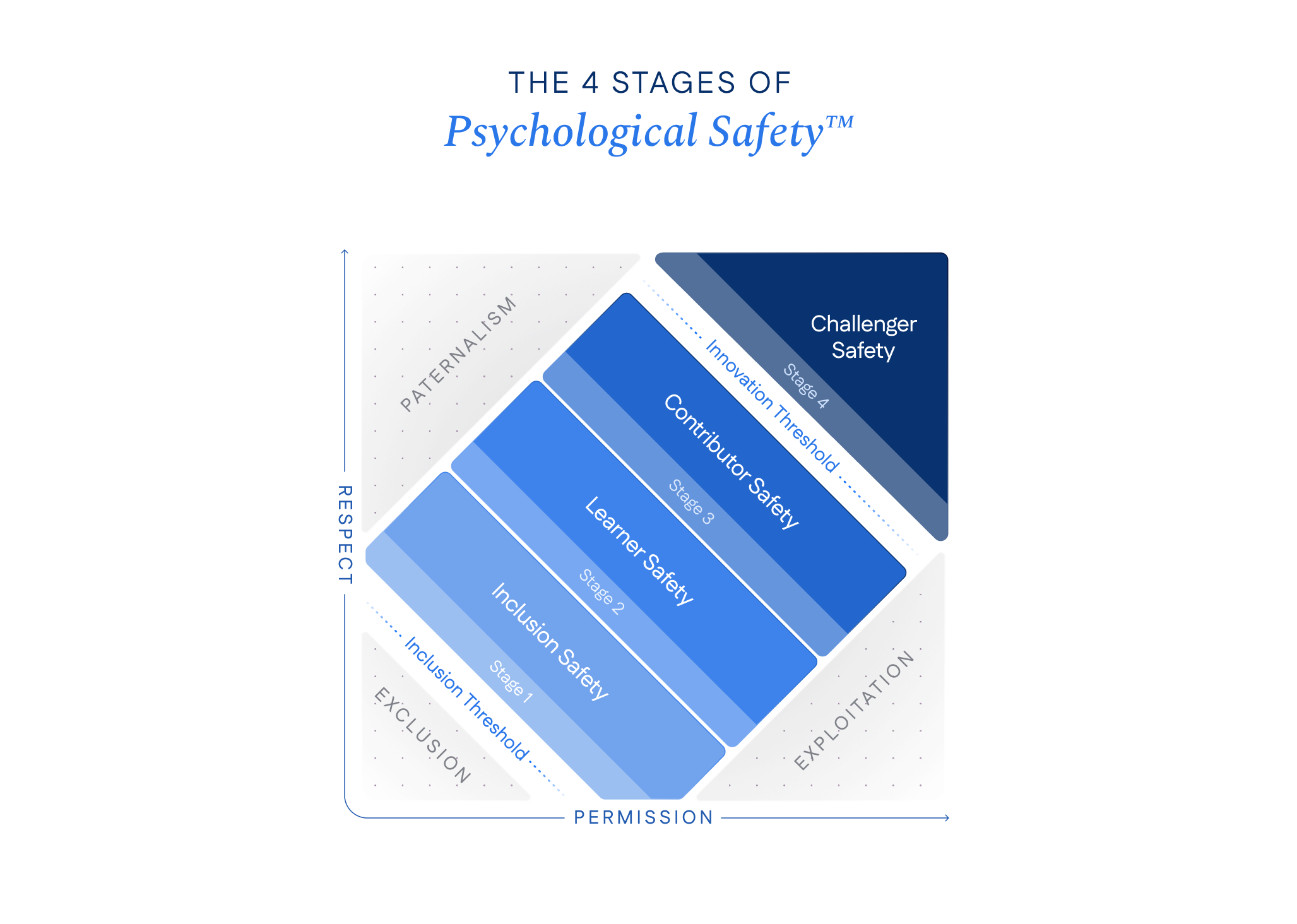
The signs above become far more actionable when you locate which kind of safety is missing. The 4 Stages of Psychological Safety™ frame safety as a developmental progression, and each stage has its own failure signature:
- Stage 1 — Inclusion Safety is missing when people are marginalized or excluded, cliques form, and certain voices are never invited in. The felt experience: “I’m not fully accepted here.”
- Stage 2 — Learner Safety is missing when questions go unasked and mistakes are punished. People fear looking incompetent, so they stop learning out loud. The felt experience: “It’s not safe to not know.”
- Stage 3 — Contributor Safety is missing when people are micromanaged, their ideas aren’t solicited, and their contributions are undervalued. The felt experience: “My work isn’t wanted or trusted.”
- Stage 4 — Challenger Safety is missing when dissent has historically been punished and leaders react defensively. This is the most fragile stage and the first to disappear. The felt experience: “It’s not safe to disagree or challenge the status quo.”
Most teams don’t lose all four stages at once. A team can feel included (Stage 1) yet be completely unable to challenge upward (Stage 4)—which is exactly the kind of gap a diagnostic surfaces and a values poster misses.
What causes low psychological safety?
Low psychological safety is caused by any repeated pattern that teaches people vulnerability will be punished. The usual suspects are visible: leaders who react to bad news with defensiveness or anger, blame that follows mistakes, and steep hierarchy where the power distance makes challenging up feel career-threatening. The greater the power distance, the higher the perceived risk of speaking—so the grander the perch, the rarer the honest feedback that reaches it.
But there’s a cause most leaders never suspect, because it looks like the opposite of a problem.
A nice culture doesn’t feel low-safety—it feels pleasant, which is what makes it dangerous. Its consequences are severe: it chokes innovation (ideas get filtered for likability, not merit), activates crises (problems are ignored until too big to hide), bleeds talent (A-players leave when they can’t make an impact), slows decisions to a consensus-seeking crawl, and breeds learned helplessness (people stop speaking up once they see it changes nothing). If your team is unfailingly congenial and conflict-averse, treat that as a signal to investigate, not a sign of health.
What low psychological safety is not
Diagnosing low safety accurately means clearing up a few misconceptions, because misreading the problem leads to the wrong fix:
- It’s not the absence of comfort. Being challenged, receiving blunt feedback, or feeling stretched is not the same as being unsafe. Safety is not comfort—a good coach makes you uncomfortable while keeping you safe. Low psychological safety is being punished for honesty, not being challenged by high standards.
- It’s not solved by niceness. As above, forced pleasantness is frequently a cause of low safety, not a cure. High safety requires respectful candor and real debate, not conflict avoidance.
- It’s not a wellness gap. Yoga classes, meditation apps, and an EAP are commendable, but they address individual stress, not the interpersonal climate. You can have generous wellness perks and still have people terrified to admit a project is failing. Safety is about voice; wellness is about coping. Don’t treat the symptom and miss the cause.
- It’s not a shield from accountability. High safety and high accountability rise together. The highest-performing teams pair them: people own mistakes early and fix problems fast precisely because they trust they won’t be scapegoated. Low safety is what makes people hide mistakes—which lowers accountability, not raises it.
How to measure low psychological safety
You measure psychological safety with a confidential, multi-rater survey scored at the intact team level—the smallest divisible unit of culture and the place where climate is actually experienced. Anonymous polling gives you a rough read; a validated instrument gives you a defensible one you can track over time.
LeaderFactor’s PSindex® is a psychometrically validated, 12-item instrument (developed under the AERA Standards for Educational and Psychological Testing) that scores a team across all four stages—three items each for inclusion, learner, contributor, and Challenger Safety—using an 11-point scale. Responses sort into the Red, Neutral, and Blue Zones described above, and the team’s score is calculated as Blue Zone % minus Red Zone %, on a scale from −100 to +100. A negative score means more people perceive the environment as unsafe than safe—an unambiguous signal of low psychological safety and a starting line for change.
Two features make this more useful than a generic engagement pulse. First, it’s stage-by-stage, so you learn not just that safety is low but which safety is low—and therefore what to work on first. Second, it’s multi-rater: leaders routinely rate their own team’s safety higher than their people do, and that gap is often the most motivating single data point a leader sees.
For a deeper walkthrough of instruments and survey design, see how to measure psychological safety.
How to fix low psychological safety
There is exactly one mechanism for building psychological safety, and no workaround, backdoor, or shortcut around it:
- Model vulnerability yourself. Admit your own mistakes out loud. Say “I don’t know” and “I need your help.” Publicly poke holes in your own decisions. When the highest-status person in the room goes first, it lowers the risk for everyone else.
- Reward the vulnerability of others. The most important moments in culture formation happen when someone takes an interpersonal risk on stage. When a person voices a dissenting view, thank them—out loud, genuinely—and ask for more. When someone admits an error, respond with curiosity, not consequences. What people watch for is what happens to the person who spoke up; that outcome, repeated, becomes the norm.
A few concrete moves accelerate this: run blameless post-mortems that ask what went wrong, not who; formally assign dissent so someone is expected to argue the other side; grant everyone participation rights so voice isn’t gated by seniority; and repair breaches openly (a leader who apologizes for shutting someone down can actually strengthen safety).
Two cautions. You can’t declare your way to safety—announcing the team is “now psychologically safe” without changing behavior reads as tone-deaf and makes things worse. And safety is perishable: it’s more like fitness than a finish line, improving or eroding with daily behavior, so rebuilding it is sustained practice, not a one-time initiative.
Where to go next
Low psychological safety is a solvable problem once you can name the pattern, locate which stage is thin, and change the behaviors that punish vulnerability. Explore these related topics to go deeper:
- The 4 Stages of Psychological Safety™ — the full framework and language for diagnosing and building safety
- Barriers to psychological safety — what gets in the way and how to remove it
- Building psychological safety in teams — the practical, team-level playbook
- Psychological safety vs. trust — how the two relate and why they’re not the same
Frequently asked questions
- What is low psychological safety?
- Low psychological safety is a workplace where speaking up feels risky because vulnerability is punished more often than it is rewarded. LeaderFactor defines psychological safety as a culture of rewarded vulnerability, so a low-safety team is one where people conclude that admitting mistakes, asking questions, or challenging ideas will be met with ridicule, exclusion, or retaliation—so they stay silent to protect themselves.
- What are the signs of low psychological safety on a team?
- The clearest signs are silence and surface-level agreement in meetings, a blame reflex when things go wrong, few questions or admissions of not knowing, ideas raised privately instead of publicly, and rising turnover among your strongest people. Because vulnerability feels unsafe, people withhold discretionary effort—the honest feedback, dissent, and new ideas a team needs to perform.
- What causes low psychological safety at work?
- Low psychological safety is caused by patterns that punish vulnerability: leaders who react defensively to bad news, blame after mistakes, and steep hierarchy where challenging up feels career-threatening. A subtler cause is a 'nice' culture that prizes politeness over candor—spreading a thin layer of niceness over a thick layer of fear, which drives real concerns underground.
- How do you measure low psychological safety?
- Psychological safety is measured with a confidential, multi-rater survey scored at the team level. LeaderFactor's PSindex® scores all four stages—inclusion, learner, contributor, and Challenger Safety—and sorts responses into a Red Zone (punished vulnerability), Neutral Zone (inconsistent), and Blue Zone (rewarded vulnerability), so leaders see exactly where safety is thin.
- How do you fix low psychological safety?
- You rebuild psychological safety through one mechanism: model vulnerability yourself and reward the vulnerability of others. In practice that means owning your own mistakes out loud, responding to bad news and dissent with curiosity rather than defensiveness, and consistently thanking people who speak up. It is built through repeated daily behavior, not slogans, and takes sustained practice to hold.