





How to measure psychological safety
How to measure psychological safety at work — the survey items, four-stage scoring, how to read your results, and how often to re-measure with PSindex®.
To measure psychological safety, you give an intact team a short, confidential survey about how safe people feel to belong, learn, contribute, and challenge — then score the results stage by stage so you can see exactly where the fear sits. That is the short version of how to measure psychological safety, and the second half is the part most organizations skip. They bolt one question onto an annual engagement survey, get an ambiguous number back, and have no idea what to do with it.
LeaderFactor defines psychological safety as a culture of rewarded vulnerability — an environment where the risky, human things people do at work (asking a question, admitting a mistake, disagreeing with the boss) are met with reward rather than punishment. That definition is what makes the concept measurable. You are not trying to score a mood. You are measuring a pattern: when people take an interpersonal risk on this team, what happens next?
Why an engagement survey can’t measure psychological safety
An engagement survey measures the outcome. Psychological safety is the input that produces it. That’s why engagement results so often land as ambiguous — the score tells you people are disengaged, but not what’s driving it or what to change on Monday. Psychological safety is the lead indicator for engagement: we engage in environments that engage with us in return, and it is rewarded vulnerability that creates those environments in the first place.
There’s a structural problem too. Engagement surveys are usually reported at the org or department level, where averages smother the signal. Psychological safety is a team-level phenomenon. Two teams sitting twenty feet apart, under the same policies and the same values statement, can have opposite cultures — because culture is the way we interact, and “we” is a team, not a company.
If you’ve never deliberately measured or shaped your culture, what you have is a default culture. Default cultures aren’t actively inclusive or innovative. They carry hidden problems. Toxicity spreads and nobody can say why, and people stay quietly disengaged until they leave. The alternative — culture by design — starts with knowing where you actually are. You cannot improve a culture you have never measured.
How do you measure psychological safety?
Measuring psychological safety well comes down to five decisions, made in this order.
- Define the construct before you measure it. If your team doesn’t share a definition, your data won’t mean the same thing to any two people reading it. Decide what you’re measuring — a culture of rewarded vulnerability across four stages — and say so in the invitation.
- Choose the unit of analysis. Measure at the intact team level, the smallest divisible unit of culture and the one with the most direct influence on individual behavior. Rolling everything up to a company average is how real problems disappear.
- Use a validated instrument, not a homemade question set. Items that haven’t been tested for reliability and validity produce numbers that look precise and mean very little. LeaderFactor’s PSindex® is built to the American Educational Research Association (AERA) Joint Standards for Educational and Psychological Testing, developed under professional psychometricians, with internal consistency evaluated by Cronbach’s alpha. The psychological safety assessment page covers how the instrument itself works.
- Collect both numbers and words. Quantitative items tell you where safety is low. Open-ended items tell you why. You need both to write an action plan.
- Protect confidentiality, and say how. Responses should be linked to demographics (tenure, function, location) for pattern analysis but never disclosed individually — only in aggregate. Taking the survey is itself an act of vulnerability. Handle it as one.
What should you measure? The four stages
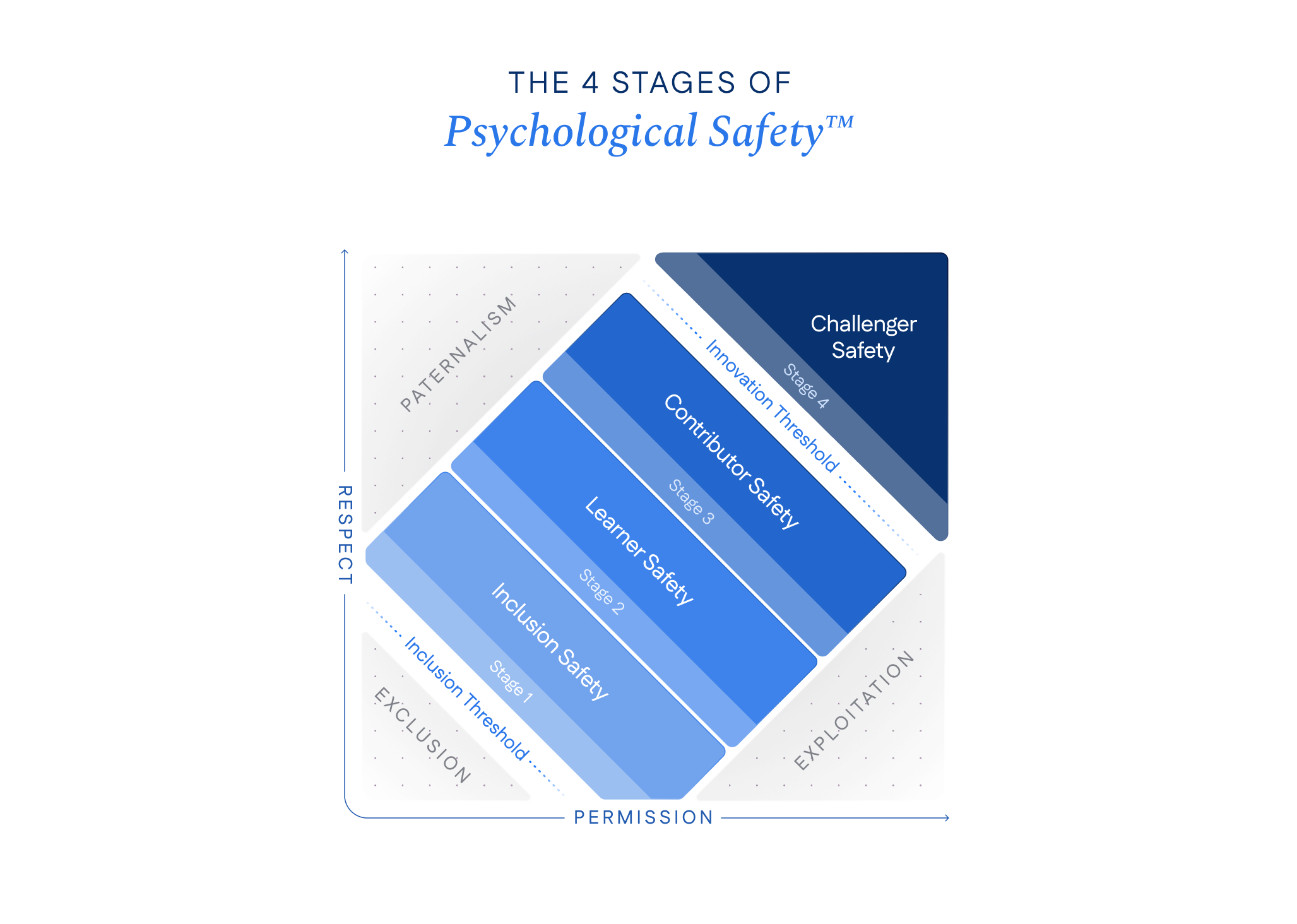
The reason a single psychological-safety question fails isn’t just sample size — it’s that psychological safety isn’t one thing. The 4 Stages of Psychological Safety™ describe a sequence of human needs, and a team can satisfy the early ones while failing the later ones badly.
PSindex® measures 12 items organized as four three-item subscales, one per stage, each rated on an 11-point scale from 0 to 10:
- Inclusion Safety — do people feel included, respected, and accepted as members of the team?
- Learner Safety — is the team supportive of learning, comfortable with questions, and tolerant of honest mistakes?
- Contributor Safety — is contribution valued, encouraged, and given enough autonomy to happen?
- Challenger Safety — can people challenge the status quo, take reasonable risks, and disagree without being punished?
Measuring the stages separately matters because the sequence is real, not decorative. In a PSindex® study of 3,366 employees across more than twenty organizations, respondents were asked what order they would engage in these behaviors on a new team, with the stages presented in randomized order. 65% put inclusion first, 63% put learning second, 81% put contribution third, and 86% put challenging the status quo last — with strong agreement across the sample (Kendall’s W = .73). People reliably need to belong before they’ll learn, and to have contributed before they’ll challenge. A stage-blind score can’t tell you where in that progression your team stalled.
What makes a psychological safety survey question work
Three things separate items that produce action from items that produce shrugs.
They describe behavior, not sentiment. “I can question a decision without it being held against me” is answerable. “I feel valued here” is a Rorschach test.
They’re anchored to one stage each. An item that blends belonging and dissent gives you a number you can’t assign to a cause.
They’re paired with open-ended questions. PSindex® adds four qualitative items — one per stage, capped at 140 characters so people write the real answer instead of an essay:
What is one thing that prevents you from feeling included on your team? What is one thing that prevents you from learning on your team? What is one thing that prevents you from contributing on your team? What is one thing that prevents you from challenging the status quo on your team?
Those four questions are usually where the value is. A low challenger-safety score tells you to act; a hundred short answers naming leader defensiveness or a history of punished dissent tell you what to act on. They’re also the fastest way to surface the specific barriers to psychological safety operating on that particular team.
How do you score and read the results?
PSindex® adapts Net Promoter Score methodology to psychological safety. Every response on the 0–10 scale falls into one of three zones that map to what people actually concluded from their threat detection:
| Score | Zone | What it means |
|---|---|---|
| 9–10 | Blue Zone | A consistent pattern of rewarded vulnerability — an empowering environment that builds confidence, courage, and self-efficacy |
| 7–8 | Neutral Zone | An inconsistent pattern of reward and punishment — unpredictability and doubt. “Sometimes I’m safe, sometimes I’m not. I’ll protect myself.” |
| 0–6 | Red Zone | A consistent pattern of punished vulnerability — a diminishing environment that induces fear, self-censoring, and withdrawal |
The team score is then calculated as Blue Zone % minus Red Zone %, on a range from −100 to +100. Neutral responses are excluded from the calculation. If 50% of responses land in the Blue Zone and 15% in the Red Zone, the score is 35. A negative score means more people on that team experience punished vulnerability than rewarded vulnerability — that is a live risk, not a development opportunity.
The same math is applied at three levels: overall, stage by stage, and item by item. Read them in that order, then invert it. The overall score tells you whether to worry; the stage scores tell you where; the item scores tell you what to change.
Two notes on the Neutral Zone, because it’s the most misread part of a report. First, it’s not “fine” — it’s the signature of an environment people can’t predict, which produces self-protection just as reliably as an openly hostile one. Second, because Neutral responses are excluded from the score, a team can post a modest positive number while most of its people are sitting in doubt. Always look at the distribution behind the score.
What do your results actually tell you?
Three patterns carry most of the diagnostic weight.
The stage profile. Teams are rarely uniformly safe or unsafe. A common shape is strong Inclusion Safety and weak Challenger Safety: people feel they belong, and they still won’t say the hard thing. That team doesn’t need a values offsite. It needs air cover for candor — and it will keep missing problems until it gets it. A persistently low score on one stage is a more useful finding than a mediocre overall average.
The self-versus-others gap. PSindex® is multi-rater — the leader rates themselves, and so do their manager, peers, and direct reports. Leaders very commonly rate the safety of their team higher than the people in it do. That gap is one of the most useful numbers in the whole report, and typically the most motivating: it’s hard to argue with the difference between what you intended and what people experienced.
Divergence between rater groups. When manager, peer, and direct-report scores agree, you have a stable read on the environment. When they diverge, safety is being experienced differently by role — which usually means it’s conditional on power, and that’s a finding in itself.
How often should you measure psychological safety?
Measure on the rhythm of behavior change, not the rhythm of the reporting calendar.
- Baseline before intervention. Run the assessment before training or a workshop so results are diagnostic rather than promotional, and so participants arrive with their own data.
- Practice for four to six weeks. Behavior change is the mechanism. Leaders pick one specific behavior per stage from their action plan and practice it consistently — that’s the window where anything measurable happens.
- Re-assess at about 90 days. Long enough for new behaviors to become a visible pattern and for the team’s threat detection to update. This is the cadence LeaderFactor uses to verify change across the stages.
- Then settle into a semi-annual or annual cycle to track drift, reorganizations, and new leaders.
Weekly pulse surveys have their place on volatile projects, but they mostly measure mood. Sampling faster than culture can move gives you noise with a trend line drawn through it.
Mistakes that ruin the measurement
Measuring before there’s shared language. Assessment results only mean something if everyone reading them shares a definition of what psychological safety is and isn’t. Training that establishes the common vocabulary makes the numbers legible.
Using the results punitively. The moment a low score is used to identify “problem people” or “problem teams,” you’ve punished the vulnerability of answering honestly and guaranteed that your next round of data is fiction.
Reporting only the average. Company-level averages hide the team-level variance that is the entire point of the exercise.
Stopping at the number. Measurement is diagnostic, not therapeutic. A score with no action plan attached lowers safety, because people learn that being asked is not the same as being heard.
What to do once you’ve measured
Work from the data outward: find the lowest-scoring stage, read the open-ended barriers for that stage, choose one behavior the leader will model and reward consistently, practice it for four to six weeks, and re-measure at 90 days. One stage, one behavior, one cycle — repeated — beats a broad initiative every time.
The goal of measuring psychological safety isn’t a dashboard. It’s a specific, defensible answer to the question every leader is guessing at right now: where, exactly, does my team stop telling me the truth?
Frequently asked questions
- How do you measure psychological safety?
- You measure psychological safety with a short, confidential survey given to an intact team and scored by stage rather than as one average. LeaderFactor's PSindex® uses twelve items — three for each of the four stages — plus four open-ended questions, so leaders see both the score and the specific barrier behind it.
- How do you measure each of the four stages of psychological safety?
- Each stage gets its own subscale. Three items measure Inclusion Safety, three measure Learner Safety, three measure Contributor Safety, and three measure Challenger Safety. Scoring each subscale separately shows where a team's safety actually breaks down — many teams score well on inclusion and poorly on Challenger Safety, which is where innovation lives.
- What is a good psychological safety score?
- PSindex® scores run from −100 to +100, calculated by subtracting the percentage of Red Zone responses from the percentage of Blue Zone responses. Positive scores mean more people experience rewarded vulnerability than punished vulnerability; negative scores mean fear is the dominant pattern. Always read the stage-by-stage scores, not just the overall number.
- How often should you measure psychological safety?
- Establish a baseline before any training, then re-measure about 90 days later — long enough for leaders to practice new behaviors for four to six weeks and for teams to register the change. After that, a semi-annual or annual cadence tracks drift. Measuring faster than behavior can change produces noise, not insight.
- Who should take a psychological safety survey?
- Survey the intact team — the smallest divisible unit of culture and the level where psychological safety is actually experienced. PSindex® is multi-rater, gathering perspectives from the leader, their manager, peers, and direct reports. Comparing those views exposes the gap between how safe a leader believes the team is and how safe it feels.