





Which comes first: psychological safety or employee engagement?
Unlock the path to peak employee engagement with insights on the critical link between psychological safety and engagement.
Unlocking employee engagement: the critical role of psychological safety
In today’s ever-evolving work landscape, organizations are continually seeking strategies to boost employee engagement and productivity. However, amidst these efforts, a critical component often remains overlooked: psychological safety. This foundational element not only underpins employee engagement but also significantly influences organizational culture and overall success. Drawing insights from a discussion on the LeaderFactor podcast, “Culture by Design,” let’s explore the intertwined relationship between psychological safety and employee engagement and why understanding this connection is pivotal for leaders aiming to cultivate a thriving workplace.
Psychological safety and employee engagement: unraveling the connection
Tim, an Oxford-trained social scientist and CEO and founder of LeaderFactor, alongside co-host Junior, delves into why employee engagement has remained a focal point for organizations globally. Engagement surveys dotting the corporate landscape gauge the pulse of an organization, yet the root cause of disengagement often eludes leaders. They pose a fundamental question with profound implications: in the causal chain of workplace dynamics, does psychological safety lead to employee engagement, or is it the other way around?
The essence of employee engagement
Employee engagement far transcends the mere satisfaction of employees— it encapsulates their active, holistic expression within their roles. Drawing from the pioneering work of Professor William Kahn, engagement is defined as the “simultaneous employment and expression of a person’s ‘preferred self’ in task behaviors.” This expression spans across emotional, intellectual, physical, and social spectrums, marking a deeply personal and active involvement in one’s work.
Psychological safety: a precedent to expression
The pathway to true employee engagement is paved with psychological safety, described as an environment of rewarded vulnerability. Tim eloquently leads us to understand that for employees to fully express themselves— to engage, learn, contribute, and challenge the status quo— they must first feel secure in their vulnerability. Psychological safety, therefore, is the catalyst for engagement, making it the environment that enables expression.
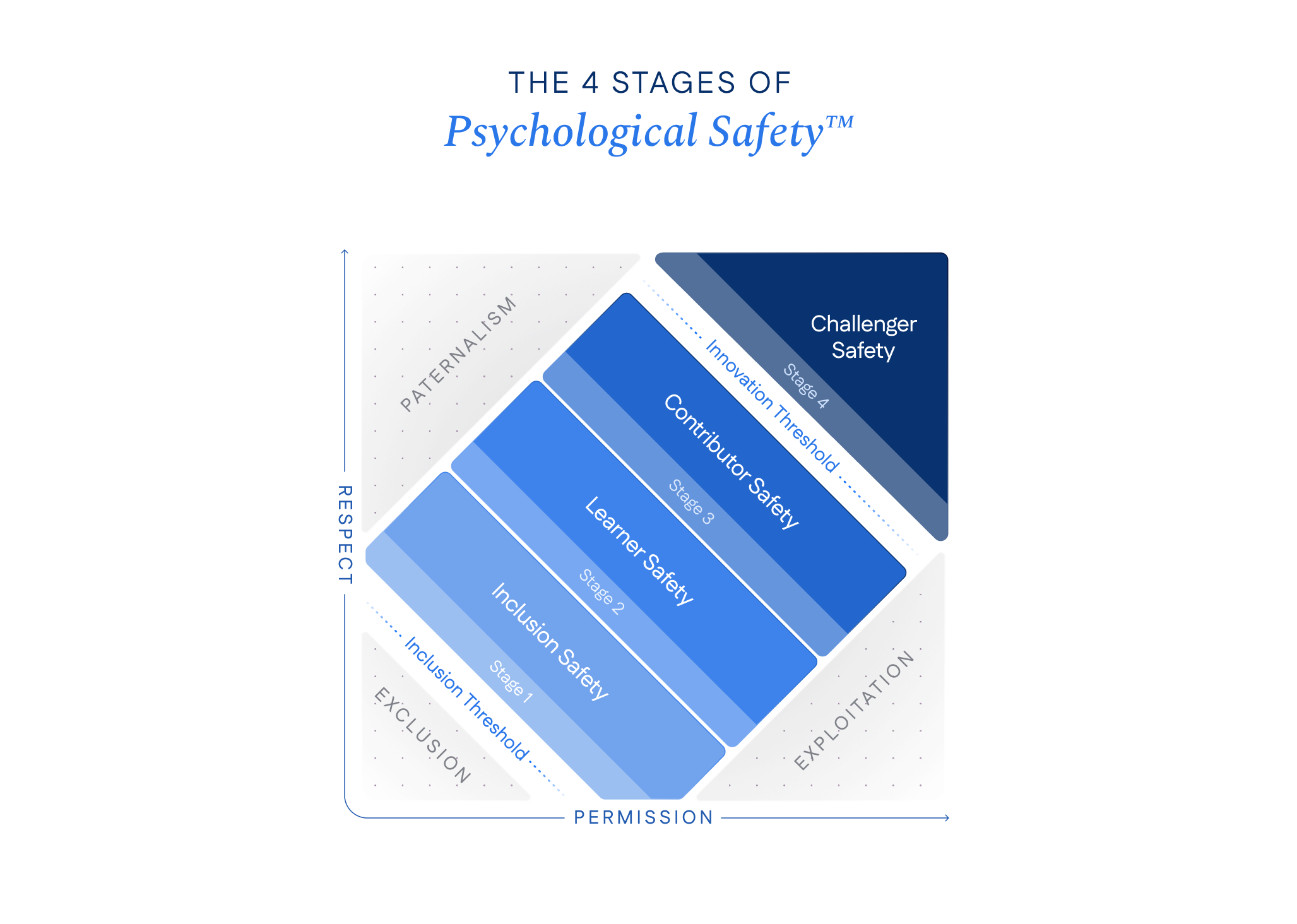
The 4 Stages of Psychological Safety™
Unpacking the concept further, Tim introduces a model detailing four progressive stages of psychological safety:
- Inclusion Safety — feeling included, accepted, and belonging.
- Learner Safety — the liberty to engage in the learning process, inclusive of asking questions and making mistakes without fear of retribution.
- Contributor Safety — the ability to make a meaningful contribution and apply learned skills.
- Challenger Safety — the freedom to challenge the status quo without risking personal or professional standing.
This progression underscores the nuanced journey from feeling included to actively shaping organizational culture and innovation— each step facilitated by an environment that rewards, rather than penalizes, vulnerability.
From theory to practice: cultivating a psychologically safe environment
Practical application lies at the heart of transforming organizational culture to nurture psychological safety. Tim emphasizes modeling behaviors and rewarding acts of vulnerability as pivotal mechanisms. By authentically demonstrating vulnerability, leaders carve paths for their teams to do the same, thereby fostering an atmosphere where new ideas flourish, and genuine engagement thrives.
The implications of a global pandemic
The global upheaval brought on by the pandemic spotlighted the critical importance of psychological safety. Isolation, disconnection, and the shift to remote work environments challenged our traditional understanding of connection and engagement. This uncharted territory further corroborated the need for deliberate efforts to maintain and enhance psychological safety amidst drastic changes in work dynamics.
Wrapping it up: a call to acknowledge and act
The discussion between Tim and Junior not only shines a light on the indispensable role of psychological safety in cultivating employee engagement but also serves as a compelling call to action for organizations worldwide. As we navigate the complexities of modern work environments, understanding and intentionally fostering psychological safety emerges as a cornerstone for achieving true employee engagement and, ultimately, organizational excellence.
In essence, this dialogue unravels the intricacies of workplace dynamics, urging leaders to pivot their focus upstream towards cultivating psychological safety— the bedrock of expression, innovation, and engagement. By doing so, organizations can unlock their full potential, steering towards a future where engagement is not just a metric but a testament to a culture rooted in trust, safety, and inclusivity. To go deeper, explore the four stages of psychological safety and their pivotal role in employee engagement and organizational success.
Frequently asked questions
- Which comes first, psychological safety or employee engagement?
- Psychological safety comes first. It is the environment of rewarded vulnerability that enables employees to express themselves, so it acts as the catalyst that makes genuine engagement possible.
- What is employee engagement?
- Employee engagement goes beyond satisfaction. Drawing on the work of Professor William Kahn, it is the simultaneous employment and expression of a person's preferred self in task behaviors, spanning the emotional, intellectual, physical, and social dimensions of work.
- Can employees engage without psychological safety?
- No. Engagement is the expression of a person's preferred self at work — emotional, intellectual, physical, and social. For employees to express themselves fully, to engage, learn, contribute, and challenge the status quo, they must first feel secure in their vulnerability. Safety precedes expression.