





Psychological safety assessment: what it measures and what you get
A psychological safety assessment measures whether people feel safe to speak up. See what a validated instrument measures, how it's scored, and what you get.
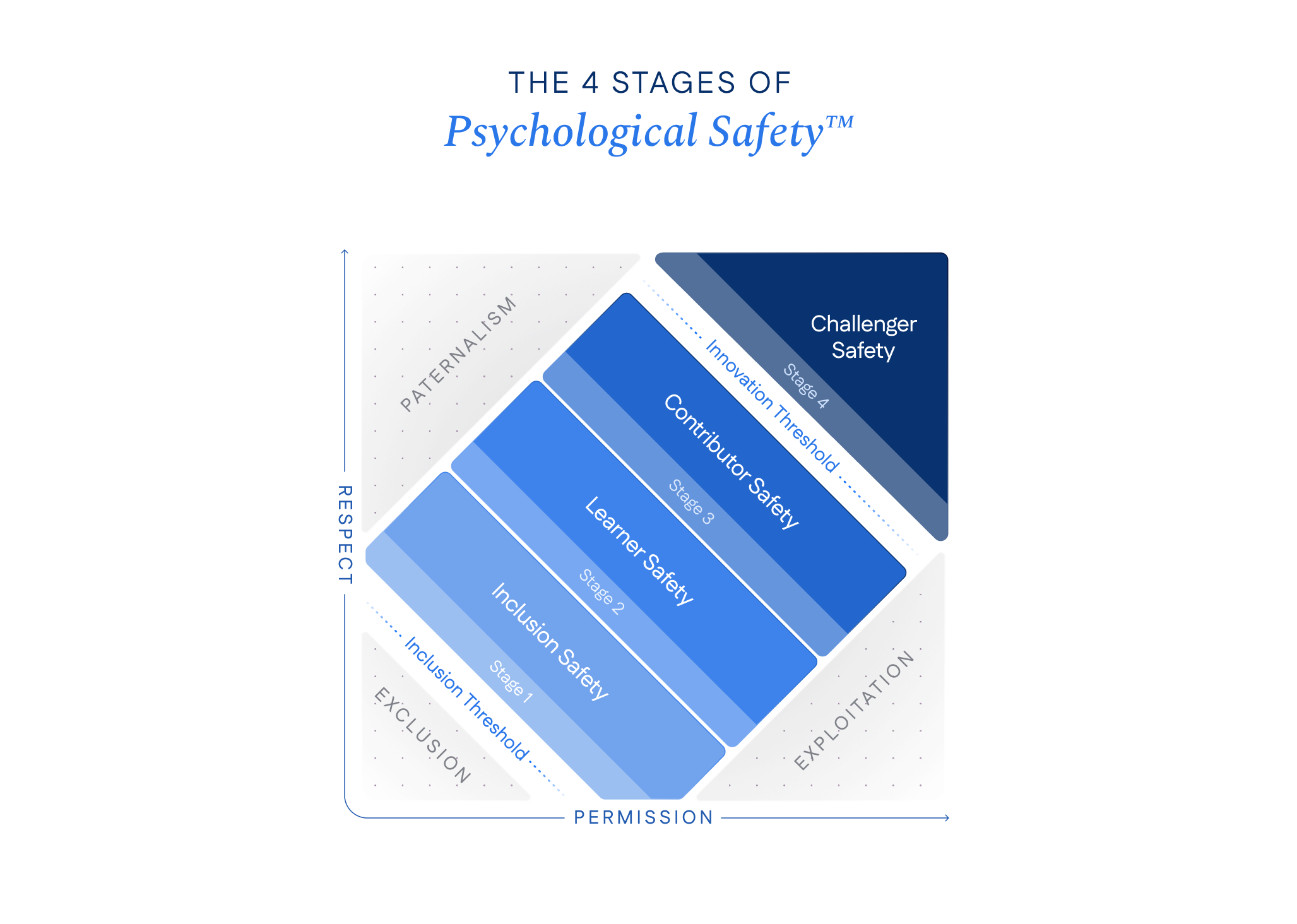
A psychological safety assessment is a survey instrument that measures whether people on a team feel safe enough to be vulnerable at work — to speak up, ask a question, admit a mistake, or challenge the status quo without being punished for it. Unlike a single item buried in an annual engagement survey, a dedicated assessment treats psychological safety as a construct in its own right, breaks it into its component parts, and tells you not just whether safety is thin but where. LeaderFactor’s instrument is the PSindex®: 12 items across The 4 Stages of Psychological Safety™, scored at the intact-team level from multiple rater perspectives.
What is a psychological safety assessment?
A psychological safety assessment is a structured, confidential survey that converts a felt experience — whether it is safe to be vulnerable here — into data a leader can act on. It asks people to rate specific, behavioral statements about their own team, then aggregates those ratings into scores you can compare across stages, teams, and time.
Most assessments on the market descend from the academic origin point: a short, single-factor scale that produces one overall psychological safety score. That answers the first question a leader has — is this team safe? — but not the second, which is the one that determines what you do on Monday: safe for what? A team can be warmly inclusive and still incapable of dissent. A single global score can’t see that difference. Scoring the underlying stages separately can.
What does a psychological safety assessment measure?
PSindex® measures psychological safety across four stages, using 12 quantitative items organized as four three-item subscales — three items per stage. Each item is a plain behavioral statement rated on an 11-point scale from 0 to 10:
- Inclusion safety — I feel included by the people I work with. I am treated with respect. I am accepted as a member of my team.
- Learner safety — My team supports my efforts to learn. I am allowed to learn from my mistakes. I feel comfortable asking questions.
- Contributor safety — My team values my contribution. I am encouraged to contribute as much as I can in my role. My team allows me to do my job.
- Challenger safety — I have the freedom to challenge the status quo. I can take reasonable risks without being punished. I feel safe disagreeing with the way my team does things.
Alongside the quantitative items are four open-ended questions, one per stage, each capped at 140 characters: What is one thing that prevents you from feeling included / from learning / from contributing / from challenging the status quo on your team?
Those four questions are where the assessment earns its keep. The numbers tell you a stage is weak; the open-ended answers tell you why — micromanagement, a leader who gets defensive, mistakes that get punished, decisions made in a silo. That’s the difference between a score and an action plan. (For a fuller catalogue of what typically shows up in those responses, see barriers to psychological safety.)
How is a psychological safety assessment scored?
PSindex® adapts Net Promoter Score logic to psychological safety. Every 0–10 response falls into one of three behavioral zones, because human beings doing threat detection in a social environment conclude one of exactly three things about it:
| Score | Zone | What the person is concluding |
|---|---|---|
| 0–6 | Red Zone | Vulnerability is consistently punished. A diminishing environment that induces fear and self-censoring. |
| 7–8 | Neutral Zone | Vulnerability is inconsistently rewarded and punished. “Sometimes I’m safe, sometimes I’m not. I’ll protect myself.” |
| 9–10 | Blue Zone | Vulnerability is consistently rewarded. An empowering environment that builds confidence, courage, and self-efficacy. |
The team’s score is then calculated as Blue Zone percent minus Red Zone percent, on a 200-point index that runs from −100 to +100. Neutral responses are deliberately excluded from the calculation. A team at 50% Blue and 15% Red scores a 35. A team where more people experience punishment than reward scores negative — and a negative number is a far more honest signal than a 3.4 out of 5 that looks vaguely fine.
The same Blue-minus-Red math is applied at three levels: the overall team score, each of the four stage scores, and each individual item. That’s what makes the output diagnostic rather than decorative.
Why the assessment is scored at the intact-team level
Psychological safety is measured at the intact team level — the smallest divisible unit of culture, and the unit with the most profound influence on individual behavior and performance. People do not experience “the culture of the company.” They experience the eight people they sit with and the manager who responds to their bad news.
That’s also why PSindex® is a multi-rater instrument rather than a self-assessment. It collects perceptions from four vantage points:
- Self — the leader’s own read on the team environment
- Manager — the leader’s manager rates the team the leader leads, not the team they report into, which avoids projection bias
- Peers — typically three to five colleagues
- Direct reports — the people who actually live inside the environment the leader creates
The comparison between those perspectives is often the most valuable page in the report. Leaders routinely rate their own teams safer than everyone else does. That gap is uncomfortable, informative, and — in practice — the single most motivating piece of data in the debrief. Convergence across rater groups means genuine agreement about the environment; divergence means the experience of safety depends on where you sit.
What makes a psychological safety assessment valid?
This is the question most buyers skip and later regret, because “science-based” is a marketing phrase, not a standard. Three things are worth insisting on.
Development standards. PSindex® is developed under the American Educational Research Association (AERA) Joint Standards for Educational and Psychological Testing, supervised by professional psychometricians, with continuous verification and revision. Ask any vendor which standards they build to and who supervises the work.
Construct validity. An instrument has construct validity when it actually measures the thing it claims to measure. PSindex® operationalizes psychological safety using The 4 Stages framework as the explicit basis of design — the four subscales exist because the construct has four parts, not because four looked tidy on a report.
Reliability. Internal consistency is estimated with Cronbach’s alpha, which measures the correlation among items loading onto the same factor — whether the three inclusion items are, in fact, all measuring inclusion.
Behind the subscale structure is a validation study of the sequence itself. In a PSindex® study of 3,366 employees across more than twenty organizations worldwide, respondents were asked what order they would engage in four behaviors when joining a new team, with the display order randomized to eliminate response bias. The result was a clean progression: 65% chose inclusion first, 63% chose learning second, 81% chose contribution third, and 86% chose challenging the status quo last. Agreement among respondents was strong (Kendall’s W = .73), and the randomization checks confirmed no meaningful display-order effect. The stages aren’t a metaphor. People move through them in order, and an assessment built on that order measures something real.
What does the report actually give you?
A psychological safety assessment is only as good as what it hands the leader afterward. A PSindex® report includes:
- An overall team score on the −100 to +100 index.
- Stage-by-stage scores, so you can see a team that is strong on inclusion and hollow on challenger safety.
- Item-level scores within each stage, narrowing “learner safety is low” to “people don’t feel safe asking questions.”
- Rater-group breakdown, including the leader’s self-perception versus everyone else’s.
- The qualitative barriers from the four open-ended questions.
- Behavioral recommendations tied to the stage that scored lowest, feeding a written action plan.
Participants also complete The Ladder of Vulnerability™, a self-assessment that rates the personal risk they perceive in 20 specific acts of vulnerability at work — admitting you don’t know something, asking for help, challenging a decision. It explains why a given behavior is hard for a given person, and why what feels trivial to the leader may feel career-threatening to someone else on the team.
Then you re-measure. Assessment sets a baseline, leaders practice specific behaviors for four to six weeks with reinforcement, and the instrument is re-taken at roughly 90 days — a 90-day measurement cycle whose pre/post comparison shows whether the change is real.
What questions should leaders ask to gauge psychological safety on their team?
Before or between formal assessments, a leader can run a fast self-audit. LeaderFactor frames six questions around a leader’s influence — because in most teams the leader is the largest single variable in whether vulnerability gets rewarded or punished:
- Presence. When you enter a room, does your influence warm or chill the air?
- Collaboration. When you work with peers, do you accelerate or decelerate the speed of discovery and innovation?
- Feedback. Fear breaks the feedback loop. Does your influence increase or restrict the flow of feedback?
- Inquiry. Telling shuts people down; asking draws them out. Which do you do more of?
- Dissent. Do you encourage and reward dissent, or discourage and punish it?
- Mistakes. Do you celebrate mistakes and the lessons learned, or overreact and marginalize the people who make them?
These are honest prompts, not a substitute for measurement — self-perception is exactly the variable a multi-rater instrument exists to correct. But they sharpen what you’re looking for when the data arrives, and they’re a useful gut-check for signs of low psychological safety between cycles.
How to choose a psychological safety assessment
Use these criteria when you evaluate any instrument, including this one:
- Does it measure a construct or a mood? Look for named subscales with published item logic, not a generic “how safe do you feel” prompt.
- What is the unit of measurement? Department- or company-level rollups average away the thing you’re trying to see. Culture lives in the intact team.
- Whose perception counts? Single-rater self-assessments miss the gap between how leaders see their teams and how their teams see them.
- Does it produce qualitative data? Numbers locate the problem; open-ended answers explain it.
- What standards was it built to? AERA Joint Standards, psychometric supervision, reported reliability.
- What happens after the score? An assessment with no behavioral pathway attached becomes a report nobody opens twice.
For the surrounding process — building the business case, sequencing training before measurement, running the survey, and debriefing results — see how to measure psychological safety. To go deeper on the model the instrument is built on, start with the 4 stages of psychological safety and LeaderFactor’s Psychological Safety skill.
Frequently asked questions
- What is a psychological safety assessment?
- A psychological safety assessment is a survey instrument that measures whether people on a team feel safe being vulnerable at work — speaking up, asking questions, admitting mistakes, and challenging the status quo. A strong one scores each component separately. LeaderFactor's PSindex® uses 12 items across the four stages of psychological safety, scored at the intact-team level.
- How is a psychological safety assessment scored?
- LeaderFactor's PSindex® uses an 11-point response scale (0–10) and sorts every response into a zone: Red (0–6) signals consistently punished vulnerability, Neutral (7–8) signals inconsistency, and Blue (9–10) signals consistently rewarded vulnerability. The team score is Blue Zone percent minus Red Zone percent, producing an index from −100 to +100.
- What questions should leaders ask to gauge psychological safety on their team?
- LeaderFactor frames six questions around a leader's influence: presence (does entering a room warm or chill the air), collaboration (do you accelerate or decelerate discovery), feedback (do you increase or restrict its flow), inquiry (do you draw people out or shut them down), dissent (do you reward or punish it), and mistakes (do you celebrate the lessons or marginalize those who make them).
- Are psychological safety assessment responses anonymous?
- PSindex® is confidential rather than strictly anonymous. Respondents receive unique links that connect their answers to demographics like tenure, department, and location, which makes cross-team analysis possible. Individual responses are never disclosed to anyone, and only aggregate data is shared — the confidentiality guarantee is what makes honest answers possible.
- How often should you re-assess psychological safety?
- About every 90 days. Psychological safety is created by repeated daily behavior, so a baseline assessment, several weeks of deliberate behavioral practice, and a re-assessment at roughly 90 days form a closed measurement loop. The pre/post comparison shows with evidence whether the behavior change is real or the initiative has stalled.