Every team, all four stages. Sample data, not client results.
Why run it
Who measures psychological safety, and why.
01+
“Is our culture helping performance or hurting it?”
Chief People OfficerOwns engagement, retention, and the culture story the board hears.What PSindex® gives themOne number per team, benchmarked against your industry, so you can show the board where the culture stands.
02+
“Where do we aim the leadership program, and did it work?”
Head of L&D or ODOwns the leadership program and its budget.What PSindex® gives themThe managers who need support most, and a before-and-after for every team once the program has run.
03+
“Which teams are in trouble before it shows up in exits?”
HR business partnerOwns a business unit’s people problems.What PSindex® gives themA team-by-team read of where the dynamics are breaking down, with the reasons in their own words, before it shows in performance or exits.
04+
“Will people speak up before something goes wrong?”
Safety or operations leaderOwns the incident numbers.What PSindex® gives themChallenger Safety scores by team, so you know which crews are keeping concerns to themselves.
The research
Psychological safety correlates with ten outcomes you already report.
Peer-reviewed studies link it to each of these. The guide gives every outcome a page, with the correlation and the studies behind it.
PSindex® Organization is the validated survey built on The 4 Stages of Psychological Safety™. It measures whether people on each team feel safe to be themselves, to ask questions and make mistakes, to do real work, and to push back on how things are done. Six things to know about it.
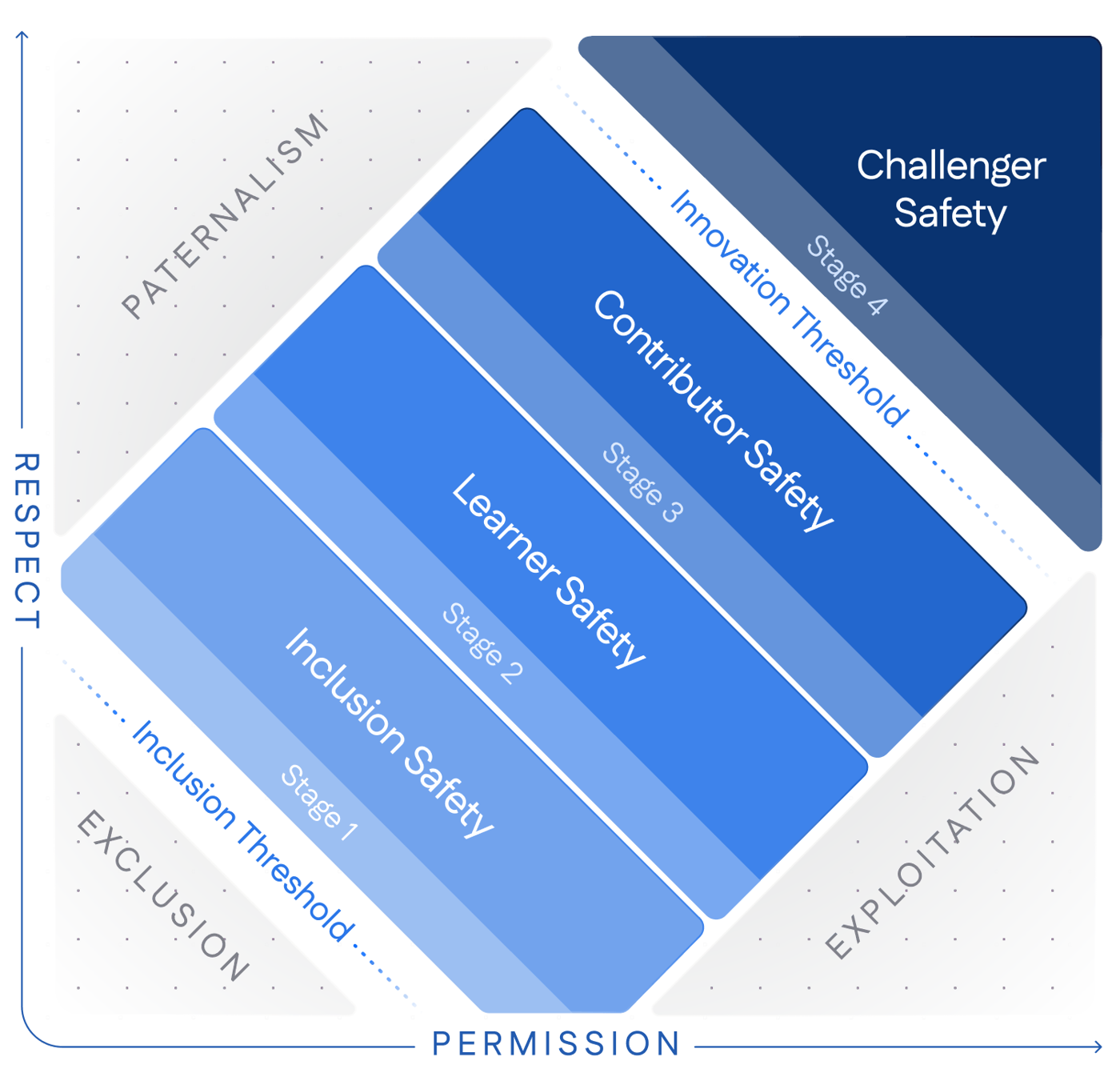
People feel included long before they feel free to challenge anything, so the survey scores each team on all four stages in order: Inclusion Safety (am I accepted here?), Learner Safety (can I ask questions and make mistakes?), Contributor Safety (am I trusted with real work?), and Challenger Safety (can I challenge how we do things?). Across more than 10,000 teams we have measured, Challenger Safety is the lowest of the four in about three teams out of four.
Dr. Timothy R. Clark is the founder and CEO of LeaderFactor and author of The 4 Stages of Psychological Safety. The survey was built to measure his model and then tested to see whether the model held; the technical report documents how.
Challenger Safety
I can push back on a decision here without it costing me.
0
1
2
3
4
5
6
7
8
9
10
Three questions per stage, each answered 0 to 10, plus one open question per stage. Most people finish in about five minutes. The questions are about specific moments, not “do you feel psychologically safe at work”: owning up to a mistake, asking for help, being handed real work, pushing back on a decision.
Illustrative wording. The validated questions are in the technical report.
A 9 or 10 is the blue zone, where speaking up is rewarded. A 6 or below is the red zone, where it’s punished. A team’s score on a stage is the share of blue answers minus the share of red, from −100 to +100.
.951Cronbach’s alpha, 3,047 responses
In the validation sample of 3,047 responses, the twelve questions measured one underlying thing, a single factor explaining 66% of the variance, and measured it consistently, with a Cronbach’s alpha of .951 overall and .85 to .90 on each stage.
Nobody ever sees an individual answer. A team or a demographic group needs at least three responses before its page exists, so nobody can be worked out by elimination. That floor is also what lets you cut the results by gender, age, or ethnicity without anyone being identifiable. Admins see the whole organization. A manager who is given access sees their own team’s page and nothing else.
The product
Six views of the whole organization, and answers from every team report.
Your admins get all six views for the whole organization, and can give each manager a page for their own team. Any team report can be asked a question in plain words.
All seven windows use sample data. A score is blue-zone responses minus red-zone responses, from −100 to +100. Click a view to hold it still.
The largest normative database on psychological safety in the world.
PSindex® compares every score with 1.3 million answers from organizations in ten industries. You see where each team stands in your industry, and whether the team’s score moved since last year.
You send a roster and name an admin. We build the survey, send it, chase the responses, and report.
01YouYou send us a roster
A spreadsheet of names, work emails, and who reports to whom, plus anything you want to cut the results by, such as level, tenure, location, gender, age, or ethnicity. You name one or two people as admins.
02LeaderFactorWe build the survey from it
An onboarding specialist loads the roster, checks that every team sits under the right manager, and agrees a launch date with you.
03LeaderFactorEveryone gets an email with their own link
The invitation comes from the LeaderFactor platform. People open their link and answer twelve questions and four open ones about their own team. Most people finish in about five minutes. There’s no login and no account to create.
04BothThe survey stays open while we chase responses
Most surveys stay open about three weeks. Reminders go to anyone who hasn’t answered, and your admins can see how many people have responded and nudge the managers whose teams are behind.
05LeaderFactorReports go live
Reports open the moment the survey closes, or on a date you set. Your admins get all six views of the whole organization, and can give each manager a page for their own team.
06LeaderFactorWe walk you through what it says
An interactive debrief that helps you understand your survey results and decide what to do next.
07YouYou run it again
A year later to track the culture, or about 90 days after a program to see whether it worked. The twelve questions don’t change, so the numbers compare.
No. PSindex® Organization is the survey and the reporting, sold on its own. Many organizations run it before any training to see where to start, and some run it without any training at all.
Who takes it?
Everyone on every team you include. Each person rates their own team on twelve questions, 0 to 10, three per stage, and answers one open question per stage. The results become a page for every team and a view of the whole organization.
How big do we need to be?
Any team with three or more responses gets a page, so PSindex® Organization works for one division as well as a whole enterprise. The organization-wide views and the industry benchmark get more useful the more of the organization you include.
What do we have to provide?
A roster: names, work emails, who reports to whom, and anything you want to cut the results by, such as level, tenure, location, gender, age, or ethnicity. We build the survey from it, check that every team sits under the right manager, agree a launch date with you, and send the invitations and reminders.
Is it confidential?
Yes. Nobody ever sees an individual answer. A team or a demographic group needs at least three responses before its page exists, so nobody can be worked out by elimination. That floor is also what lets you cut the results by gender, age, or ethnicity without anyone being identifiable. Admins see the whole organization. A manager who is given access sees their own team’s page and nothing else.
Is it a validated instrument?
Yes. PSindex® was built to the AERA, APA, and NCME Standards for Educational and Psychological Testing. In the validation sample of 3,047 responses, the twelve questions measured one underlying thing, a single factor explaining 66% of the variance, and measured it consistently, with a Cronbach’s alpha of .951 overall and .85 to .90 on each stage.
People answer from a link in an email, with no login or account. Managers and admins read the reports in the LeaderFactor platform. Single sign-on and API connections are set up through our integration service, LeaderFactor™ Connect.
Is our data secure?
LeaderFactor holds a SOC 2 Type 2 attestation. Data is encrypted at rest and in transit, an outside firm runs a penetration test every year, and your people’s answers are never used to train AI models. The reports and the full control list are at security.leaderfactor.com.
Is it in other languages?
Yes. The survey runs in English, Spanish, Portuguese, French, Japanese, Chinese (simplified and traditional), Thai, Malay, Russian, and Kinyarwanda, and each person gets the email and the questions in the language set for them on the roster, so one survey can run in several languages at once. Other languages are arranged per engagement through LeaderFactor™ Translate.
What is PSindex® Leader?
A separate assessment for one manager. They rate how often they do the things that create psychological safety, their team rates them too, and they take The 4 Stages of Psychological Safety™ course with their own results as the frame, then build an action plan in the Behavior Change Center. It isn’t sold on its own, and PSindex® Organization never requires it.
What does it cost?
It depends on how many people you survey. Reporting is included, and you don’t have to buy training.
We already ask about psychological safety in our engagement survey. Why run this?
An engagement survey usually carries one or two questions about speaking up and reports them for the whole organization. Gallup’s Q12 has one: “At work, my opinions seem to count.” PSindex® Organization asks twelve questions, three on each of the four stages of psychological safety, and reports every team of three or more on its own page, with an open answer per stage and a percentile against 1.3 million answers. You learn which teams are below zero, where more people are being punished for speaking up than rewarded, and on which stage. One question can’t tell you that.
Why use PSindex® instead of Amy Edmondson’s scale, or the Fearless Organization Scan built on it?
Edmondson’s seven questions give a team one score, an average of how safe it feels, which can’t tell you what’s missing. PSindex® scores a team on four stages people reach in order, Inclusion, Learner, Contributor, and Challenger Safety, so you see where a team stalls and what to work on first. The scoring also keeps the people being punished in view. A score is the share of answers in the blue zone, 9 or 10, minus the share in the red zone, 6 or below, so a team split between people who feel safe and people who don’t reads as a zero, where an average would call it moderate. An open answer on every stage puts the reasons beside the number. Because the stages are the same four the training and the debrief use, a team’s lowest stage is the thing you teach next. One diagnostics client moved every stage with the survey and stage-matched resources, and no workshops.
What about the free psychological safety survey templates?
Most of them are Edmondson’s seven questions on a survey tool, and they give one team one score. They don’t come with a page for every team in the organization, roll-ups by division, cuts by level, tenure, or site, a benchmark to read the score against, or evidence that the questions measure what they claim to. PSindex® Organization has all of those, and the reporting is included.
Can we drop the questions into our own engagement survey?
No. PSindex® is a registered instrument, and its questions aren’t licensed for use inside another survey. It runs on the LeaderFactor platform, and the reporting comes with it.
We value your privacy
We use cookies to run the site, measure traffic, and improve your experience. Accept all, reject
non-essential, or choose what to allow. See our Privacy Policy.