





The decision-making process, step by step
The decision making process in 7 steps: define the problem, set criteria, weigh priorities, generate options, decide, execute, and review. What breaks and where.
The decision-making process is a structured sequence for getting from a problem to a committed course of action, and most teams don’t have one. They have meetings. A decision is a commitment to a chosen course of action among alternatives; a decision-making process is how that commitment gets made deliberately, using facts, explicit criteria, and clear reasoning instead of intuition, bias, or fatigue. This page walks the full sequence, where it breaks in practice, and how to make it something your team runs rather than something it reads about.
What a real process does
Two numbers frame the problem, and neither is flattering. Most of the decisions any of us make run on autopilot: fast, associative, pattern-matching thinking that psychologists call System 1. It’s efficient and mostly fine. But it carries systematic distortions into exactly the decisions that deserve better, and research by Herbert Simon added the second constraint: even at our deliberate best, we decide under bounded rationality. Limited information, limited time, limited attention. We don’t optimize; we satisfice, choosing an option that’s good enough under the circumstances.
A process is the honest response to both constraints. It’s the manual override for autopilot, and it’s a way of satisficing well: making the good-enough choice on purpose, against named criteria, at the speed the decision deserves.
The 7 steps
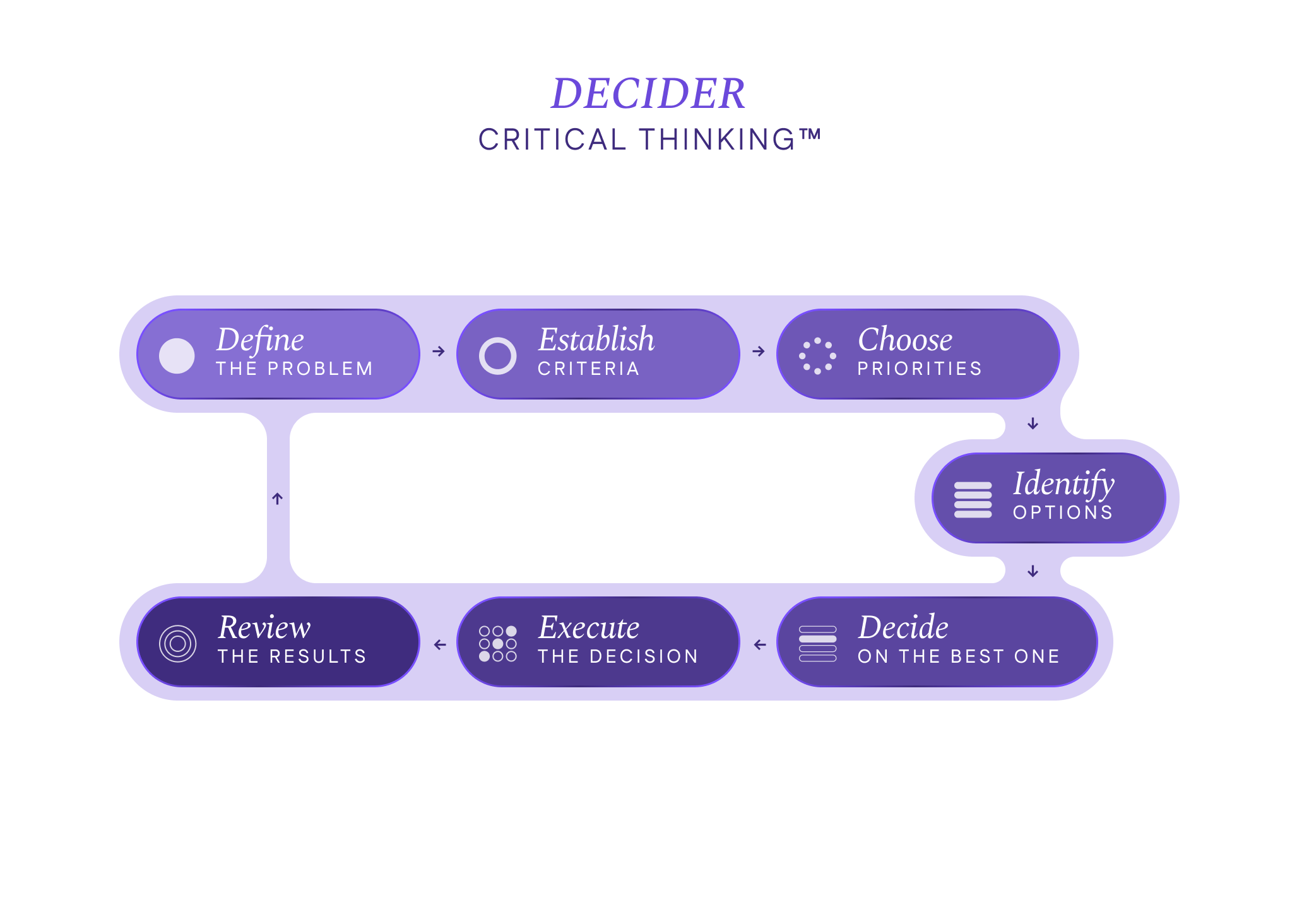
1. Define the problem. Clearly articulate what decision actually has to be made, in one sentence, before discussing solutions. This step earns its position: if you misdefine the problem, you misdirect the solution. Russell Ackoff’s warning applies to most conference rooms — we fail more often because we solve the wrong problem than because we solve the right problem badly.
2. Establish criteria. Name the standards every option will be judged against, before any option is on the table. Criteria are the guardrails of good decisions, and four categories cover most cases: value, cost, time, and risk. Write them down; unwritten criteria get invented after the fact to justify the option someone already preferred.
3. Choose priorities. Decide which criteria matter most and what you’ll trade off. Separate must-haves from nice-to-haves. A team that hasn’t ranked its criteria hasn’t finished deciding how to decide, which is why its “final” decisions keep reopening.
4. Identify options. Generate real alternatives, not just the obvious one. Great decisions start wide and end narrow: diverge first, then converge, and generate before you judge. This is the most skipped step in the sequence — Paul Nutt’s research found fewer than 20% of managers explored more than one alternative — and skipping it converts the whole process into paperwork for a foregone conclusion. Include “do nothing” and “delay” as explicit options.
5. Decide on the best one. Score the options against your weighted criteria and make the call. Check the exits before you commit: a two-way door can be walked back cheaply, a one-way door can’t, and an option with an unacceptable downside is disqualified no matter how well it scores. Then document who decided, when, and why. Undocumented decisions get relitigated at the first sign of friction.
6. Execute the decision. A good decision fails without good execution, or as Colin Powell put it, good decisions without execution are worthless. Execution means transferring understanding, not just announcing the outcome: people commit to what they understand, and alignment is shared understanding plus shared commitment.
7. Review the results. You can’t improve what you don’t review. Evaluate the quality of the decision process separately from the outcome, because good luck can dress up a sloppy process and bad luck can slander a sound one. The review is where decision-making stops being an event and becomes a capability.
Where the process breaks
The misconception usually sounds like this: “we already have a decision-making process — we get the right people in the room and talk it through until we agree.” That’s not a process. That’s a format, and it selects for stamina and seniority, not for quality. Discussion without defined steps produces decisions made by whoever framed the problem first, judged by criteria nobody named, against alternatives nobody generated.
The replacement isn’t bureaucracy. The 7 steps scale to the decision: a hiring call might run them in a morning, a market exit over a quarter. Decision depth changes the scale, not the structure. What can’t scale down to zero is the sequence itself, because each step inherits the quality of the one before it, and the three most common breaks are all sequence violations: solutions proposed before the problem is defined, criteria reverse-engineered after a favorite emerges, and options judged as they’re generated, which shuts down the generating.
There’s a second failure mode on the other end: teams that run the process too slowly. Teams don’t just make bad decisions — they make slow ones, and a good decision made too late is a bad decision. The fix for slowness isn’t skipping steps; it’s matching depth to stakes and reversibility, then closing each step instead of circling it.
One process, different deciders
The sequence doesn’t change between individual and team decisions, but the fifth step gains a question: who actually holds the D? Participation rights (who gets heard) are not decision rights (who decides), and most team decision pain comes from leaving that distinction vague. The five models for allocating the call, from unilateral to consensus, are covered in team decision making; the biases that distort the room’s judgment are in cognitive bias in decision making.
Making it stick
It’s a Monday in April at a regional bank, and the head of retail operations is running her first branch-consolidation decision since the cohort. Last year’s version took five months and reopened twice. This time the problem statement is one sentence, the criteria were weighted before any branch was named, and the recommendation goes to the executive team as a DECIDER™ Report: options, scores, trade-offs, and the downside she’s explicitly accepting. The meeting takes forty minutes. Nobody relitigates it, because there’s nothing vague left to relitigate.
That’s what installed looks like. The DECIDERindex™ gives each leader a personal baseline of their decision-making patterns across the 7 steps, so you know which steps you personally skip before you try to run the sequence with a team.
Where to go next
Each step of the process rewards deeper study: decision-making skills covers the capabilities behind the steps, decision-making framework compares the structures teams adopt, decision-making models maps the theory, decision-making styles covers your defaults, and how to make better decisions distills the practical moves. Or start where the capability actually gets built: pick one real decision on your desk this week and run it through all 7 steps, in order, on paper. The process teaches itself the first time you watch step 1 change what step 5 would have been.
Frequently asked questions
- What is the decision-making process?
- The decision-making process is a structured sequence for moving from a problem to a committed course of action. A decision is a commitment to a chosen course of action among alternatives; the process exists so that commitment comes from facts, clear reasoning, and explicit criteria rather than from bias, politics, or whoever spoke last.
- What are the 7 steps of the decision-making process?
- In LeaderFactor's DECIDER™ model: define the problem, establish criteria, choose priorities, identify options, decide on the best one, execute the decision, and review the results. The sequence matters because each step inherits the quality of the one before it. Misdefine the problem and every later step works on the wrong question.
- What is the difference between a decision-making process and a decision-making model?
- A model describes how humans decide: rationally, intuitively, or under bounded rationality. A process is the operating sequence a person or team actually runs. Models explain and predict; a process prescribes. Most teams have read about models but never installed a process they run the same way twice.
- How long should a decision take?
- As long as its stakes and reversibility deserve, and no longer. A reversible, low-stakes decision deserves speed and a two-way door mentality. A one-way door with an unacceptable downside deserves the full process. A good decision made too late is a bad decision, so velocity is part of quality, not its enemy.
- How do you improve your decision-making process?
- Review results separately from outcomes. A good outcome can hide a lucky, sloppy process, and a bad outcome can follow a sound one. Run a consistent sequence, document who decided what and why, then evaluate the process on its own merits. Teams that review decisions compound; teams that only celebrate outcomes repeat their mistakes.