





Decision-making skills, and how to actually build them
Decision making skills are observable behaviors, not traits. The seven capabilities behind consistently good calls and the practice that develops each one.
Decision-making skills get described as if they were a temperament: some people are just decisive, good under pressure, blessed with judgment. That framing is convenient and wrong. Decision-making skills are a set of specific, observable capabilities — defining problems, setting criteria, weighing trade-offs, generating options, making the call, executing it, and reviewing what happened. Every one of them shows up as behavior, which means every one of them can be measured and built.
That’s the practical difference between this page and a list of virtues. Traits are things you have. Skills are things you do, and you can start doing them this week.
The skill behind the reputation
Think about the person in your organization everyone calls a great decision-maker. Watch closely and the mystique resolves into mechanics. They ask what problem we’re actually solving while everyone else debates solutions. They name what they’d trade before they’re forced to. They want a real alternative on the table before committing. None of that is charisma. It’s a sequence, run so consistently it looks like instinct.
The reverse is also true, and it’s the misconception worth killing: “decisiveness is the skill — good decision-makers are quick and confident.” Confidence is a feeling, and it correlates with skill far more loosely than the confident would like; overconfidence sits on every serious list of decision-distorting biases. The people who make consistently good calls aren’t the fastest in the room. They’re the ones who match their speed to the decision’s stakes and reversibility, then commit cleanly. Decisiveness without the underlying sequence is just speed at gambling.
The seven skills, as behaviors
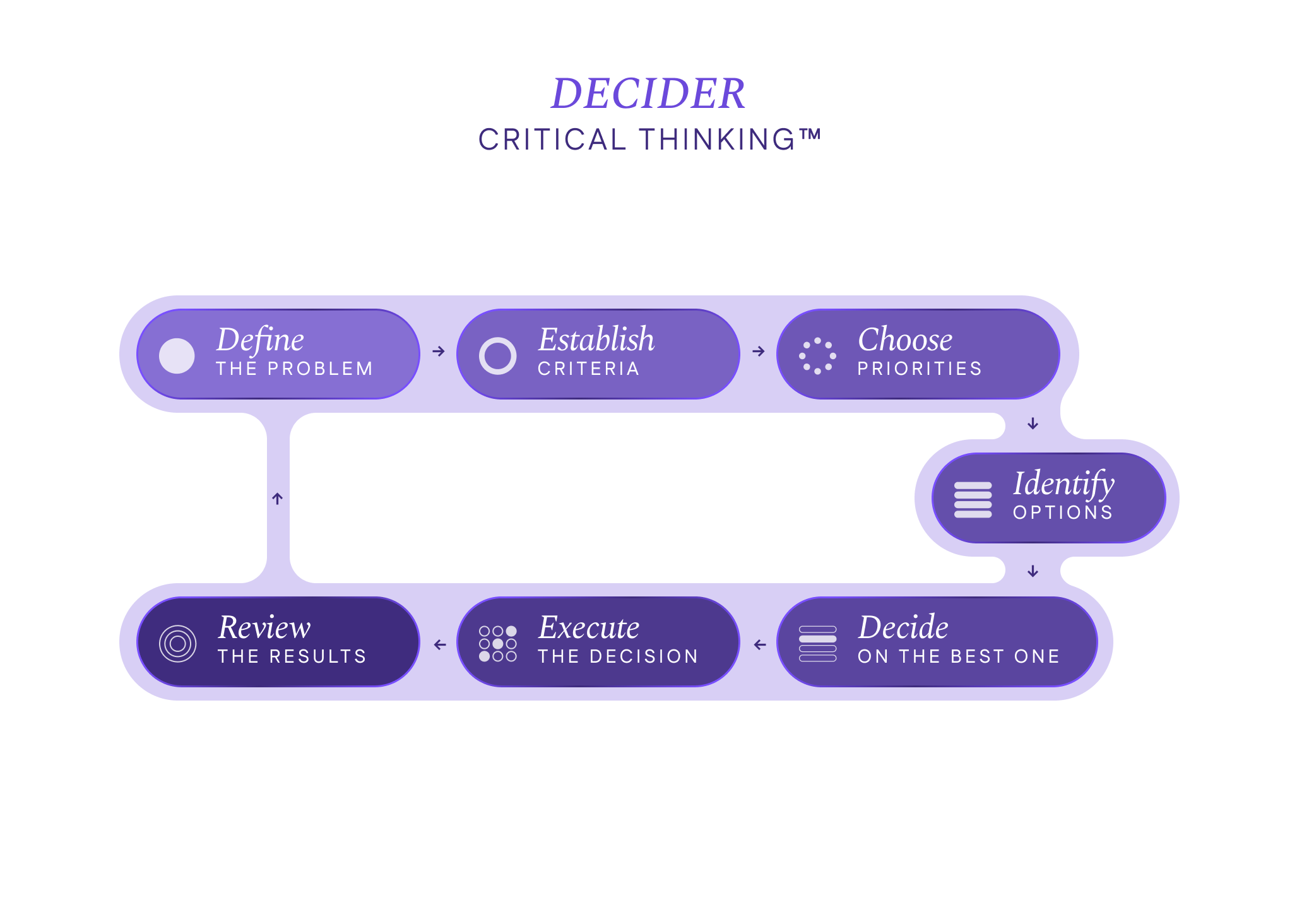
Each capability maps to a step of the decision process, and each resolves into behaviors a colleague could observe. LeaderFactor’s DECIDER Critical Thinking™ framework defines six observable behaviors per step; here’s the skill-level view:
- Problem definition. Write a one-sentence description of the decision before discussing solutions. If you misdefine the problem, you misdirect the solution — this skill fails loudest.
- Criteria-setting. Name the standards options will be judged against, before options exist. The behavior: criteria on paper, with value, cost, time, and risk all represented.
- Prioritization. Separate must-haves from nice-to-haves and say the trade-off out loud. Priorities tell us what matters most; unranked criteria are just a wish list.
- Option generation. Produce multiple viable options, including doing nothing and delaying. More options mean better choices, and this is the most commonly skipped skill in real organizations.
- Judgment. Score options against the weighted criteria, check for one-way doors and unacceptable downsides, and make the call. Then document who decided, when, and why.
- Execution. Transfer understanding, not just the announcement. A good decision fails without good execution, and the skill is building shared understanding plus shared commitment.
- Review. Evaluate the decision process separately from the outcome. This is the compounding skill: it’s how the other six improve.
The full sequence these skills serve is walked step-by-step in the decision-making process.
Why “practice” means real decisions
Decision skills don’t build in the abstract, because the thing that degrades them — bias, pressure, ambiguity — only shows up when something is at stake. Fast, automatic System 1 thinking handles most daily calls and quietly claims the important ones too; deliberate System 2 thinking is the override, and overrides are habits, built under load. That’s why case studies make interesting reading and weak training: the reps that count are the ones on decisions you actually have to live with. (The specific distortions to practice against are cataloged in cognitive bias in decision making.)
It’s a Wednesday in June at an e-commerce company in Denver, and a merchandising manager is looking at her DECIDERindex™ results with her coach. The profile is lopsided in a way she recognizes immediately: strong on problem definition and execution, near-zero on review. Eleven years of decisions, and she has never once gone back to score how one was made. Her practice plan is a single behavior: a fifteen-minute review of one decision per month, process first, outcome second. By the second review she’s found the same flaw twice — criteria set after her favorite option emerged — and now she knows what her next promotion actually depends on.
Building the skills on a team
Individual skill compounds when the team shares the vocabulary. A team where “what’s the actual problem?” and “what are we trading off?” are normal sentences runs a de facto process even before it formalizes one. Two moves accelerate that: give the team a shared sequence to point at (that’s what a decision-making framework is for), and clarify who holds decision rights so skill isn’t spent relitigating ownership (team decision making covers the models).
The Critical Thinking skill builds all seven capabilities in a five-week cohort, with each participant running a live decision through the full sequence and re-taking the DECIDERindex™ at the end — the measurement is the proof.
Start smaller than that if you like, but start observable: pick the one behavior you skipped on your last significant decision, and perform it on your next one. Skills are just behaviors that survived repetition.
Frequently asked questions
- What are decision-making skills?
- Decision-making skills are the capabilities that produce consistently good calls: defining the real problem, setting criteria, weighing trade-offs, generating alternatives, judging options, executing the choice, and reviewing results. They're observable behaviors rather than traits, which is why they can be assessed, practiced, and built like any other skill.
- Can decision-making skills be learned and developed?
- Yes. Each skill breaks down into observable behaviors — writing a one-sentence problem statement before discussing solutions, separating must-haves from nice-to-haves, generating multiple options including doing nothing. Behaviors respond to deliberate practice on real decisions, especially when you baseline your current patterns first and review results afterward.
- Why are decision-making skills important in the workplace?
- Because decisions are the mechanism by which everything else happens: hiring, priorities, budgets, product calls. An organization's speed is capped by its decision velocity, and its quality by its decision quality. Leaders with weak decision skills become bottlenecks; teams without them relitigate the same calls for months.
- How can I demonstrate decision-making skills in a job interview?
- Walk through one real decision as a process, not an outcome. Name how you defined the problem, the criteria you set, the alternatives you genuinely considered, the trade-off you accepted, and what the review taught you. A candidate who can separate decision quality from outcome luck demonstrates more skill than one with a lucky result.
- What is the fastest way to improve decision-making skills?
- Baseline, then practice one step. An assessment like LeaderFactor's DECIDERindex™ profiles how frequently you actually perform the behaviors of each decision step, which usually reveals one or two habitually skipped steps. Practicing only those, on live decisions, improves results faster than generic decisiveness advice.