





Decision-making frameworks: choosing one that holds
Decision making framework comparison — Cynefin, OODA, RAPID, SPADE and more, when each fits, and why teams need one operating framework rather than nine.
A decision-making framework is a repeatable structure for getting from problem to committed choice, and the market for them is crowded: Cynefin, OODA, RAPID, RACI, SPADE, Six Thinking Hats, decision trees, weighted matrices. Most articles on this topic are catalogs, and catalogs quietly mislead, because they imply the job is picking the cleverest framework. It isn’t. The job is installing one structure your team runs the same way every time, so decisions stop depending on who’s in the room and how the meeting went.
Here’s the landscape honestly compared, then the harder question the catalogs skip.
The frameworks, side by side
| Framework | What it actually does | Strongest when | Its blind spot |
|---|---|---|---|
| Cynefin | Classifies the situation (clear, complicated, complex, chaotic) so you decide how to decide | The team keeps applying best practices to genuinely novel problems | Classifies; doesn’t run the decision |
| OODA loop | Fast observe–orient–decide–act cycles | Competitive, fast-moving situations where iteration beats analysis | Assumes you can act and correct cheaply |
| RAPID | Assigns decision roles: recommend, agree, perform, input, decide | Decisions stall because nobody owns the call | Says who, not how |
| RACI | Assigns execution roles: responsible, accountable, consulted, informed | Work after the decision keeps dropping between owners | It’s for work, not decisions; often misapplied |
| SPADE | Setting, people, alternatives, decide, explain — structured group decisions | Cross-functional calls that need a visible rationale | Light on criteria and weighting |
| Six Thinking Hats | Forces the group through distinct thinking modes | Groups that converge too fast or argue in circles | A discussion format, not a decision sequence |
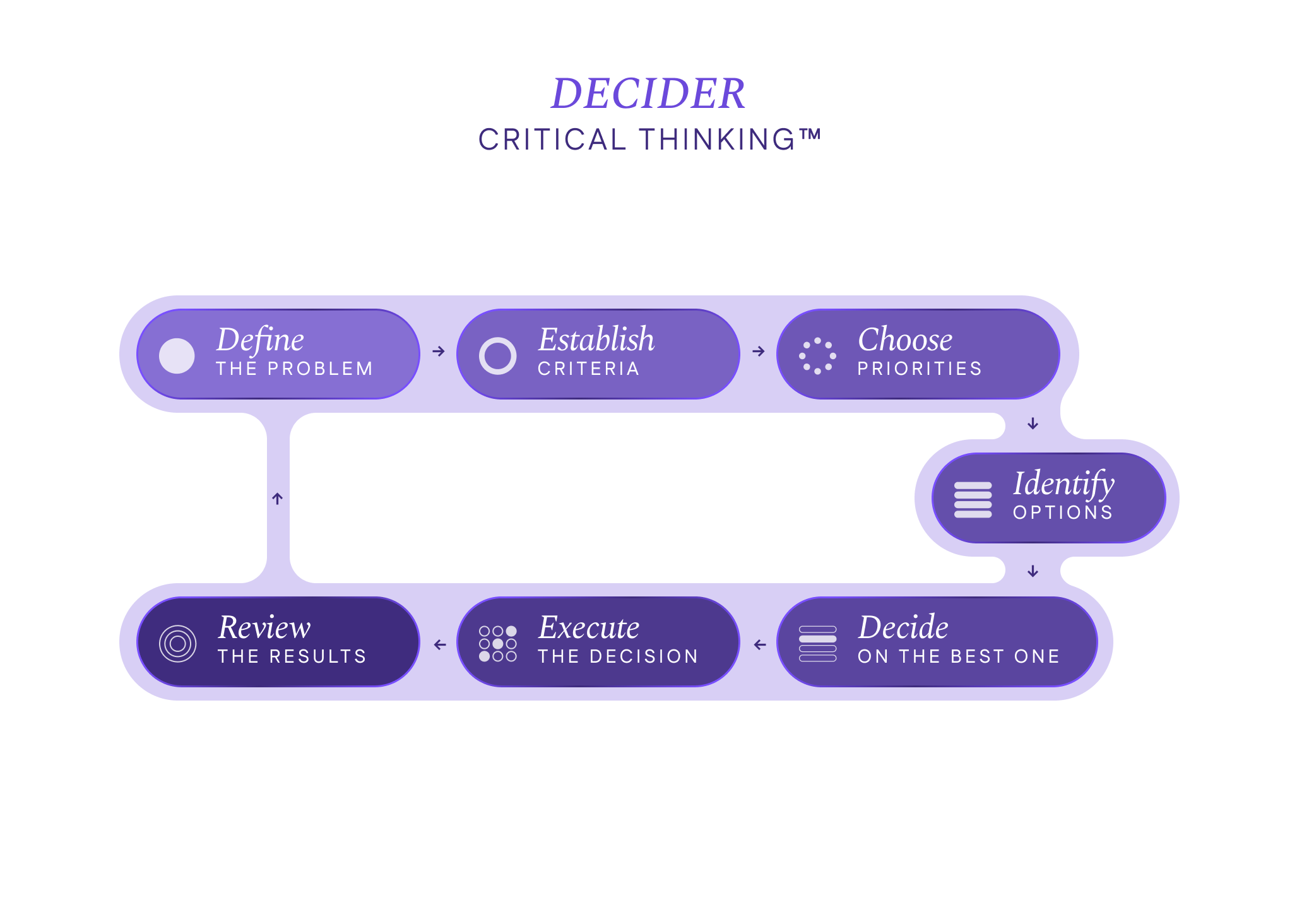
| DECIDER™ | Runs the full sequence: problem, criteria, priorities, options, decision, execution, review | You want one operating process for any decision at any level | Deliberately general; the team supplies domain judgment |
Two clarifications the comparison exposes. First, several famous “decision frameworks” don’t make decisions: Cynefin classifies, RACI allocates execution, Six Hats structures talk. Useful, and not the same thing. Second, the frameworks aren’t rivals so much as parts: role clarity (RAPID’s territory) and situation-reading (Cynefin’s) both live inside any complete decision sequence.
The collector’s fallacy
The misconception this topic runs on: “our decisions are slow and messy, so we need to find the right framework.” Then the team adopts one per quarter, each with its own vocabulary, and decision quality doesn’t move — because the problem was never framework scarcity. It was that nothing got run consistently enough to become how things work. A framework used twice is trivia. Nine frameworks used occasionally are a bookshelf.
The replacement: pick one complete sequence, and run every significant decision through it until the vocabulary is ambient. Complete means it covers the whole arc — problem definition, explicit criteria, weighted priorities, real alternatives, a documented call, execution, and review. Teams don’t just make bad decisions; they make slow ones, and consistency is what moves both dials, because a known sequence removes the meta-argument about how we’re deciding that eats most of the calendar time.
What a framework must make explicit
Whatever you install, four things have to stop being implicit, because they’re where frameworks quietly fail:
- The criteria. Value, cost, time, and risk cover most decisions. Criteria written after a favorite option emerges aren’t criteria; they’re a defense brief. Criteria are the guardrails of good decisions.
- The weights. Which criteria dominate, and what you’ll trade. A framework without priorities produces ties, and ties get broken by politics.
- The decision rights. Who holds the D, and what kind of input everyone else is giving. This is RAPID’s genuine insight, and it belongs inside your sequence, not beside it — the models for allocating the call are covered in team decision making.
- The record. Who decided, when, and why, written down. Undocumented decisions get relitigated at the first sign of friction, and the relitigation costs more than the original decision did.
Installing it
It’s early February at a B2B software company in Austin, and the VP of product has just watched the same pricing decision get made for the third time in four months. Different meeting, same arguments, no memory. The fix she runs isn’t another framework evaluation: she takes the DECIDER™ sequence, runs the pricing call through all 7 steps in two working sessions, and publishes the one-page record — problem statement, weighted criteria, the three options scored, the trade-off accepted. The next time someone reopens pricing, the answer is a link. The framework didn’t win the argument. The record did.
Installation, practically: run one live decision through the full sequence, visibly. Then a second. Baseline each leader’s patterns with the DECIDERindex™ so you know which steps your team habitually skips, because a framework is only as good as its least-practiced step. And when the sequence surfaces a step your culture resists (usually generating real alternatives, sometimes honest review), treat that as the finding — the decision-making process covers what each step demands and how to make better decisions covers the personal moves.
Choose once, run it everywhere, and let the framework become boring. Boring is what working looks like.
Frequently asked questions
- What is a decision-making framework?
- A decision-making framework is a repeatable structure a person or team uses to move from problem to committed choice. Good frameworks make the invisible parts of deciding explicit: what kind of situation this is, who holds the call, what criteria apply, and what happens after the decision. The framework's value is consistency, not cleverness.
- What are the most common decision-making frameworks?
- The ones leaders meet most often are Cynefin (classifying the situation before deciding how to decide), the OODA loop (fast iterative cycles), RAPID and RACI (role clarity), SPADE (structured group decisions), and criteria-based scoring frameworks like LeaderFactor's DECIDER™ model, which runs 7 steps from problem definition through review.
- What is the difference between RACI and RAPID?
- RACI maps roles for executing work: who is responsible, accountable, consulted, and informed. RAPID maps roles for making a decision: who recommends, agrees, performs, gives input, and decides. Teams often use RACI when their actual problem is an unowned decision, which is a RAPID problem.
- Which decision-making framework should my team use?
- Match the framework to your failure mode. If decisions stall because nobody owns them, fix decision rights first. If they stall in analysis, use a criteria-and-scoring sequence with a deadline. If they keep getting remade, your framework is missing documentation and review. One framework run consistently beats several used occasionally.