





How to make better decisions, faster
How to make better decisions without more analysis: match depth to stakes, diverge before you converge, check the doors, and review process separately from luck.
How to make better decisions is usually answered with a virtue list: be rational, gather information, sleep on it. The advice isn’t wrong so much as unpriced — it ignores that deciding costs time, and time is part of the decision. A good decision made too late is a bad decision. So the real skill is moving two dials at once, quality and velocity, and the moves below are the ones that move both.
Size the decision before you work it
The first move is classification, because the most common decision error isn’t choosing badly — it’s spending one-way-door effort on two-way-door choices, and vice versa. A two-way door is reversible: walk through, look around, walk back if it’s wrong. Those decisions deserve speed, and treating them as experiments is what speed safely looks like. A one-way door is expensive or impossible to reverse, and it deserves the full sequence: criteria, alternatives, and a hard look down the train of consequences for an unacceptable downside — the loss you couldn’t absorb no matter how attractive the upside.
Most overthinking is a classification failure. So is most recklessness.
Diverge before you converge
Great decisions start wide and end narrow: generate options before you judge them. The evidence says this is precisely what busy people skip — Paul Nutt’s research found fewer than 20% of managers explored more than one alternative — and the cost is invisible because you never meet the option you didn’t generate. The behavioral fix is small: before committing, force one real alternative onto the table, plus the two free ones (do nothing, and delay). If the original option still wins, it wins better; now it’s a choice rather than a reflex.
Converging has its own discipline: name your criteria before you fall in love. Once a favorite exists, criteria written afterward will bend toward it — that’s confirmation bias doing what it does, quietly. Value, cost, time, risk, weighted honestly, then score. The rest of the bias catalog and its countermeasures live in cognitive bias in decision making.
Decide, then let it stay decided
Two moves protect the decision after it’s made. First, document it: who decided, when, and why, in a place the team can find. Undocumented decisions get relitigated at the first sign of friction, and every relitigation is velocity you already paid for once. Second, distinguish persistence from escalation. When new evidence arrives, intelligent persistence asks whether the original logic still holds; escalating commitment doubles down because quitting would mean the sunk cost was “wasted.” The sunk cost is gone either way — the only live question is what the next dollar and month buy.
It’s a Thursday in September at a Portland outdoor-gear company, and the founder is staring at the same wholesale-channel decision she’s “made” four times this year. This time she runs it differently: problem in one sentence, four weighted criteria, three options including exit-the-channel, pre-mortem on the winner, decision documented in the Monday notes. Total elapsed time: six days, versus a year of ambient agonizing. The decision isn’t just better. It’s over, and over is a business asset nobody prices until they’ve lacked it.
Review the process, not the luck
The compounding move, and the one almost nobody does: review decisions on their process, separately from their outcome. Good outcomes bless sloppy processes; bad outcomes slander sound ones. If you only learn from results, you’re training on noise. A monthly fifteen-minute review of one significant decision — was the problem defined? were there real alternatives? what did we miss and why? — is how judgment actually improves. You can’t improve what you don’t review.
Where this leads
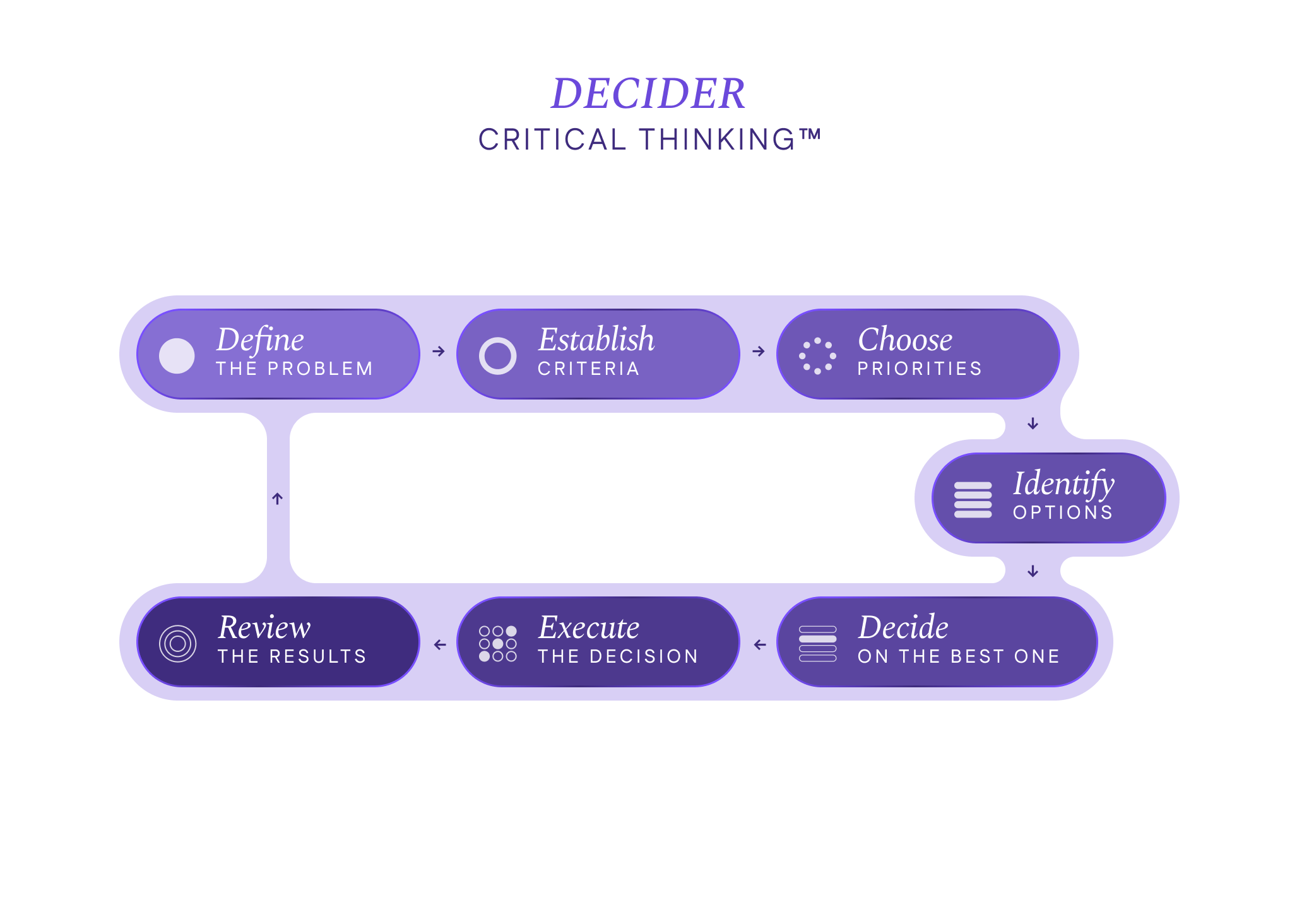
Every move above is a fragment of one sequence, and the fragments work better installed together. The full 7-step walk-through is in the decision-making process; the underlying capabilities are in decision-making skills. LeaderFactor’s DECIDER™ model packages the sequence into an operating discipline — the Critical Thinking skill teaches it on a decision you’re actually facing, with the DECIDERindex™ profiling which of these moves you already do and which you only believe you do.
Start tonight with the cheapest one: take the decision you’ve been circling longest, and classify its door. If it’s two-way, you already know what to do tomorrow morning.
Frequently asked questions
- How do you make better decisions?
- Work the sequence, not the anxiety: define the actual problem in one sentence, name your criteria before falling for an option, generate at least one real alternative, check whether the door is one-way or two-way, then commit and review. Better decisions come from a better process, not from more deliberation time.
- How do I stop overthinking decisions?
- Classify the decision first. If it's a two-way door — cheap to reverse — decide fast and treat the decision as data. Overthinking usually means running one-way-door analysis on a two-way-door choice. Reserve deep analysis for decisions that are irreversible or carry an unacceptable downside, and give even those a decision deadline.
- Should I trust my gut when making decisions?
- Trust it as a hypothesis, not a verdict. Intuition is fast pattern-matching, and it's most reliable where you have deep, repeated experience with feedback. In novel or high-stakes territory it inherits your biases. The practical move: notice the gut answer, then ask what evidence would change it before acting on it.
- How do you make decisions faster without losing quality?
- Speed and quality aren't opposites; they're the two dials of the same skill. A good decision made too late is a bad decision. Velocity comes from matching process depth to stakes, deciding two-way doors quickly, setting explicit criteria once instead of debating ad hoc, and documenting calls so they stay made.