





Decision-making models compared: which one fits when
The major decision making models side by side — rational, bounded rationality, intuitive, recognition-primed, Vroom-Yetton, creative — and when each earns its keep.
Decision-making models are theories of how deciding works — and, less obviously, arguments about how it should work. The rational model says optimize. Herbert Simon’s bounded rationality says you can’t, so satisfice well. Gary Klein’s recognition-primed model says experts don’t compare options at all. They’re each right about something, which is why the practical question isn’t “which model is true?” but “which model fits this decision, this decider, and this much time?” Here’s the honest comparison, and then what to do with it.
The six models, side by side
| Model | How it decides | Strongest when | Its limit |
|---|---|---|---|
| Rational | Define, list alternatives, score against criteria, optimize | High stakes, time available, information gettable | Assumes information and attention you may not have |
| Bounded rationality | Satisfice: structured “good enough” under real constraints | Almost everywhere; it’s the rational model with honest inputs | ”Good enough” needs defining, or it excuses laziness |
| Intuitive | Experience-based pattern matching, fast and holistic | Deep, repeated experience with fast feedback | Inherits your biases confidently in novel territory |
| Recognition-primed (Klein) | Recognize situation type, mentally simulate one workable option | Genuine experts under time pressure (fireground, ER) | Only as good as the pattern library; misfires outside it |
| Vroom-Yetton | Chooses the involvement level, not the option | Deciding how much to involve the team | Says who and how much, nothing about the analysis itself |
| Creative | Incubate, diverge, generate novel options before evaluating | Novel problems where existing options all lose | Needs a converging discipline bolted on, or it never lands |
The table repays a second look, because the models sort into three families. Two describe analysis (rational and its realistic correction, bounded rationality). Two describe expertise (intuitive and recognition-primed, which is intuition studied rigorously). Two are really about process design (Vroom-Yetton allocates involvement; creative structures divergence). They’re not competing answers to one question. They’re answers to three different questions, and most bad model advice comes from mixing the families up.
The misconception: pick a model, get better decisions
Here’s how this topic usually goes wrong in practice: a leadership team reads the catalog, self-identifies (“we’re intuitive deciders here — we move fast”), and treats the label as a method. But a model describes how deciding happens; it doesn’t run the decision. Rational analysis without a sequence becomes an eternal spreadsheet. Intuition without boundary conditions becomes bias with seniority. Vroom-Yetton without an underlying process just tells you how many people to invite to the confusion.
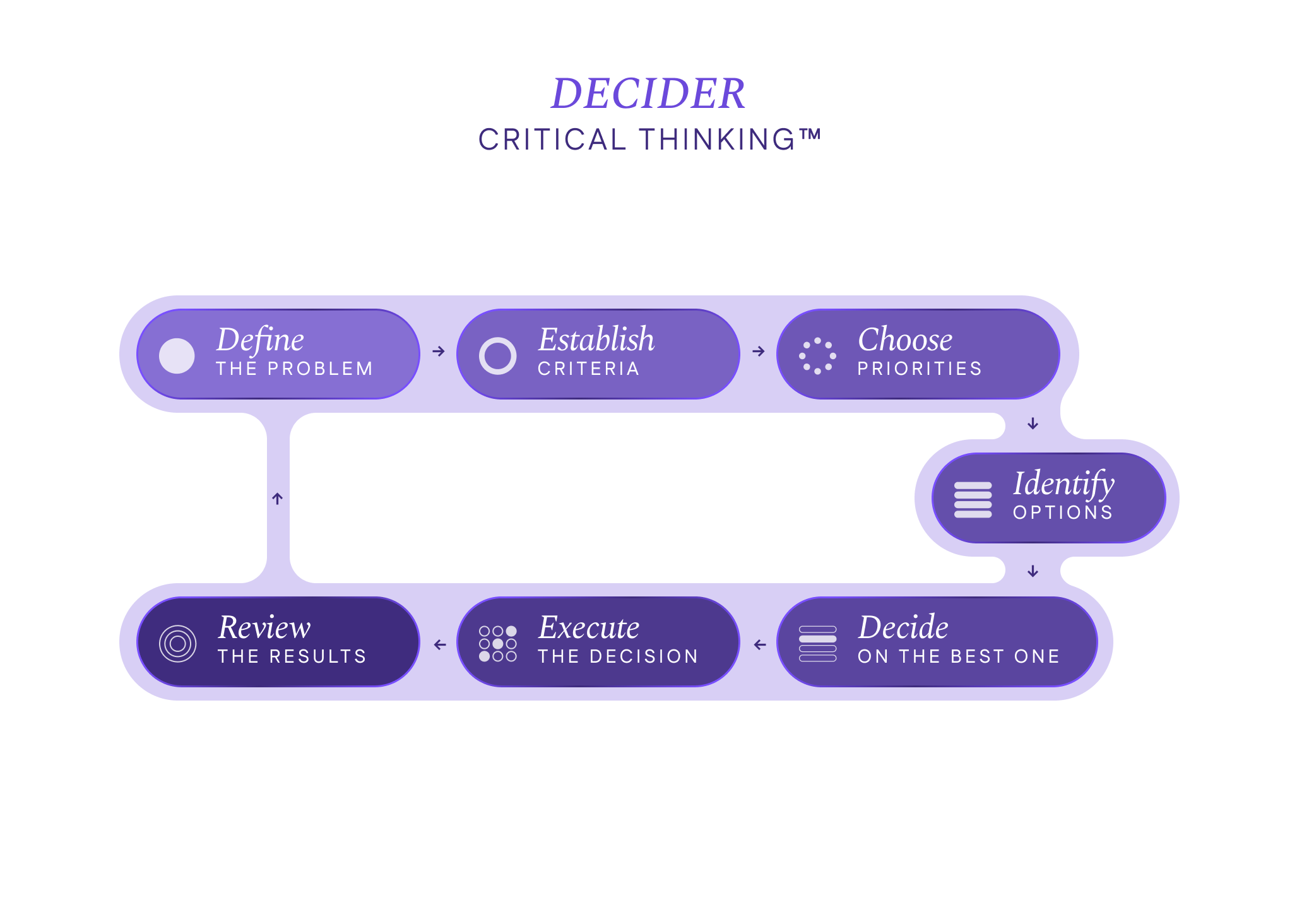
The replacement: models inform, a process operates. What a team installs is a sequence — and the sequence can then deploy each model where it’s strong. That’s the design logic of LeaderFactor’s DECIDER Critical Thinking™: a rational-model backbone with bounded rationality built into its honesty (satisficing on purpose, against named criteria), room for intuition as a hypothesis at the option-generation step, and the involvement question handled as decision rights. Grounded in the decision science of Kahneman, Tversky, and Simon, it’s the models, operationalized.
Fitting the model to the moment
A working heuristic for the families:
- Use analysis (rational/bounded) when stakes are high, the situation is unfamiliar, and time exists. The discipline that matters most: real criteria before real options, and an explicit definition of good enough. The decision-making process is this family as a walkable sequence.
- Trust expertise (intuitive/RPD) when your pattern library genuinely covers the situation — years of exposure, fast feedback, consequences you’ve watched land. And even then, on one-way doors, run the cheap check: what evidence would change my mind?
- Design the process (Vroom-Yetton’s question) before either: who decides, and who’s involved at what level, because the answer changes what analysis and expertise can even contribute. The five involvement models are covered in team decision making.
It’s a Thursday in July at a specialty insurer in Hartford, and the head of underwriting is watching two model failures collide. Her senior underwriter prices a novel cyber product by feel — twenty years of intuition, none of it about this risk class. Her actuarial team counters with a rational model whose inputs are guesses dressed as parameters. Neither is wrong about their method; both are wrong about its jurisdiction. The resolution runs through the sequence: criteria first (loss tolerance, capital, time-to-market), the intuitive price admitted as one option among three, the model’s guesses labeled as such, and a review date set before the decision ships. Models argued. Process adjudicated.
What to take from the catalog
Learn the models for what each teaches: bounded rationality’s honesty about constraints, Klein’s respect for real expertise, Vroom-Yetton’s insight that involvement is itself a decision, the creative model’s insistence that options are made, not found. Then stop collecting and install the sequence that puts them to work — decision-making framework covers that choice, and cognitive bias in decision making covers the distortions every model must survive. The theory is settled enough. The next decision on your desk is where it earns something.
Frequently asked questions
- What are the main decision-making models?
- Six recur across the literature: the rational model (structured, criteria-driven analysis), bounded rationality (satisficing under real constraints), the intuitive model (experience-based pattern matching), recognition-primed decision making (Gary Klein's expert model), Vroom-Yetton (choosing how much to involve the team), and the creative model for novel problems.
- What is the difference between the rational model and bounded rationality?
- The rational model assumes you can define the problem, list all alternatives, and optimize. Bounded rationality, Herbert Simon's correction, observes that real deciders face limited information, time, and attention, so they satisfice — choose an option that's good enough under the circumstances. Practical models build on the second assumption.
- What is the Vroom-Yetton decision model?
- Vroom-Yetton is a model for choosing a decision style rather than a decision: it walks a leader through questions about decision quality requirements, information location, and commitment needs, then recommends how much to involve the team — from deciding alone to facilitating group consensus. Its insight is that involvement level is itself a decision.
- When should you use intuitive decision making?
- When your experience genuinely covers the situation: deep, repeated exposure with fast feedback, the conditions Gary Klein found among firefighters and nurses. There, pattern recognition is fast and reliable. In novel, rare, or high-stakes territory, intuition inherits your biases with full confidence, so treat it as a hypothesis to test.