





Performance coaching: how managers develop people in the flow of work
Performance coaching is how a manager improves results by transferring thinking and ownership — not a specialist you hire or a process you run on underperformers.
Performance coaching is how a manager improves someone’s results by developing the person’s own thinking and ownership, rather than by supplying the answer and checking whether it got done. It happens in short conversations about live work — a decision someone is stuck on, a project that slipped, a customer call that went sideways — and its output is not a solved problem but a person who solves the next one without you.
Search the term and you will mostly find two other things: profiles of performance coaches you can hire, and step-by-step processes for documenting an underperformer. Both are real, and neither is what most managers need. The version that changes an organization is unglamorous and daily: the manager already in the room getting better at the conversation they are already having.
What performance coaching actually is
Performance coaching is a leadership behavior in which a manager uses questions, feedback, and agreed accountability to raise a person’s capability and results over time. It is ongoing rather than episodic, developmental rather than evaluative, and aimed at capable people as much as struggling ones.
That last point is where most organizations quietly go wrong. When coaching is only ever deployed after a problem, being coached becomes a signal that you are in trouble — and the moment coaching reads as a diagnosis, people manage the conversation instead of using it. Coaching that is universal is coaching people will actually be honest in.
LeaderFactor frames coaching as one of the two levers a leader has. The first is modeling — demonstrating the standard yourself, which establishes credibility and sets the tone. The second is coaching — transferring critical thinking and ownership to other people, which is the only one of the two that scales. Modeling shows people what good looks like. Coaching makes them capable of producing it when you are not there.
Performance coaching vs performance management
These get used interchangeably and they are close to opposites in purpose. Performance management is the organization’s system for evaluating and recording work. Performance coaching is the manager’s practice for improving it.
| Performance management | Performance coaching | |
|---|---|---|
| Purpose | Evaluate and document | Develop and improve |
| Owner | HR, through a defined cycle | The manager, continuously |
| Cadence | Annual, biannual, or quarterly | Weekly, or in the moment |
| Orientation | Backward — what happened | Forward — what happens next |
| Primary tool | Ratings, goals, written reviews | Questions, feedback, commitments |
| Output | A record | A more capable person |
The practical relationship is simple: performance management identifies the gap; performance coaching is what closes it. An organization with a sophisticated review cycle and no coaching capability produces very well-documented stagnation — everyone knows precisely where they fall short, and nobody is any better at the thing.
The four steps of a coaching conversation
LeaderFactor’s Coaching Skills Cycle breaks every coaching conversation into four steps that run in sequence. The sequence matters more than the content, because skipping ahead is the most common way a well-intentioned conversation fails.
Most managers, under time pressure, execute step four and call it coaching. The advice is often good. It rarely takes, because the person never did the thinking that would let them apply it to a situation that looks slightly different — and never took on the ownership that would make them want to.
Step one is the step managers assume they have already cleared. They usually have not: a direct report’s willingness to be candid with the person who writes their review is not a given, and it is not established by announcing that your door is always open. It comes from what happens the last time someone brought you bad news. This is the direct link between coaching and psychological safety — a coaching conversation is a request for vulnerability, and people only accept when the environment has earned it.
Knowing when to tell and when to ask
The single most useful idea in coaching is that directing and asking are both correct, at different moments. LeaderFactor calls this the Coaching Continuum, running from Tell to Ask.
- Tell — you supply the direction, the information, the answer. Appropriate when stakes are high, time is short, safety is involved, or the person genuinely lacks the baseline knowledge to reason it out. Telling a new hire how the escalation process works is not a coaching failure. It is Tuesday.
- Ask — you use questions to draw out their thinking and let them arrive at the answer. Appropriate when the goal is building judgment and the person has enough capability to get there. It costs more time now and buys capability later.
The skill is not living at the Ask end. It is choosing on purpose rather than defaulting. Managers who always tell produce a team that waits to be told and a leader who is the bottleneck for every decision. Managers who always ask produce frustration — asking someone to discover an answer they have no way of knowing is not development, it is a guessing game with a power imbalance.
A useful test before you open your mouth: is this a knowledge gap or a thinking gap? Knowledge gaps close faster when you tell. Thinking gaps only close when they do the thinking.
Micro-coaching: where it actually happens
Traditional coaching is a structured session with a beginning and an end — a scheduled conversation, a development topic, thirty minutes. It is valuable and it is rare, because calendars are what they are.
Micro-coaching is a brief, real-time intervention in the flow of work: ninety seconds after a meeting, a question in a hallway, one line in a message thread. “What’s your read on why that stalled?” “What would you do if I weren’t available?” “What’s the one thing you’d change about how we ran that?”
Micro-coaching is where the compounding happens, for two reasons. It is frequent enough to actually shift behavior, and it lands while the situation is still live and the person still cares about it. A manager who runs one formal coaching session a quarter and never micro-coaches is coaching four times a year. A manager who micro-coaches well is coaching constantly and may never book a session at all. If you want a container for the longer version, the one-on-one meeting is it.
The relationship and accountability trap
Coaching fails in a predictable way, and LeaderFactor’s Coaching Box explains why. Plot two dimensions — the strength of your relationship with someone, and the rigor of the accountability you hold them to — and four leader types appear:
| Low accountability | High accountability | |
|---|---|---|
| High relationship | The Buddy — liked, not respected. Warmth substitutes for standards, and performance drifts. | The Coaching Box — trust makes accountability survivable, and accountability makes the relationship serious. |
| Low relationship | The Absentee Landlord — uninvolved. People are left to sink or swim and read it as indifference. | The Micromanager — feared, not trusted. Standards without safety produce compliance and concealment. |
Most managers have a natural corner, and the corner is usually chosen by temperament rather than judgment. The point of the model is not that one quadrant is nicer. It is that relationship without accountability is not kindness, and accountability without relationship is not rigor. Each one alone degrades into its failure mode. The coaching box is the only quadrant where feedback is both honest and hearable — which is why it is the only quadrant where people actually improve.
What gets in the way
Coaching is not difficult to understand and it is genuinely difficult to do, because the pressures that make you a good operator make you a bad coach. Four patterns account for most of it:
- The answer is faster. You know the solution, you have twelve minutes, and telling them takes ninety seconds. It is correct every single time in isolation and it compounds into a team that cannot function without you.
- Coaching only the strugglers. If coaching is what happens to people in trouble, being coached becomes a status marker and everyone starts performing competence at you.
- Derailers you cannot see. Interrupting, finishing sentences, visibly checking the time, over-explaining, answering your own question. These are not character flaws — they are habits, and their effect is to tell the other person that this is theater. Nearly every manager has one or two and almost nobody can name their own without feedback.
- No follow-through. A commitment nobody ever asks about again teaches people that commitments are conversational. This is the accountability half of the job, and it is what separates coaching from an encouraging chat.
How to start this week
You do not need a program to begin. You need one substitution, made consistently.
- Pick one recurring conversation where you habitually supply the answer — a status check, a deal review, a stuck project.
- Replace your first sentence with a question. Not a leading one. “What’s your thinking?” or “What are you noticing?” Then wait through the silence, which will feel much longer than it is.
- End with a commitment in their words, not yours. “So what will you do, and by when?” If you say it for them, you have taken the ownership back.
- Ask about it next time. The follow-through is the whole thing. One remembered commitment teaches more than four coaching sessions.
Do that for a month and you will have changed a habit, which is more than most coaching training accomplishes. The frameworks are useful, but the behavior is what moves.
Where to go next
- Coaching skills for managers — the specific skills, including how to ask questions that work
- How to give effective feedback — the B.I.G. structure for feedback that lands
- Effective one-on-one meetings — the standing container for coaching
- Accountability in the workplace — the other half of the equation
- How to hold employees accountable — running the conversation when commitments slip
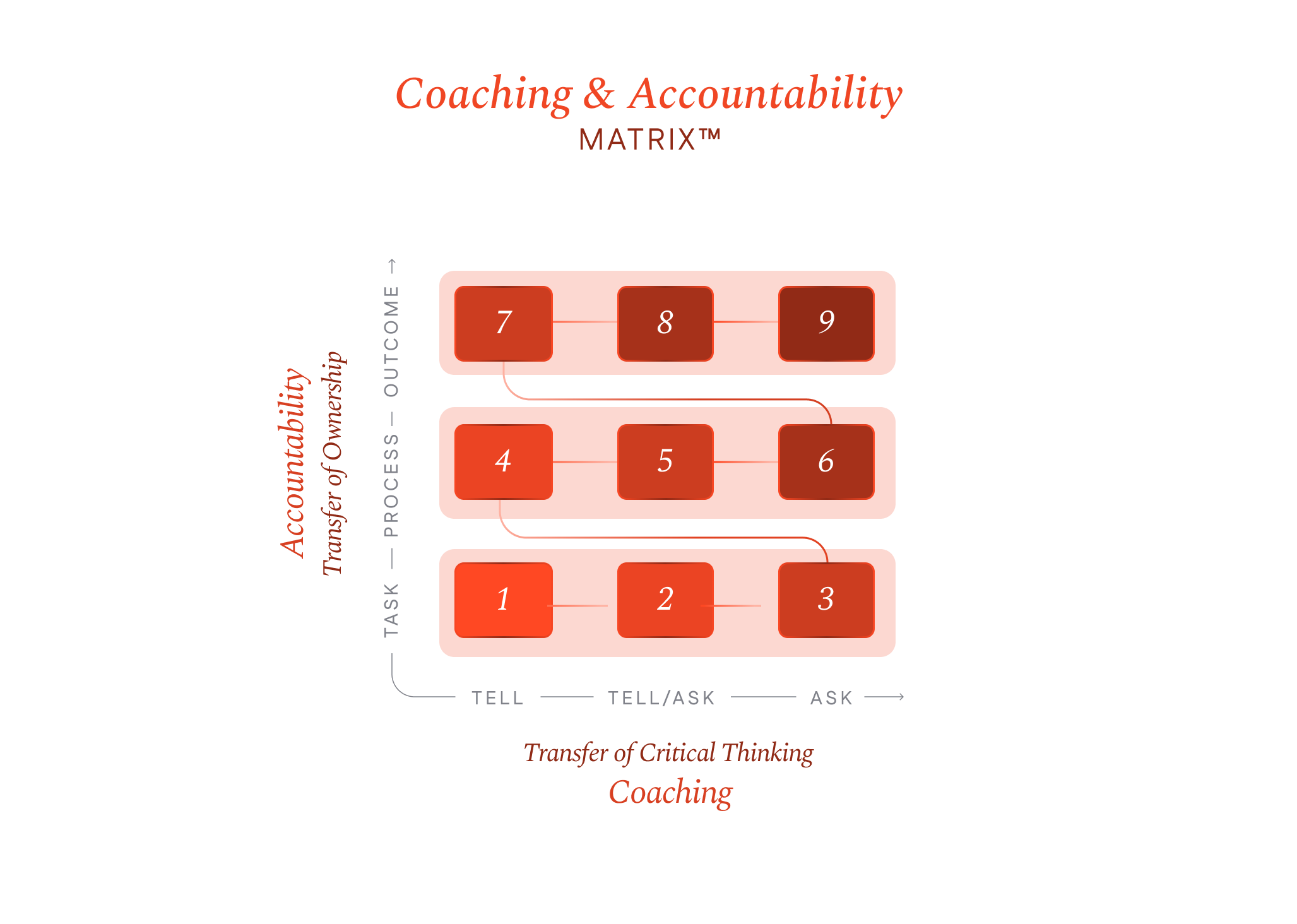
- Coaching & Accountability Matrix™ — LeaderFactor’s course for managers, built on the Coaching & Accountability Matrix™ and the COACHindex™ assessment
The Coaching & Accountability Matrix™ and the frameworks on this page were developed by Dr. Timothy R. Clark.
Frequently asked questions
- What is performance coaching?
- Performance coaching is the practice of improving someone's results by developing their thinking and ownership rather than supplying answers. The manager asks questions that build judgment, agrees on what the person is accountable for, and follows through. It is an ongoing leadership behavior, not a remedial process reserved for people who are struggling.
- What is the difference between performance coaching and performance management?
- Performance management is the system that evaluates work — goals, reviews, ratings, and documentation, usually owned by HR on an annual or quarterly cycle. Performance coaching is the conversation that improves work, happening weekly or daily and owned by the manager. Management measures the gap. Coaching closes it.
- What does a performance coaching conversation look like?
- Four moves, in order: make it safe enough for the person to be honest, ask questions that transfer the thinking to them, get a specific commitment so they own the outcome, then supply guidance and follow-through. Most managers skip straight to guidance, which is why their advice is heard but rarely acted on.
- When should a manager coach instead of just giving the answer?
- Coach when you are trying to build judgment and the person has enough capability to reason through the problem. Direct when stakes are high, time is short, or the person lacks the baseline knowledge to make a sound call. Both are legitimate. The failure is defaulting to one mode regardless of the situation.
- Do you need to be a certified coach to coach your team?
- No. Professional coaching credentials are designed for external practitioners running formal engagements. A manager coaching a direct report is doing something different and more frequent — brief, in-context conversations about live work. The skill is learnable through practice and structure rather than certification.