







Coaching skills training for managers.
Most managers either tell people what to do or leave them to figure it out. This program teaches the third option, transferring ownership and the thinking that comes with it, on purpose, and measures the change with the COACHindex™ before and after.
 COACHindex™ results in the LeaderFactor platform
The learning platform at leaderfactor.app, sample data.
- Format
- Cohort-based with self-paced modules. A coaching plan written for every direct report.
- Length
- Five weeks, with 12 months of digital workbook access after.
- Instrument
- COACHindex™ self-assessment at baseline and re-measure.
- Built for
- Managers who are the bottleneck: every delegation comes back to their desk.
Coaching skills training for managers teaches people who run teams how to develop the people on them, by transferring ownership and critical thinking rather than answers. Coaching, on LeaderFactor’s definition, is a dialog process that facilitates personal development and performance by transferring ownership and critical thinking. It engages the head, the heart, and the hands, and it is rooted in relationship, not technique.
This page covers what a program should teach, why most of them leave the manager exactly where they started, which format fits which rollout, and how to know before you buy whether anything will transfer.
Why most coaching training leaves the manager as the bottleneck
The typical program teaches active listening and open questions. Managers practice on each other, enjoy it, and return to a calendar with eleven direct reports and forty unanswered Slack threads. By Thursday they are answering questions again, because answering is faster than asking and nothing in the training changed the thing that made answering the default.
The misconception is that coaching is a style, a warmer way of managing that some people have. It is a different job. Managing directs the work; coaching transfers the thinking. A manager who only manages assigns tasks and checks status, and every decision routes back through them. A manager who coaches asks the questions that build judgment, so the next decision doesn’t have to come back. The training has to make that distinction operational: when to direct, when to develop, and for whom.
The second failure is accountability. Most programs treat it as the opposite of coaching, the stick you reach for when the carrot fails. In practice accountability is being answerable for performance, owning results rather than being surveilled, and the more of it a person demonstrates, the more autonomy they earn. A coaching program that doesn’t teach how to set accountability at the right level for each person produces managers who are kind, present, and still doing everyone’s work.
What the training should teach: the models and the matrix
LeaderFactor’s program is built on the Coaching & Accountability Matrix™, a capstone three-by-three with five models underneath it.
The Coaching Skills Cycle gives every conversation four steps: create safety, transfer thinking, transfer ownership, then provide guidance and accountability. The first step is the one most managers skip. A direct report who does not feel safe to learn, contribute, or push back cannot be coached, only instructed, which is why this program and psychological safety training reinforce each other.
The Coaching Box is a two-by-two of relationship and accountability. High relationship with low accountability is the buddy, who gives people a pass. Low on both is the absentee landlord. Low relationship with high accountability is the micromanager, on a leash about six inches long. The coaching box is the corner where both are high, and nobody is born there. The Coaching Continuum runs from tell to ask: direct when stakes are high or capability is low, ask when you are building critical thinking. The single biggest problem with most coaches is that they tell too much.
Task-to-Outcome Accountability pitches accountability at the task, the process, or the outcome, and raises it as the person earns more autonomy. The Coachability Framework reads willingness against self-awareness, and willingness is the more important of the two: consistent willingness always turns into progress. The Matrix puts the continuum and the accountability levels on two axes and places each direct report in a box. The goal is always the next box, and you can’t skip boxes.
Practiced in the one-on-ones you already run
The program does not add meetings. It changes the ones that exist. Traditional coaching is formal, infrequent, and scheduled for thirty to sixty minutes. Micro-coaching is informal, frequent, unscheduled, and often two to five minutes long, and it is where most development actually happens. The practice moves are built for that scale: tell-to-ask, the question funnel, and B.I.G. feedback, which names the observable behavior neutrally, shows its impact, and then guides, ideally by letting the coachee generate the guidance.
Consider an engineering manager at a software company with nine reports, two of them senior. Her COACHindex™ places her squarely in the micromanager corner for the seniors, whom she reviews line by line, and the buddy corner for the two newest hires, whom she protects. Her matrix placement says the seniors are ready for outcome-level accountability and asking; the new hires need task-level accountability and telling. She has had it backwards for a year. Her coaching plan for each report is one line: the box they’re in, and the next one. That is the whole intervention, and it is written down before the course ends.
Which format fits your rollout
- A manager cohort is the default. Managers apply the matrix to their own direct reports in parallel and compare placements, which is where most of them discover they coach everyone the way they themselves like to be coached.
- Self-paced modules carry the models between sessions, with twelve months of digital workbook access so the coaching plans stay live past the course.
- Facilitator certification lets an internal L&D team run the cohort at its own cadence.
How you’ll know it worked
Measure the manager, and watch the work. The COACHindex™ is the manager’s coaching self-assessment: it maps how you currently coach, where you sit on the Coaching Box, which steps of the cycle you skip, and which of the sixteen derailers show up in your conversations. It is a development diagnostic rather than a psychometric instrument; its value is the conversation it starts with yourself. Managers take it before the course, apply the matrix to real reports during it, and retake it after, so movement is measured one box forward.
The second measure needs no instrument. Count the delegations that come back. When they stop boomeranging to the manager’s desk, ownership has transferred, and the training did what it was bought to do.
Where to start
Start with the managers whose teams have stopped thinking. The sign is a queue: questions waiting on one person, decisions waiting on one calendar. Put those managers in the first cohort, let the matrix place their reports, and read the plans they write. A month later, ask each one what came back to their desk this week that used to. That number is the result.
What the program covers
Six models, one matrix, a plan for every report.
The Coaching & Accountability Matrix™ is the capstone. The five models underneath it give a manager the moves, and the course ends with a written coaching plan for each person they lead.
-
The Coaching Skills Cycle
Four steps in every coaching conversation: create safety, transfer thinking, transfer ownership, then provide guidance and accountability.
-
The Coaching Box
A two-by-two of relationship and accountability. The goal is the corner where both are high, not buddy, absentee landlord, or micromanager.
-
The Coaching Continuum
Tell to ask. Direct when stakes are high or capability is low; ask when you're building critical thinking. The single biggest problem with most coaches is that they tell too much.
-
Task-to-outcome accountability
Pitch accountability at task, process, or outcome, and raise it as the person earns more autonomy. Ownership transfers; hovering doesn't.
-
The Coachability Framework
A two-by-two of willingness and self-awareness that tells you who is accelerating, progressing, plateauing, or failing, and how hard to push.
-
The Coaching & Accountability Matrix™
The three-by-three that places each report by coaching approach and accountability level, so you stop over-coaching the capable and under-coaching the new.
-
The practice moves
Tell-to-ask, the question funnel, and B.I.G. feedback (behavior, impact, guidance), practiced in the one-on-ones you already run.
-
A coaching plan per report
Every manager leaves with a written plan for each person they lead: where they sit on the matrix today, and the next box.
Assess, learn, apply, prove. One platform.
The program runs on leaderfactor.app: the baseline, the cohort and self-paced modules, the application tools, and the re-measure, with org-level reporting for the people who bought it.
COACHindex™ baseline 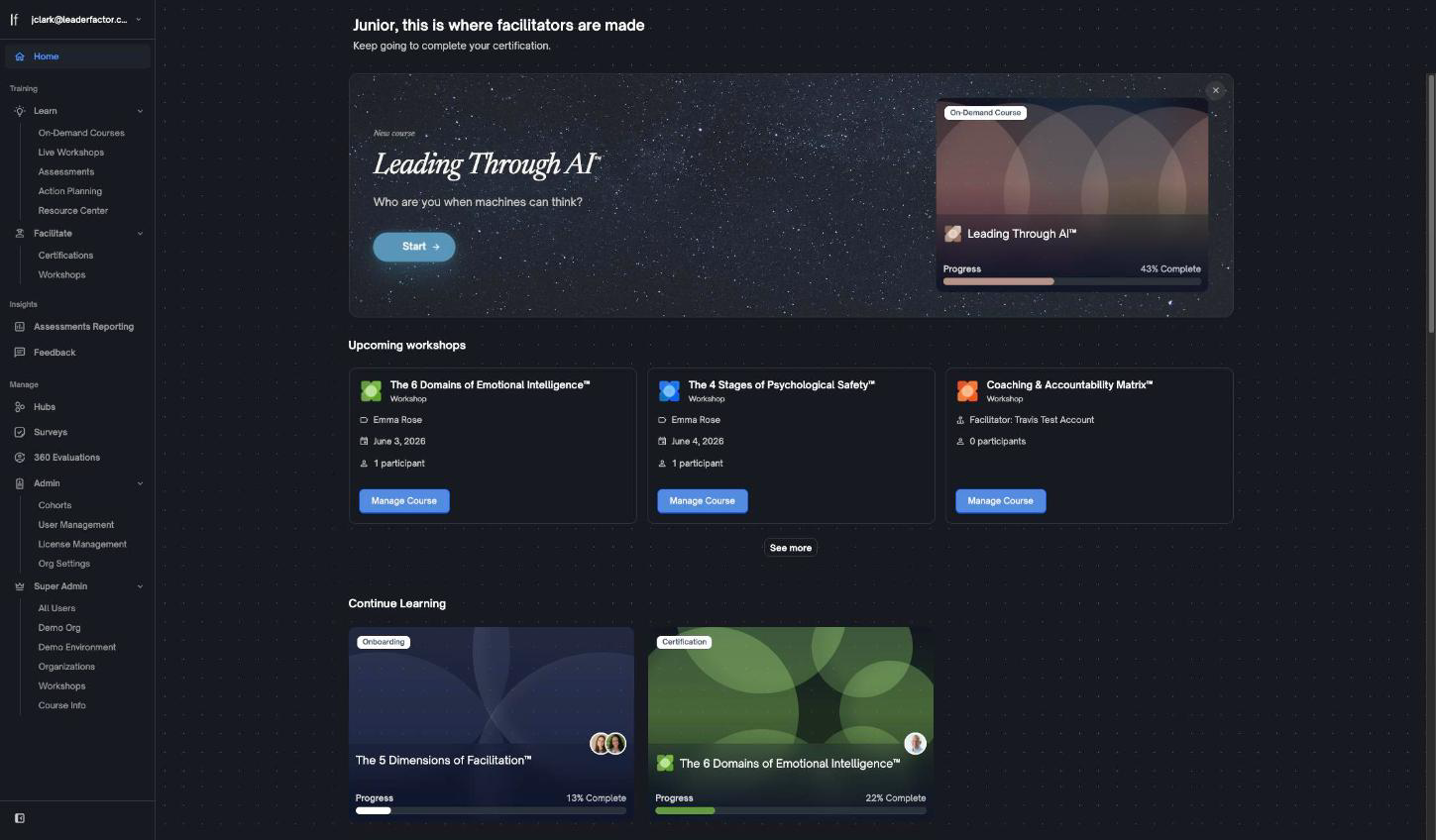 The learner home in the LeaderFactor platform
 COACHindex™ re-measure
Screens from leaderfactor.app with sample data. Not client results.
Not sure this is the skill you need?
If the mechanics are there but relationships keep fraying, the gap is Emotional Intelligence. If work stalls between teams rather than boomeranging back to one manager, it is Team Performance. This program is for managers whose people stop thinking because everything routes through them.
See the Emotional Intelligence programFrequently asked questions
- What is coaching skills training for managers?
- Coaching skills training for managers teaches how to develop people by transferring ownership and critical thinking instead of answering every question yourself. A good program gives managers a structure for the coaching conversation, a way to set accountability at the right level for each person, and a measurement before and after so the change is visible.
- What is the difference between managing and coaching?
- Managing directs the work; coaching transfers the thinking. A manager who only manages assigns tasks and checks status, and stays the bottleneck. A manager who coaches asks the questions that build judgment, so the next decision doesn't have to come back to them. The skill is knowing which one a given person and situation needs.
- What should a manager coaching program include?
- A structure for the conversation, such as the four-step Coaching Skills Cycle. A way to diagnose each direct report, such as the Coaching & Accountability Matrix™. Practice moves like tell-to-ask and behavior-impact-guidance feedback. A coaching plan per report. And a self-assessment before and after, so managers see whether their own habits moved.
- How long does coaching skills training take?
- LeaderFactor's program runs five weeks, cohort-based with self-paced modules, and the habits form in the one-on-ones that follow. Managers take the COACHindex™ before the course, apply the matrix to their real direct reports during it, retake the instrument, and keep digital workbook access for twelve months.
- How do you measure whether coaching training worked?
- Two ways. The COACHindex™ maps how a manager currently coaches, where they sit on the Coaching Box, which steps they skip, and which derailers show up, at baseline and again after the course, so movement is measured one box forward. And the work itself: when delegations stop boomeranging back to the manager's desk, ownership has transferred.
Turn managers into coaches people follow.
See the program run in a free one-hour Skill Preview, assessment included. Or talk with us about a cohort for your leaders.
or start with the free guide, The coaching blueprint →