





Building a culture of accountability without the fear
Building a culture of accountability means transferring ownership, not tightening consequences. Why fear produces deflection and what actually changes behavior.
Building a culture of accountability usually gets translated into a tougher operating system: clearer consequences, tighter tracking, more follow-up. Then the culture produces the opposite of what it promised — fewer surfaced problems, more polished explanations. Accountability, properly defined, is being answerable for performance. It’s about owning results, not about control or surveillance. A culture of accountability is one where that ownership is genuinely transferred and genuinely accepted, and you can’t install it with pressure.
This page covers what the culture actually consists of, why the consequence-first version backfires so reliably, and the ladder that builds the real thing.
Start with the distinction most rollouts skip
Responsibility is the obligation to do the work. Accountability is being answerable for the result. The difference sounds academic until you watch a project fail with every task complete: everyone was responsible for something, nobody was accountable for the outcome, and the gap between those two sentences is where the quarter went.
Tools like RACI charts and SMART goals handle the responsibility half, and they’re worth having. But a chart can only assign. Accountability has to be accepted, person by person, and acceptance is a function of how ownership is offered — which is why this is a coaching problem before it’s a process problem. Patrick Lencioni put avoidance of accountability among his five team dysfunctions for a reason: it sits directly on top of trust, and it collapses when trust does.
Why the consequence-first version backfires
The misconception sounds responsible: “people need to know there are consequences; that’s what accountability means.” Raise the fear, the logic goes, and ownership follows.
What fear actually raises is deflection. Under pressure, people reach for one of three patterns: denial (“that’s not true”), blame (“it wasn’t my fault”), or excuse (“I had a reason”). All three are rational responses to an environment where owning a miss is dangerous. If you deflect, you’re stuck. If you hold yourself accountable, you move forward — but nobody holds themselves accountable in a culture that punishes the act of doing so. This is where accountability meets psychological safety: contributor safety is earned autonomy in exchange for results, and it only functions where admitting a miss costs standing for a moment rather than permanently.
The replacement idea: accountability is transferred ownership, and transfer follows a principle — the more accountability someone demonstrates, the more autonomy they earn. The culture is built by running that exchange consistently, not by raising the price of failure.
The ladder: task, process, outcome
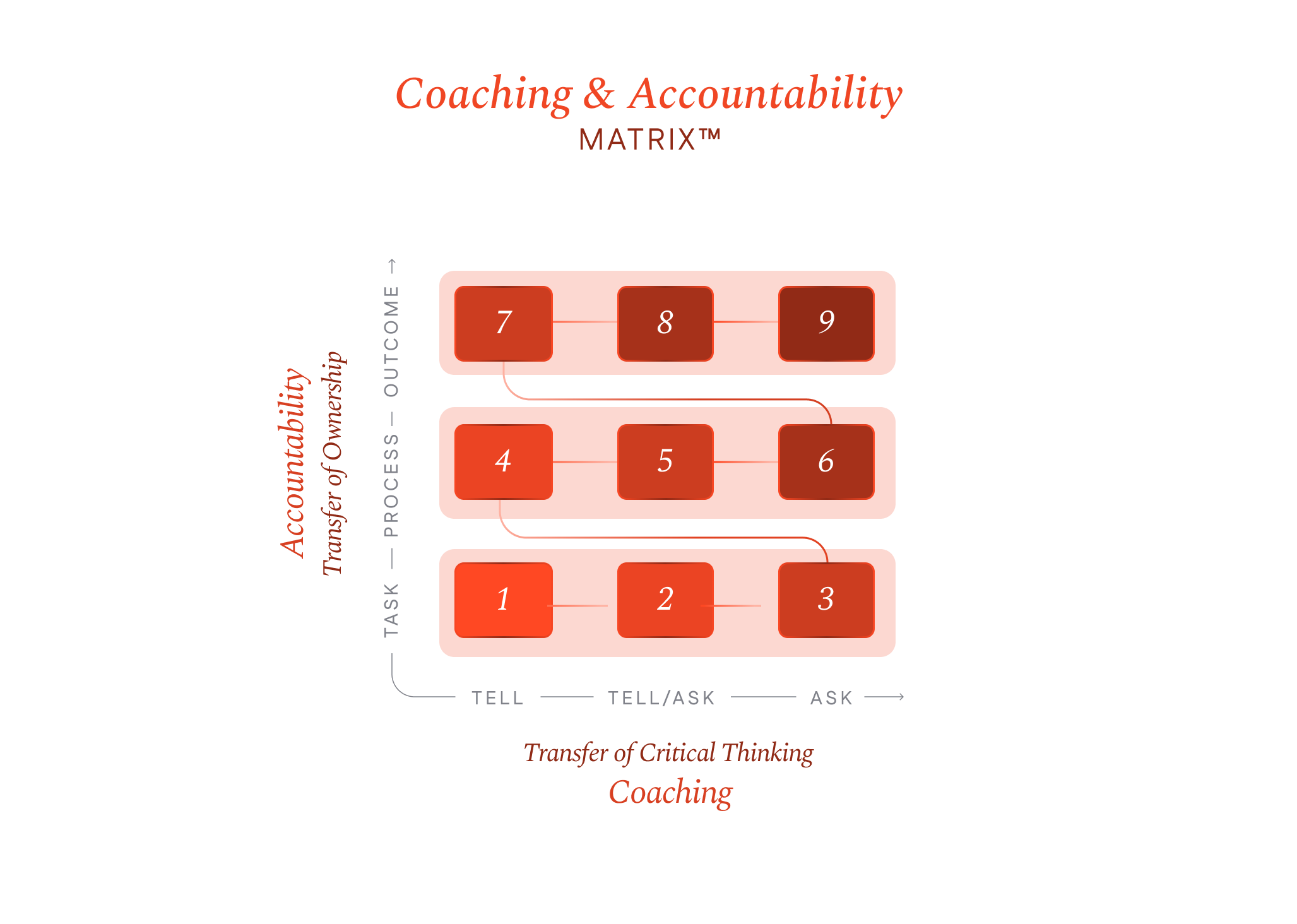
Ownership transfers in levels, and the levels give you the culture’s operating mechanics. Task accountability: owning a defined piece of work. Process accountability: owning how the work gets done. Outcome accountability: owning the result itself. A culture of accountability is simply a place where most people are moving up that ladder on purpose.
Three practices run it:
- Agree on the level explicitly. Most accountability failures are level mismatches nobody named: a manager expecting outcome ownership from someone who was only ever offered a task, or holding a proven operator at task level until they stop caring.
- Coach at the level, not above or below it. Someone new to process ownership needs more telling; someone holding an outcome needs questions that build judgment, not instructions. The full mechanics are in the Coaching & Accountability Matrix™.
- Raise the level when it’s earned, visibly. Promotion up the ladder is the culture’s reward system. When people see autonomy actually follow demonstrated ownership, the exchange becomes believable and the whole team starts opting in.
What leaders model is what the culture learns
On a Wednesday night shift at a food-packaging plant outside Columbus, a line supervisor watches a batch go out two hours late and says nothing upward, because the last supervisor who flagged a delay spent a month explaining it. Six weeks later the plant manager starts running the numbers differently: he opens the weekly review by walking through his own worst call of the week before anyone else reports. Within a quarter, delays are surfacing the same day they happen. Nothing else changed. The team wasn’t taught accountability; it was shown that owning a miss is survivable at the top, which is the only place that lesson can start.
That’s the modeling layer, and it can’t be delegated. Own your misses first, specifically. Keep the commitments you make to the team with the same seriousness you expect back. And when someone does own a failure plainly, make the next thirty seconds safe; the room is watching what honesty costs.
Where to start
Pick one team and run the ladder honestly: for each person, name the level they hold, the level they’re coached at, and the mismatch if there is one. Fix the worst mismatch first. Then instrument the leader side — the COACHindex™ self-assessment in the Coaching & Accountability skill shows a manager where their own coaching defaults are creating the deflection they’re frustrated by.
For the broader discipline this culture work sits inside, read coaching and accountability; for the individual-level mechanics, how to hold employees accountable and accountability in the workplace. Then go own something small and public. The culture starts with whoever goes first.
Frequently asked questions
- What is a culture of accountability?
- A culture of accountability is one where people own results without being made to. Accountability means being answerable for performance: owning outcomes rather than being controlled or surveilled. In an accountable culture, people surface problems early, own mistakes without deflecting, and treat commitments as real, because ownership was transferred to them, not imposed on them.
- How do leaders transfer ownership to their teams?
- By agreeing explicitly on what each person owns — a task, a process, or an outcome — coaching to build the capability that level requires, and raising the level visibly as it's earned. Ownership transfers when autonomy reliably follows demonstrated accountability; it stalls when levels stay vague or the promotion up the ladder never arrives.
- Why doesn't punishing mistakes create accountability?
- Because fear triggers deflection, not ownership. Under threat, people reach for denial, blame, or excuses — rational moves in a culture where owning a miss is dangerous. Punishment teaches concealment and polished explanations. Accountability grows where admitting a miss is survivable, which is why leader modeling does more than consequences ever have.
- How do leaders model accountability?
- By owning their own misses first, specifically and without excuse, before asking anyone else to. Teams learn the real rules from what leaders do after a failure, not from the values slide. A leader who says 'I misjudged that timeline, here's what I'm changing' licenses everyone below them to stop hiding problems.