





Coaching and accountability: one discipline, not two
Coaching and accountability aren't opposing management styles. How the two combine into one discipline that transfers ownership without lowering standards.
Coaching and accountability are usually taught as separate skills, and managed as a trade-off: lean into coaching and you’re the supportive manager, lean into accountability and you’re the demanding one. Pick your brand. In practice they’re one discipline. Coaching is a dialog process that transfers ownership and critical thinking to your people. Accountability is being answerable for performance — owning results. One transfers the thinking; the other defines what the thinking is for. Run them separately and both degrade.
This page is the overview of that discipline: what each half actually means, the matrix that combines them, and what the combination sounds like in a real conversation.
The trade-off assumption
The misconception usually arrives as a scheduling problem: “I don’t have time to coach; I have results to deliver.” Underneath it is the belief that coaching and accountability pull in opposite directions, that every hour spent developing someone is an hour not spent holding the line.
Look at where managers actually land when they believe that, and the trade-off falls apart. LeaderFactor’s Coaching Box maps managers on two axes, relationship and accountability. High relationship with low accountability produces the Buddy, who gives everyone a pass. Low relationship with low accountability produces the Absentee Landlord. Low relationship with high accountability produces the Micromanager, with a leash about six inches long. Every one of those positions is a manager who picked a side. The corner that works, high on both, is the coaching box, and nobody is born in it.
The replacement idea: coaching and accountability aren’t competing for the same hour. Accountability without coaching is inspection, and it caps your people at whatever judgment they walked in with. Coaching without accountability is a pleasant conversation with no destination. Managing directs the work; coaching transfers the thinking, so the next decision doesn’t have to come back to you.
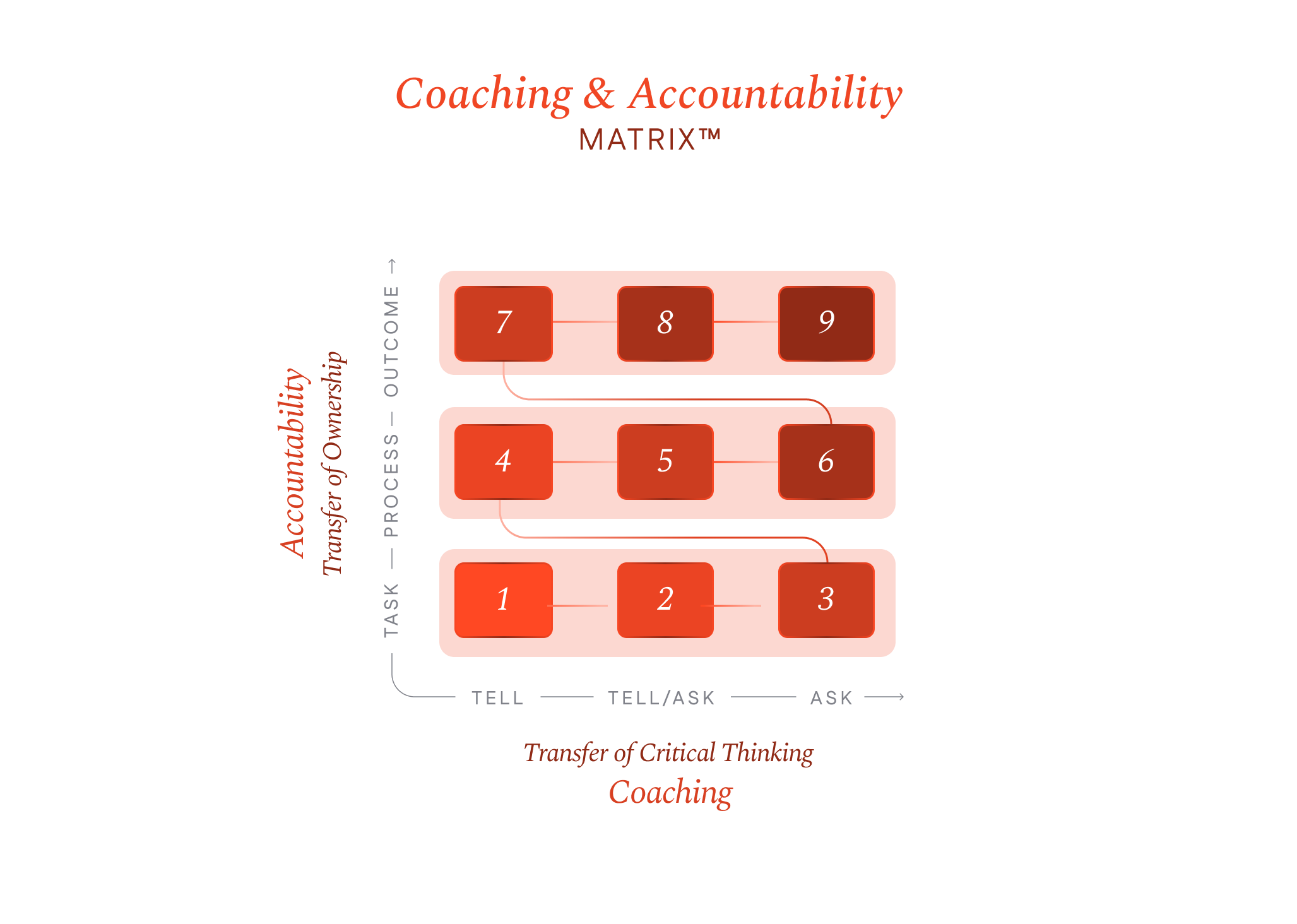
The Matrix: match the coaching to the accountability
The two axes answer the two questions every delegation raises.
What does this person own? Task accountability means owning a defined piece of work. Process accountability means owning how the work gets done. Outcome accountability means owning the result, however they get there. The principle that moves people up the ladder: the more accountability you demonstrate, the more autonomy you earn. Holding a proven operator to task-level check-ins is how good people leave. Handing outcome-level ownership to someone who hasn’t held process yet is how projects quietly fail.
How should I coach them at that level? The coaching continuum runs from tell to ask. Telling is right when stakes are high or capability is low. Asking is right when you’re building critical thinking, and the single biggest problem with most coaches is that they tell too much. Reaching “ask” at a given accountability level is mastery of that level, which is why the Matrix reads as three journeys, not nine random boxes.
What it sounds like in practice
The discipline lives in ordinary conversations, most of them short. Micro-coaching, the informal two-to-five-minute exchange, does more cumulative work than the scheduled monthly hour.
Two tools carry most of the weight. The first is the question funnel: open questions at the top (what, why, how), narrowing questions in the middle (who, when, which), yes/no at the bottom. Stay at the top of the funnel; that’s where critical thinking transfers. When someone brings you a problem they could solve, “what have you considered?” transfers ownership. “Do it this way” takes it back.
The second is B.I.G. feedback: name the behavior, state its impact, offer guidance. It keeps accountability conversations concrete and forward-facing, and it works identically for praise and correction.
It’s a Thursday afternoon at a mid-sized marketing agency, and an account director is looking at her calendar: nine check-ins this week, every one a delegation that boomeranged back to her desk. Her COACHindex™ results say why. She’s a chronic teller, coaching everyone at task level regardless of what they’ve earned, so her most capable strategist gets the same six-inch leash as last month’s hire. Nothing about her effort is wrong. The ownership just never leaves her office, because her coaching never asks anyone to hold it.
Where the discipline starts
Start with placement, not technique. Take your direct reports and place each one honestly on the Matrix: what level of accountability do they hold today, and how do you actually coach them? Most managers find at least one person they’re over-coaching (a capable operator stuck at task level) and one they’re under-coaching (someone handed an outcome they’ve never been developed to own).
Then pick the one placement that’s costing you the most and plan the move to the next box. The COACHindex™, the manager’s coaching self-assessment in the Coaching & Accountability skill, maps where you sit on the Coaching Box and which coaching moves you skip; it’s a development diagnostic, and its value is the conversation it starts with yourself. For the culture-level version of this work, read building a culture of accountability; for the conversation mechanics, coaching skills for managers and how to hold employees accountable.
The discipline in one sentence: agree on what each person owns, coach to build the capability that level requires, and step back as they earn the next one. Ownership transfers. Hovering doesn’t.
Frequently asked questions
- What is coaching and accountability in leadership?
- Coaching is a dialog process that transfers ownership and critical thinking to the person being coached. Accountability is being answerable for performance: owning results, not being surveilled. Together they form one discipline, where a manager matches the coaching approach (tell to ask) to the accountability level (task, process, or outcome) a person has earned.
- Can you coach someone and hold them accountable at the same time?
- Yes, and the best managers do both in the same conversation. Coaching without accountability drifts into friendly chats that change nothing. Accountability without coaching becomes inspection. The combination works because accountability defines what the person owns, and coaching builds the judgment they need to own it.
- What is the Coaching & Accountability Matrix?
- The Coaching & Accountability Matrix™ is LeaderFactor's 3×3 framework that places each direct report by two dimensions: the accountability level they hold (task, process, or outcome) and the coaching approach they need (tell, tell/ask, or ask). It shows managers who they're over-coaching, who they're under-coaching, and what the next box is.
- What is micro-coaching?
- Micro-coaching is the informal, frequent, unscheduled coaching that happens in two-to-five-minute exchanges, in contrast to the traditional scheduled 30-to-60-minute session. It carries most of the real development in a manager's week: one good question, asked at the moment a decision would otherwise boomerang back to the manager's desk.