





How to hold employees accountable (without becoming a micromanager)
How to run the accountability conversation — the setup, the can't-vs-won't diagnostic, the three deflection patterns, and what to do when the same commitment slips again.
Holding employees accountable means following up on specific commitments consistently enough that the commitments become real — naming gaps without attacking the person, and matching your response to whether the cause is capability or willingness. Most of the difficulty managers report with accountability is not in the confrontation. It is in the setup, which happened weeks earlier and was too vague to enforce.
The dominant advice on this topic is “set clear expectations and follow up.” That is correct and insufficient. Here is what to actually do, including the parts that go wrong.
Before the conversation: check your own setup
If any of these three is missing, the problem is upstream of the person and the accountability conversation will not land.
- One named owner. Not the team, not “we.” If the commitment was made to a room, it belonged to nobody.
- A defined standard. Would you and they describe “done” the same way? Most misses are calibration failures wearing the costume of effort failures.
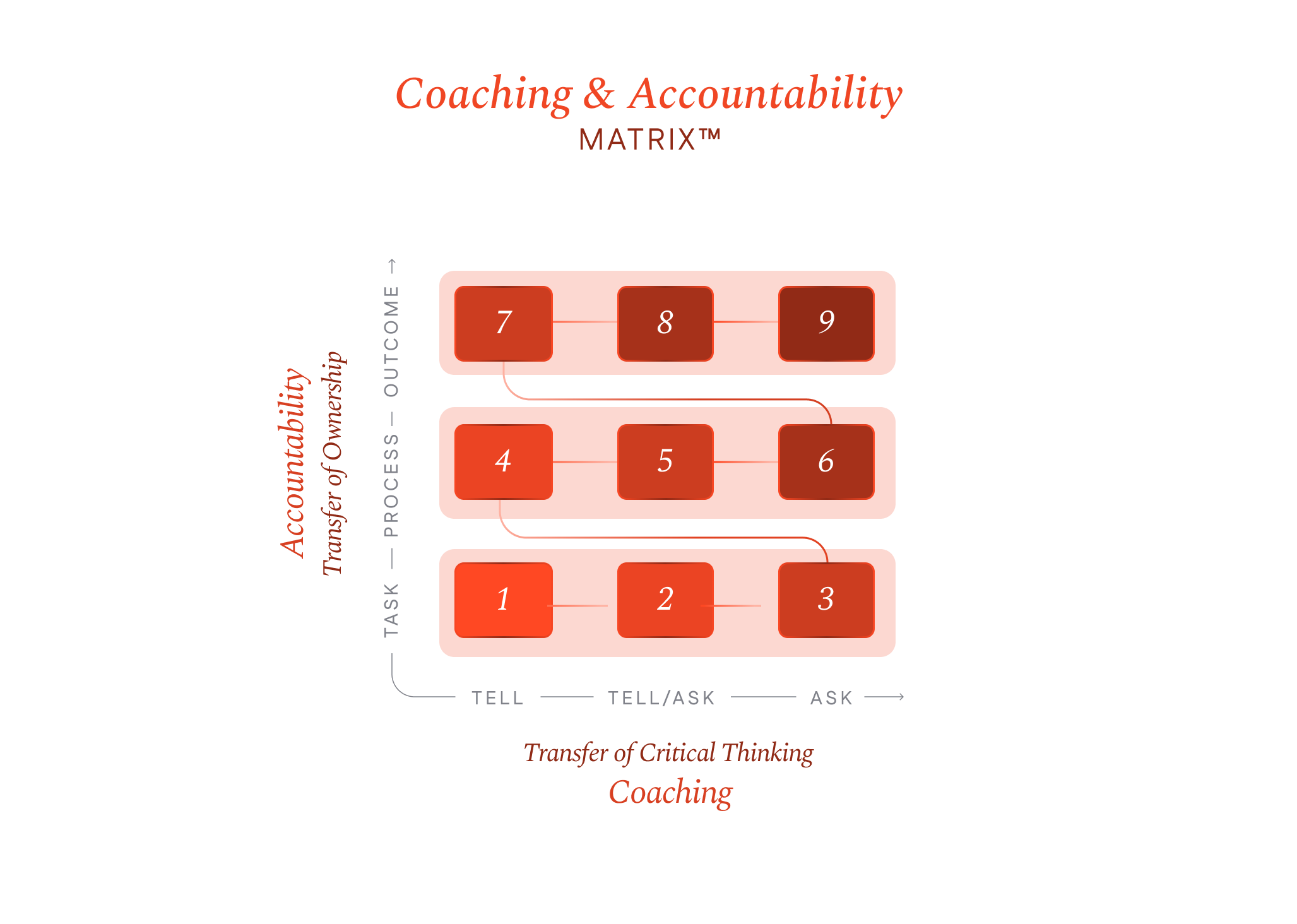
- The right level. Are you holding them to a task (did you do the thing), a process (did you follow the approach), or an outcome (did you get the result)? Holding a capable person to task level is micromanaging; holding a new person to outcome level is abandonment. See accountability in the workplace for the full model.
The conversation, step by step
Keep it short and specific. A long accountability conversation is usually a manager talking themselves out of their own discomfort.
- Name the observable gap, not the interpretation. “The client summary went out Thursday; we’d agreed Tuesday.” Not: “You’ve been unreliable lately.” One is a fact and can be discussed; the other is a verdict and will be defended. The B.I.G. structure — behavior, impact, guidance — is the sentence pattern for this.
- State the impact once. “It meant the account team went into the renewal call without numbers.” This is the part that converts a rule into a reason. Say it plainly and do not stack four more examples on it; piling on turns a specific conversation into a character trial.
- Ask before you conclude. “What happened?” Then be quiet. You are testing a hypothesis, not delivering a verdict, and roughly a third of the time the answer changes what you thought the problem was.
- Land a new commitment in their words. “So what will you do differently, and by when?” If you supply it, you have taken ownership back and they will treat it as your plan, not theirs.
- Say when you’ll check. “I’ll look for it Thursday morning.” Unspecified follow-up is the same as no follow-up.
Is it can’t or won’t?
This is the diagnostic that determines everything after, and skipping it is why so many accountability conversations repeat verbatim for months. The same missed deadline has two completely different causes:
- Can’t — a capability gap. They do not have the skill, the information, the access, or the time. More pressure produces stress and no improvement, because pressure does not install a skill. The response is coaching, resourcing, or reducing the scope until it matches what they can currently do.
- Won’t — a willingness gap. They can do it and something else is in the way: they disagree with the priority, they are disengaged, they are overloaded elsewhere, or there has never been a consequence. The response is a direct conversation about the commitment itself, not more training.
Getting this backwards is expensive in both directions. Sending a willing-but-unskilled person to a motivational conversation insults them. Sending an unwilling person to training wastes a training budget and buys you a certificate.
The question that usually separates the two: “If this were the only thing on your plate and you had all the time you needed, could you do it?” A yes points to willingness or capacity. A hesitant no points to capability, and often to something they have been reluctant to admit.
The three ways people deflect
When people feel exposed, they reach for one of three moves. LeaderFactor calls these the Patterns of Deflection, and recognizing them keeps you from arguing with a defense mechanism.
All three are normal responses to feeling threatened, not evidence of bad character. The mistake is treating deflection as insubordination and escalating your tone, which raises the threat and produces more deflection. The move is almost always the same: validate the true part, then return to the part they own. Where deflection is constant rather than occasional, the underlying issue is usually safety — people conceal when honesty has been expensive.
Without micromanaging
The two get conflated because both involve attention. The difference is what you are attending to.
Micromanaging is holding someone to a lower level of accountability than they have earned — inspecting the method when they have proven they can deliver the outcome. Accountability is agreeing on the level, then staying out of everything below it.
So the way to hold someone accountable without micromanaging is not to check in less. It is to check in on the outcome rather than the steps, and to say so out loud: “I don’t need to see the draft. I need it to be right by the 14th, and I’d rather hear early if that’s slipping.” You have raised the standard and released the method in the same sentence. Frequency is not the problem; granularity is.
When it keeps happening
If the same commitment slips a third time, stop having the same conversation. It is no longer about an instance.
- Name the pattern with evidence. “This is the third time — the 3rd, the 17th, and yesterday. I want to understand what’s going on.” Three dates are hard to deflect. One is easy.
- Change one variable. Smaller commitments with a tighter loop, a written standard, or a mid-point check. If nothing about the system changes, expect the fourth miss.
- Be explicit about the stakes. People are entitled to know when a pattern has become serious. Discovering it for the first time in a formal review is a failure of the manager’s nerve, not the employee’s performance; the whole performance management cycle exists so that no review contains a surprise.
- Escalate cleanly if it continues. Loop in HR, document, follow your process. Consistency here is what makes accountability credible for everyone watching — and people are always watching.
Handled this way, most accountability problems resolve in the first or second conversation, and the ones that do not resolve at least resolve honestly. What corrodes a team is not the manager who addresses a missed commitment. It is the one who addresses it with everyone except the person responsible.
Where to go next
- Accountability in the workplace — the levels, and why accountability breaks down
- How to give effective feedback — the B.I.G. structure for naming a behavior
- Performance coaching — the development side, for when the cause is capability
- Coaching skills for managers — question technique and the derailers to avoid
- Effective one-on-one meetings — the cadence that catches slippage early
- Coaching & Accountability Matrix™ — LeaderFactor’s course for managers, with the COACHindex™ assessment
The Patterns of Deflection and Task-to-Outcome Accountability frameworks were developed by Dr. Timothy R. Clark.
Frequently asked questions
- How do you hold an employee accountable?
- Agree on a specific commitment with an owner, a standard, and a date. Then follow up on the date — every time. In the conversation, name the observable gap, ask what happened before concluding why, land a new commitment in their words, and write down when you will check. Follow-through is what makes it real; without it you have only made a request.
- What do you do when an employee keeps missing commitments?
- Stop addressing the instance and name the pattern: three specific dates, said plainly, with the effect it is having. Then diagnose whether it is capability or willingness, because the responses differ completely. Change one variable — smaller commitments, a tighter check-in, or a clearer standard — and be explicit about what happens if the pattern continues.
- What is the difference between accountability and blame?
- Blame asks whose fault it was and attaches to the person; accountability asks what changes next and attaches to the behavior and the outcome. Blame closes a conversation with a culprit. Accountability closes it with a commitment and a date. The practical consequence is that blame teaches people to hide problems, which makes small ones expensive.
- How do you respond when someone blames others or makes excuses?
- Acknowledge what is genuinely outside their control, then redirect to what isn't: 'That's real, and it did affect the timeline. What was in your control here?' Fighting the deflection entrenches it. The move is to validate the circumstance without accepting it as the whole explanation, then get back to the part they own.