





Accountability in the workplace: what it is and how it's actually built
Accountability in the workplace is ownership of outcomes, pitched at the right level for each person — not blame, not surveillance, and not a personality trait.
Accountability in the workplace is a person’s ownership of what they committed to and answerability for what resulted — including raising problems before they become surprises. It is not a character trait some employees have and others lack. It is a condition leaders create through specific agreements and consistent follow-through, and when it is missing, the cause is almost always structural rather than moral.
Most writing on the topic gets to “accountability is not blame” and stops. That is true and it is not actionable. The useful questions are the next ones: accountable for what, exactly, at what level of detail, and what should a manager do the third time the same commitment slips?
What accountability at work actually means
Accountability means a specific person answers for a specific outcome. It has three parts, and dropping any one of them collapses the whole thing:
- An owner. One named person, not a team and not a role.
- A standard. What “done well” means, concrete enough that two people would judge it the same way.
- A reckoning. A moment where the outcome is actually discussed — not as punishment, but because a commitment nobody ever revisits is not a commitment.
The third part is the one that quietly disappears. Managers set clear expectations, delegate cleanly, and then never circle back — and every uninspected commitment teaches the team that deadlines are aspirational. What people learn from is not what you announced. It is what you noticed.
Accountability vs responsibility
These are used as synonyms and the distinction is load-bearing:
| Responsibility | Accountability | |
|---|---|---|
| What it is | The work you’re assigned to do | Answering for whether the outcome happened |
| How many people | Can be shared across many | Works best held by exactly one |
| When it applies | During the work | After the outcome — and before, in the commitment |
| Can it be delegated? | Yes | No — you can delegate the task, not the answerability |
Six people can be responsible for a product launch. If six people are accountable for it, nobody is. The most common version of this failure is the diffuse one: everyone in the meeting nodded, so everyone assumed someone else had it.
Accountability is not blame — and here is the actual difference
The distinction is not tone. A gentle voice does not convert blame into accountability. The differences are structural:
- Blame looks backward; accountability looks forward. Blame’s question is whose fault was this? Accountability’s is what will be different next time, and who owns it?
- Blame attaches to the person; accountability attaches to the behavior and the outcome. “You’re careless” is a verdict on someone’s identity, which they will defend. “The report went out with the wrong figures” is a fact, which they can act on.
- Blame is a terminal event; accountability is a loop. Blame ends the conversation with a designated culprit. Accountability ends it with a commitment and a date.
There is a practical reason this matters beyond fairness. Blame produces concealment. In an environment where mistakes get personal, the rational move is to hide the problem and hope it resolves itself — which converts small, cheap, early problems into large, expensive, late ones. This is the direct link to psychological safety: the accountability you can enforce is capped by the honesty people can afford. Cultures with high standards and no safety do not get high performance. They get high-quality reporting about problems that were already unfixable.
The three levels of accountability
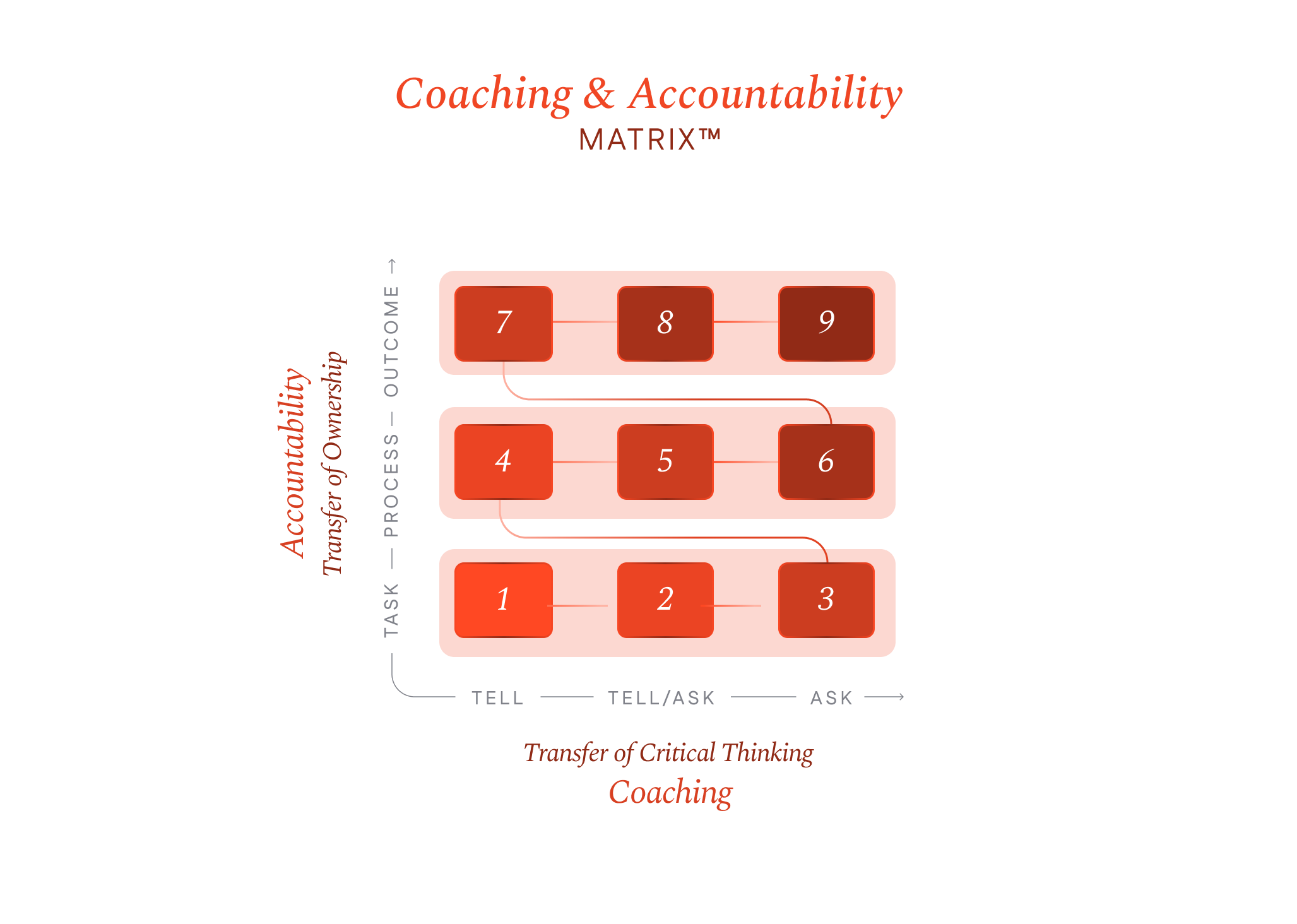
This is the piece most treatments of the topic miss entirely, and it is where the practical leverage is. Accountability is not one setting. LeaderFactor’s Task-to-Outcome Accountability framework pitches it at one of three levels:
Two failure modes follow directly, and both are extremely common:
- Pitching too low for the person. Holding an experienced performer to task-level accountability is the technical definition of micromanaging. It reads as distrust, it wastes their judgment, and capable people leave over it.
- Pitching too high for the person. Giving outcome accountability to someone who lacks the capability to reason toward the outcome is not empowerment, it is abandonment. They fail, and the failure was designed in.
Accountability level should rise as capability does, and the rise should be explicit — a conversation, not a drift. “You’ve earned the how on this one; I only need the result by the 14th” is a promotion in everything but title, and people feel it.
Why accountability breaks down
When it is missing, work through these in order before concluding anyone is disengaged:
- Ownership was plural. The commitment was made to a room. Fix: name one person out loud, in the meeting.
- The standard was implicit. You knew what good looked like; they were guessing. Fix: define done, in a sentence, before work starts.
- Nobody followed up. The first unremarked miss sets the real deadline culture. Fix: put the check-in on the calendar when you make the agreement.
- The level was wrong. They were held to outcomes without the capability, or to tasks despite having it. Fix: match the level to the person, and say which level you are using.
- Honesty is expensive. Raising a risk early gets you assigned more scrutiny; staying quiet does not. Fix: make the first person who flags a slipping deadline visibly better off than the person who hid one.
Note that four of the five are the manager’s to fix. That is not a rhetorical move — it is the finding. Teams do not usually have an accountability problem distributed across their members. They have an accountability system that was never built.
Building a culture of accountability
Culture here is not a values statement; it is the aggregate of what gets noticed. Four things build it:
Leaders go first. The fastest way to establish that commitments are real is to be visibly accountable for your own — including naming your own miss before anyone else has to. A leader who explains away their own slipped deadline has just published the excuse template.
Consistency over severity. A moderate consequence applied every time shapes behavior far more reliably than a severe one applied occasionally. Uneven enforcement doesn’t teach standards; it teaches politics — people learn to read who can get away with what.
Fix the broken windows. The missed deadline nobody mentioned. The process everyone quietly skips. Each unattended signal tells the team the standard is optional, and they are cheap to ignore individually and ruinous in aggregate.
Separate the person from the pattern. One miss is an event; three is a pattern, and the pattern is the thing to name. This keeps individual conversations low-drama while still letting you address something real.
The tell for whether you have it: watch what happens to bad news. In an accountable culture, problems travel fast and upward, because people have learned that flagging is cheaper than hiding. Where accountability has curdled into blame, bad news travels sideways, slowly, and arrives as a fait accompli.
Where to go next
- How to hold employees accountable — the conversation itself, including when it keeps slipping
- Performance coaching — the development half of the equation
- Coaching skills for managers — building the underlying skill
- How to give effective feedback — the structure for naming a behavior without triggering defense
- Effective one-on-one meetings — where follow-through gets its cadence
- Coaching & Accountability Matrix™ — LeaderFactor’s course pairing accountability with coaching, and the COACHindex™ assessment
The Task-to-Outcome Accountability framework and the Coaching & Accountability Matrix™ were developed by Dr. Timothy R. Clark.
Frequently asked questions
- What is accountability in the workplace?
- Accountability in the workplace is a person's ownership of the commitments they make and the outcomes they produce — including surfacing problems early and answering for results without deflecting. It is created by agreements, not personality: a clear owner, a clear standard, and a leader who consistently follows up.
- Why is accountability important in the workplace?
- Because without it, work quality becomes a function of who happens to care. Accountability is what makes commitments load-bearing enough for other people to plan around. Teams with it move faster because less energy goes into checking, chasing, and covering; teams without it spend their capacity on rework and quiet renegotiation.
- What causes a lack of accountability at work?
- Rarely apathy. Usually one of four mechanical causes: ownership was never specific, the standard was never defined, the leader never followed up, or the accountability was pitched at the wrong level for the person's capability. Fear is the fifth — when admitting a problem is punished, people conceal instead of flag.
- What are the three levels of accountability?
- LeaderFactor's Task-to-Outcome Accountability framework pitches accountability at one of three levels: task (did you complete the assigned thing), process (are you following the agreed approach), and outcome (did you achieve the result, deciding the how yourself). The level should rise explicitly, in a real conversation, as a person's capability grows.
- Is accountability the same as responsibility?
- No. Responsibility is the work you are assigned — it can be shared across several people. Accountability is answering for the outcome, and it works best held by one person. A team can be responsible for a launch; one person is accountable for whether it launched. When accountability is shared, it tends to belong to nobody.