





Coaching skills for managers: the six that actually change performance
The coaching skills managers need — asking, listening, transferring ownership, calibrating tell vs ask — plus the derailers that quietly undo all of them.
Coaching skills for managers are the specific, learnable behaviors that let a leader improve someone’s performance through conversation — asking rather than telling, listening without solving, and converting a discussion into a commitment somebody owns. They are not personality traits, and they are not the same skills that made you good at the work itself. In many cases they are the opposite ones.
That last point explains why coaching is so unevenly distributed among managers. People are promoted for having the answers quickly. Coaching requires withholding the answer you already have while someone slower arrives at it themselves — which feels, in the moment, like doing your job badly.
The six skills that matter
Most lists run to fifteen items and mix traits with techniques. These six are the ones that determine whether a coaching conversation produces change, roughly in the order they show up in a conversation.
1. Creating enough safety for honesty
Everything downstream depends on whether the person will tell you something true. If a direct report believes that admitting confusion will be filed away and recalled at review time, you will be coaching a performance rather than a person. Coaching sits inside the wider performance management cycle, but it only works when the conversation feels like development rather than evidence-gathering.
This is not built by saying “be honest with me.” It is built by what happened the last three times someone brought you a problem — whether you got curious or got tense. See creating a psychologically safe environment for the mechanics.
2. Asking questions with a structure
Good coaching questions are not spontaneous. LeaderFactor teaches the Question Funnel, which moves deliberately from wide to narrow:
- Open — invites thinking, imposes nothing. “What’s your read on what happened?” “What are you noticing?”
- Specific — narrows to detail and tests understanding. “What happened right before it stalled?” “Which part are you least sure about?”
- Binary — forces a clear yes or no, used to land commitment. “Will you have that to me by Thursday?”
The sequence prevents the most common question failure: opening with a leading question that is really an instruction wearing a question mark. “Don’t you think we should escalate this?” is not a coaching question. The person’s job is now to agree with you, and they know it.
A second technique worth more than it costs: wait. After you ask, stay quiet for a full four seconds. Most managers fill the pause within two, which trains people that if they hesitate, you will answer for them.
3. Listening to understand, not to diagnose
Managers listen well by most standards — they track the facts, spot the issue, and start assembling the fix. That is listening to diagnose, and the other person can tell, because your questions stop being curious and start being confirmatory.
Listening to understand means staying in their frame long enough to learn how they are thinking about it, which is the thing you are actually there to develop. The tell is whether you learned something you did not expect. If every coaching conversation confirms what you assumed walking in, you are conducting interviews, not coaching.
4. Transferring ownership
This is the skill that separates coaching from a supportive chat, and the one most often skipped. The conversation has to end with a specific commitment, stated by them, with a date attached.
Two failure modes: ending on sentiment (“Great, sounds like you’ve got a handle on it”), and stating the commitment for them (“So you’ll rewrite the deck by Friday”). The second feels efficient and hands ownership straight back to you. Ask instead: “So what are you going to do, and by when?” — then let them say it. People honor commitments they authored at a noticeably higher rate than commitments they merely received.
5. Giving feedback that names a behavior
Coaching without feedback is incomplete, and vague feedback is the most common kind. The structure LeaderFactor teaches is B.I.G. — Behavior, Impact, Guidance — covered in full in how to give effective feedback.
6. Calibrating between telling and asking
The final skill is knowing which mode the moment calls for. The Coaching Continuum runs from Tell to Ask, and both ends are legitimate: direct when stakes are high, time is short, or the person lacks baseline knowledge; ask when you are building judgment and they have enough capability to reason. The failure is having a default and applying it regardless. See performance coaching for how to make the call.
The derailers that undo all six
Coaching derailers are habits that signal to the other person that this conversation is not genuine. They are not character flaws — they are patterns built over years of being busy — and their effect is immediate: the person stops thinking and starts waiting for you to land the plane.
The common ones:
- Interrupting or finishing sentences
- Over-explaining — answering a small question with a lecture
- Asking and then answering your own question
- Visible impatience — the glance at the clock, the tightened jaw, the drumming fingers
- Dismissing the first idea they offer, which reliably ends the flow of ideas
- Sarcasm, which is read as a verdict no matter how it was meant
Almost nobody can name their own derailers unaccompanied. The cheapest diagnostic is to ask someone who sits through your coaching conversations: “What do I do that makes it harder to be straight with me?” Then do not defend the answer — defending it is itself a derailer, and the demonstration will be more instructive than the feedback.
Knowing who you’re coaching
The same conversation lands differently on different people, and the variable that matters is coachability. LeaderFactor maps it on two axes — willingness to change, and self-awareness about where they stand:
| Low self-awareness | High self-awareness | |
|---|---|---|
| High willingness | Progressing — eager, inaccurate about themselves. Needs feedback and mirrors more than encouragement. | Accelerating — takes input and adjusts fast. Give them range and get out of the way. |
| Low willingness | Failing — neither sees it nor wants to. The hardest case; be honest with yourself about the ceiling. | Plateauing — knows exactly what to change and is not moved to. This is a motivation conversation, not a skills one. |
The practical use is calibrating effort. Coaching a Plateauing person harder on technique is wasted energy — they already know the technique. Coaching a Progressing person on motivation misreads them entirely; they are willing, they just cannot see themselves accurately yet. Matching the intervention to the quadrant is most of the skill.
How to actually build the skill
Coaching capability does not come from understanding coaching. It comes from reps with feedback:
- Pick one skill, not six. Question technique is the highest-yield place to start.
- Choose a recurring, low-stakes conversation to practice in. Do not debut a new approach in a termination conversation.
- Script your first question in advance until it stops feeling artificial. Every manager who coaches well went through a phase where it felt like reading lines.
- Get one piece of feedback a month from someone you coach. Ask what you did that helped and what shut them down.
- Track follow-through, not conversations. The number of commitments made and revisited is the only metric here that means anything.
Where to go next
- Performance coaching — the fuller picture of what coaching is and when to use it
- How to give effective feedback — the B.I.G. structure in detail
- Effective one-on-one meetings — where these skills get their standing container
- Accountability in the workplace — what makes commitments hold
- How to hold employees accountable — the harder conversation, when things slip
- Coaching skills training for managers — what the program covers, which format fits, and how the COACHindex™ shows the change
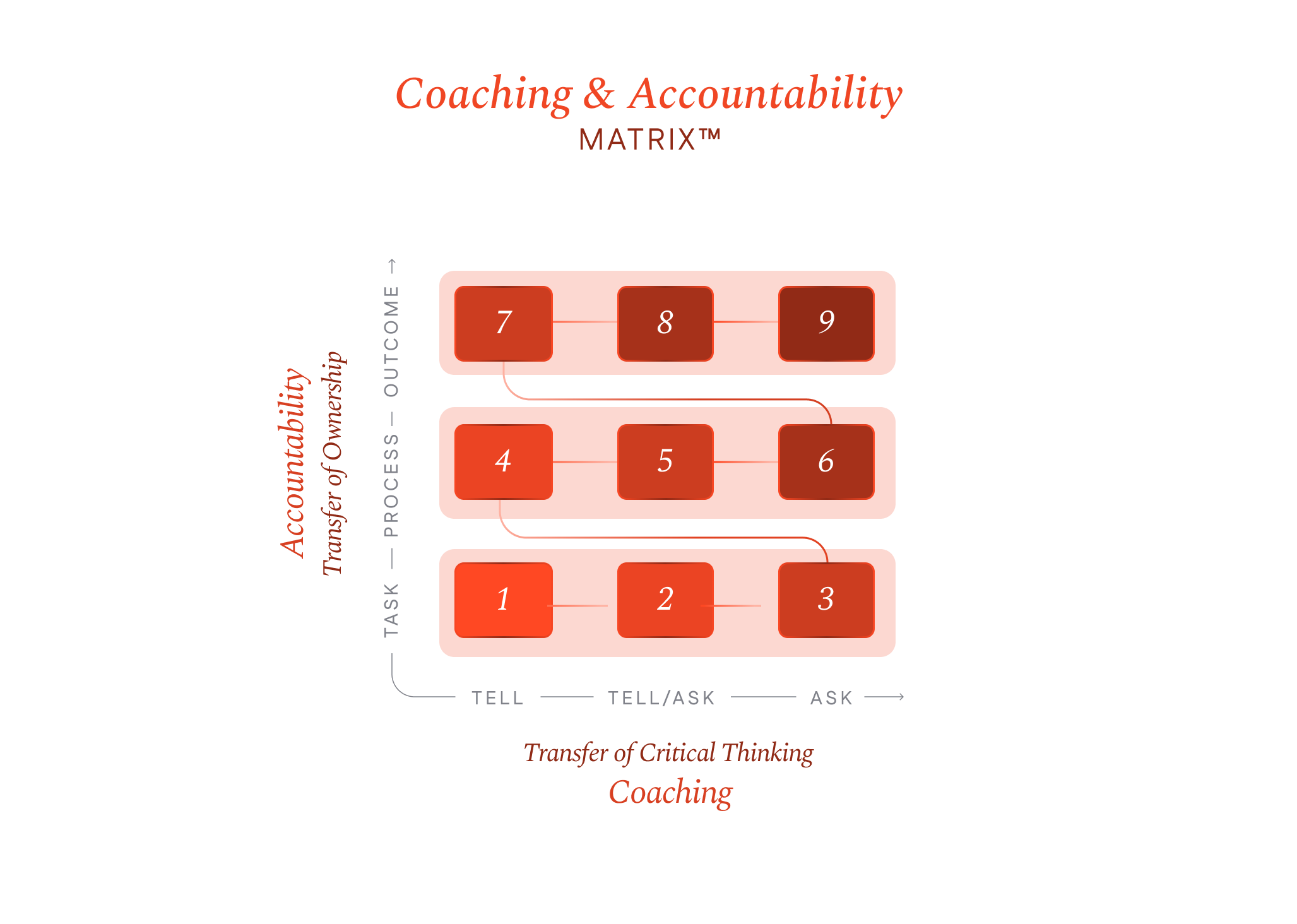
- Coaching & Accountability Matrix™ — LeaderFactor’s manager course, built on the Coaching & Accountability Matrix™
The Coaching Skills Cycle, the Question Funnel, and the Coachability Framework were developed by Dr. Timothy R. Clark.
Frequently asked questions
- What coaching skills does a manager need?
- Six: creating enough safety for honesty, asking questions that build thinking, listening without diagnosing, transferring ownership into a specific commitment, giving behavioral feedback, and calibrating between directing and asking. Most lists include empathy and active listening but omit the two that decide whether anything changes — ownership transfer and follow-through.
- How do you ask good coaching questions?
- Use a funnel. Open wide with questions that invite thinking — 'What's your read on this?' — then narrow to specifics — 'What happened right before it stalled?' — and close binary when you need commitment: 'Will you have that by Thursday?' The common mistake is starting narrow with a leading question that telegraphs the answer you want.
- What stops managers from coaching well?
- Derailers — habits that signal the conversation is theater. Interrupting, finishing sentences, checking the time, over-explaining, or asking a question and answering it yourself. They are rarely deliberate and almost never visible to the person doing them, which is why identifying your own usually requires asking someone who sits through them.
- What is the difference between coaching and mentoring?
- A mentor shares their own experience and advises from it; the value flows from what the mentor knows. A coach draws out the other person's thinking; the value comes from what the coachee works out. Mentoring is generally career-spanning and voluntary. Coaching is task-adjacent, ongoing, and part of a manager's job.