





Healthcare leadership: where silence has a mortality rate
Healthcare leadership explained for practitioners: the clinical hierarchy problem, why speaking up is a patient-safety system, and the leadership that fixes it.
Healthcare leadership carries a distinction most leadership contexts don’t: the cost of a team’s silence is sometimes clinical. In an office, an unvoiced concern becomes rework; on a med-surg floor, it can become an event with a patient’s name on it. That single fact reorganizes the whole topic — and yet search this term and you’ll find mostly association homepages and degree-program brochures, as if healthcare leadership were a credential rather than the hardest human-systems job in the economy. This page is the practitioner’s version: what the role uniquely demands, why voice across hierarchy is its central problem, and what the leadership that fixes it actually does.
What makes the context genuinely different
Every leadership fundamental applies in healthcare — direction versus management, coaching, change — but four conditions sharpen everything:
The hierarchy is professional, not just organizational. Physician–nurse–tech gradients carry decades of training culture, and they suppress voice in ways no org chart shows: the question not asked of the attending, the concern softened into a hint. The stakes ride on every shift — healthcare’s error chains are famously human, and most involve information somebody had. Clinical excellence is the promotion criterion — charge nurses, chiefs, and medical directors are routinely elevated for being superb clinicians and handed leadership work nobody developed them for. And the workforce runs under chronic load — emotional, physical, staffing — which means healthcare leaders manage energy and meaning as core work, not as wellness programming.
The central problem: making the truth travel upward, fast
Here’s the reframe that makes healthcare leadership legible: a care team’s safety system is mostly made of sentences people either say or don’t. The checklist works if the tech feels able to halt the line when an item’s skipped. The briefing works if the newest nurse actually voices the med concern. The escalation protocol works if the resident admits uncertainty to the attending. Every one of those is an interpersonal risk taken against a steep hierarchy — and whether it’s taken is a function of what happened to the last person who tried.
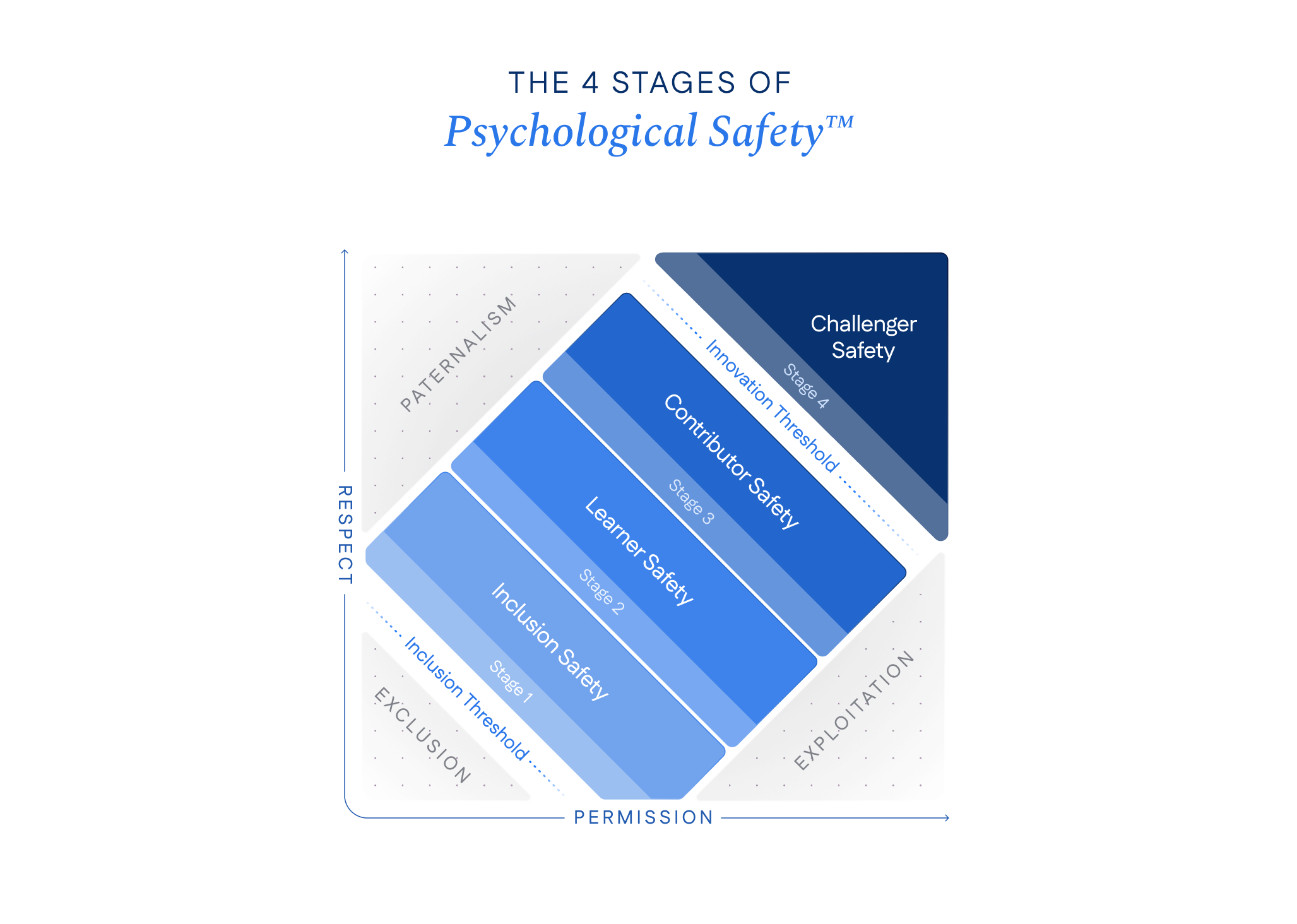
This is psychological safety doing literal safety work, and healthcare is where the connection stops being metaphor: LeaderFactor’s own strongest case for the 4 Stages is titled, without exaggeration, psychological safety saves lives. In stage terms, a unit needs its people included across professional lines, safe to learn (the resident’s uncertainty, admissible), safe to contribute (the tech’s observation, wanted), and safe to challenge (the nurse’s “doctor, stop” — the sentence entire protocols exist to make sayable). A unit strong on protocol and weak on Stage 4 has laminated its safety system and disabled its sensors.
What the effective ones actually do
The healthcare leaders who move these systems share a behavioral repertoire more than a style:
- They answer the first flag with gratitude, publicly. The response to “I might be wrong, but—” is the unit’s most-watched leadership act; it prices every future flag. One thanked near-miss report buys ten more; one dismissed one costs a quiet year.
- They flatten the room deliberately. First names in the huddle, junior voices asked first in debriefs, the attending’s own uncertainty modeled out loud — cultural flatness practiced as clinical technique.
- They develop their clinician-leaders on purpose, treating the excellent-clinician-to-leader transition as a real development program with coaching behaviors and measurement, not a badge ceremony. (Coaching for healthcare leaders covers the one-to-one version.)
- They measure the room, not just the outcomes. Event rates lag; the team’s actual willingness to speak leads — and it’s measurable at the team level, unit by unit, before the outcomes data arrives with the bad news.
- They lead the change load honestly — new systems, new protocols, perpetual transformation — using real change discipline rather than memo-and-hope, because clinical staff have seen too many kickoffs to extend free credibility.
It’s a Tuesday night in February on a telemetry unit in Dayton, and a first-year nurse pages the hospitalist about a rhythm change she can’t quite name — half-apologizing as she does it, because on her last unit this call would have earned her a reputation. This hospitalist comes, looks, catches it early, and then does the thing her old unit’s physicians never did: finds her at the station afterward and says, loudly enough for the shift to hear, “That page was exactly right. Make it again anytime.” The unit’s leadership didn’t change a protocol that night. It changed a price — and the next three months of earlier calls, on that unit, are the compounding return.
Healthcare leadership, at its center, is the discipline of changing that price across an entire organization of hierarchies, one demonstrated response at a time — and then wiring it into development, measurement, and the way change itself is led. The degrees can wait. The next shift can’t.
Frequently asked questions
- What is healthcare leadership?
- Healthcare leadership is leading clinical and operational teams in life-critical environments: setting direction and running systems like any leadership role, plus demands unique to care delivery — steep professional hierarchies, safety stakes on every shift, regulatory density, and a workforce under chronic emotional load.
- Why is leadership so important in healthcare?
- Because in healthcare the gap between what frontline staff notice and what they say out loud is measured in patient outcomes. Leadership sets whether a nurse questions a dosage, a tech flags a shortcut, a resident admits uncertainty — and those moments are the safety system's actual sensors.
- What are the biggest challenges in healthcare leadership?
- The recurring set: professional hierarchies that suppress voice across roles, burnout and staffing strain, leading clinicians promoted without leadership development, regulatory and financial pressure, and constant change. The common thread is human systems under load — which is why the behavioral work matters most.
- How does psychological safety affect patient safety?
- Directly: most care failures involve information someone had and didn't successfully voice. Teams where questioning authority is safe catch errors earlier — the whole logic of checklists and briefings depends on people actually speaking. Making candor safe across hierarchy is patient-safety infrastructure, not a soft skill.