





Building a culture of innovation, in the right order
Building a culture of innovation starts lower in the stack than idea programs: the safety that makes deviation speakable, and the behaviors that reward it.
Building a culture of innovation is mostly written up as an additive project: add hackathons, add idea platforms, add a lab, add “fail fast” to the values slide. The additions are fine and mostly beside the point, because culture is not what a company adds. Culture is the way we interact — and an innovation culture is one where deviating from the status quo is interpersonally safe, cheap to test, and rewarded when honest. That definition puts the work lower in the stack than most innovation programs ever reach, and the order of operations turns out to be nearly everything.
Innovation is deviation, and deviation is a risk someone takes
Strip innovation to its behavioral core and it’s this: someone proposes that the current way is wrong, or at least beatable. Innovation requires deviation from the status quo. Which means every act of innovation begins as an interpersonal risk — the new idea implicitly criticizes the old one, the experiment might fail publicly, the challenge might land badly with whoever built the thing being challenged.
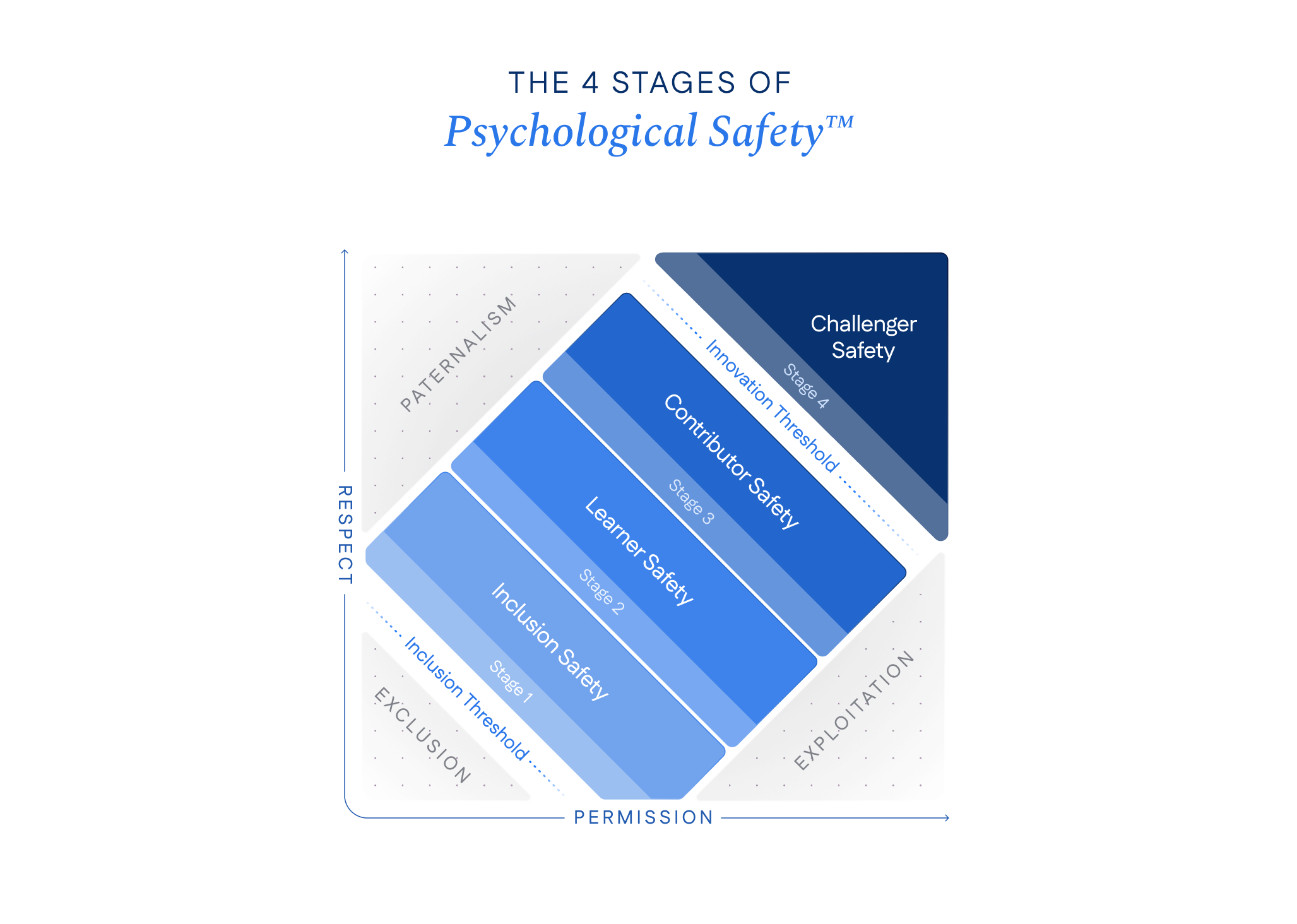
So the first question of innovation culture isn’t “where do ideas go?” It’s “what happened to the last person who took that risk?” Amy Edmondson’s research named the underlying variable — psychological safety — and Google’s Project Aristotle famously rediscovered it as the top predictor of team effectiveness (the full story is here). LeaderFactor’s 4 Stages of Psychological Safety™ puts it in sequence: teams progress from inclusion safety through learner and contributor safety to challenger safety — the stage where people can challenge the status quo, up, down, and sideways, without retaliation. Innovation lives at Stage 4, and Stage 4 is the last one a team reaches.
The sequence error
Here’s the misconception that quietly wrecks most innovation-culture initiatives: “we need more ideas — let’s build the pipeline.” Idea boxes, innovation weeks, a VP of Innovation. Then the pipeline runs dry, leadership concludes the people aren’t creative, and the cycle restarts with better branding.
The ideas were never missing. They were unpriced-in: every person on the team runs a private calculation about what proposing a deviant idea costs here, and in most organizations the honest answer is something — a skeptical look from the room, a reputation ding if it fails, a manager who hears critique of the current process as critique of the manager. People correctly read that price and keep their best ideas in the notebook. The replacement principle is the one LeaderFactor’s framework builds toward: teams that chase innovation first get silence, because the 4 Stages run in order and skipping to Stage 4 collapses it.
The exchange that runs Stage 4
Challenger safety operates as an exchange: air cover in exchange for candor. The team member brings the dissent — the uncomfortable observation, the heterodox proposal — and the leader provides protection: visible, reliable cover from the social and political cost of having spoken. Where the exchange runs, four patterns show up together: cultural flatness (the best argument wins, not the highest title), constructive dissent, a high tolerance for candor, and creative abrasion — ideas colliding hard while people stay safe.
Two boundary conditions keep the exchange honest. First, the distinction between an innovator and an agitator is the intent behind the dissent: challengers get air cover for trying to make the thing better, not for recreational grievance. Second, watch the two failure patterns that masquerade as culture: paternalism (high respect, low permission — “we love your ideas, run everything past me first”) and exploitation (high permission, low respect — take the ideas, credit the boss). Both produce the quiet you were trying to cure.
What leaders actually do
Culture moves on repeated, visible leader behavior, and the moves are specific:
- Reward vulnerability, publicly. When someone challenges your plan and they’re half right, the room learns from your next sentence what dissent costs. Psychological safety is a culture of rewarded vulnerability, and the reward has to be observable.
- Run experiments small and honor honest failures. A failed test reported plainly should leave the reporter’s standing higher, not lower. Teams watch what happens to the person, not what the poster says.
- Flatten the argument, not the org chart. Ask juniors to weigh in first; let evidence beat rank in design reviews. Cultural flatness is a meeting behavior before it’s a structure.
- Draw the challenge into the open. “What would make this fail?” asked sincerely, with the answers thanked, is an innovation program that costs nothing and runs weekly.
It’s a Tuesday in February at an industrial-controls company in Cleveland, and the engineering director is reviewing year one of the innovation program: 340 submissions in the idea portal, 9 from her own division, none from the senior engineers who know the product best. Then she sits in on a design review and watches why — a second-year engineer floats an unconventional sensor approach, and the room’s most tenured voice answers with a smirk and a story about the last time someone tried something clever. Nobody logs ideas into a portal after watching that. Her actual innovation program starts the next week, and it’s not a portal: it’s her, in that same review, asking the junior engineers first and thanking the challenge before evaluating it.
Measure the base, then build on it
Because the precondition is measurable, the work can be honest: LeaderFactor’s PSindex® baselines a team across all four stages, and a low challenger-stage score is your innovation culture diagnosed — before a single program dollar. The Psychological Safety skill builds the leader behaviors that move it; the relationship between safety and innovation gets its own deeper treatment in psychological safety in innovation; and the surrounding cluster covers what innovation looks like day to day, the tactical fostering moves, and the barriers worth clearing first.
Start with the audit only you can run: recall the last three times someone challenged the current way in front of you, and what it cost them. If you can’t recall three, that’s the finding.
Frequently asked questions
- What is a culture of innovation?
- A culture of innovation is one where deviation from the status quo is safe to propose, cheap to test, and rewarded when it's honest — whether or not it works. Culture is the way we interact, so an innovation culture lives in how a team responds to challenges, odd ideas, and failed experiments, not in its lab budget.
- How do you build a culture of innovation?
- In sequence: establish the safety to dissent before asking for the dissent. Practically that means leaders rewarding vulnerability — responding to challenges and failed experiments in ways that raise the challenger's standing rather than taxing it — then adding idea pathways, experiment time, and recognition once speaking up is genuinely safe.
- Why do cultures of innovation fail?
- Most fail from sequence error: the organization installs innovation programs — hackathons, idea boxes, labs — on top of an environment where challenging the status quo is still socially expensive. People correctly read the real price of deviation and stay quiet, so the programs harvest an empty field.
- What is creative abrasion?
- Creative abrasion is ideas colliding hard while the people proposing them stay safe — vigorous argument over proposals without personal cost to the proposers. It shows up in teams with challenger safety, alongside cultural flatness and constructive dissent, and it's the productive alternative to both polite silence and personal conflict.