





Innovation in the workplace: what it actually looks like
Innovation in the workplace is mostly small deviations in ordinary rooms, not lab breakthroughs. The types, the conditions, and where it actually starts.
Innovation in the workplace suffers from its own press photos: the lab, the launch, the founder on stage. Defined honestly, workplace innovation is useful deviation from the current way of working — a process changed, a product improved, a customer served differently, because someone saw a better way and the organization let the better way win. Most of it is incremental, local, and unglamorous, which is exactly why the organizations that get lots of it don’t look dramatic from outside. They just compound.
The types, without the taxonomy tour
Three cuts cover most of what you’ll meet. Product innovation changes what you offer. Process innovation changes how you produce and deliver it — historically the underrated one, since process gains are invisible to competitors and compound quietly. Business-model innovation changes how value is created and captured, and it’s the rarest because it challenges the most entrenched assumptions. (Frameworks like Doblin’s ten types slice this finer, usefully, mostly by revealing how many non-product places innovation can live.)
Cross-cutting all three is the spectrum from incremental to radical, and here organizational honesty matters: a healthy innovation portfolio is overwhelmingly incremental, with occasional larger bets. The academic name for holding both at once is ambidexterity — exploiting the current business while exploring the next one — and the tension is real: the operational discipline that makes this quarter reliable is the same force that resists the experiment that makes next year different. Managing that tension is a leadership job, not a program.
What it looks like on a Tuesday
Because the definition is deviation-that-wins, most workplace innovation is small enough to miss: a claims processor noticing that one document request causes half the delays and proposing its removal. A warehouse lead re-sequencing a pick route. A support rep turning a complaint pattern into a product fix. An analyst asking why the weekly report exists at all.
Notice the common structure — each one begins as an observation someone chose to voice, aimed at a status quo someone else built. That’s the part the highlight reels skip: day-to-day innovation is a stream of small speakable criticisms, and its flow rate is set by what voicing them costs. Which is why two workplaces with identical talent and budgets innovate at wildly different rates, and why the interesting variable isn’t creativity (creativity is its own topic, and it’s upstream, not identical).
The misconception: innovation is an event
The working belief in most organizations: “innovation happens in designated places — the offsite, the hackathon, the innovation team.” So innovation gets an address, a budget, and a calendar slot, and everywhere else in the company remains officially a no-deviation zone. The results are predictable: the hackathon produces demos, the demos meet the operational immune system, and the people closest to the actual work — who see the real improvement opportunities daily — were never in the room.
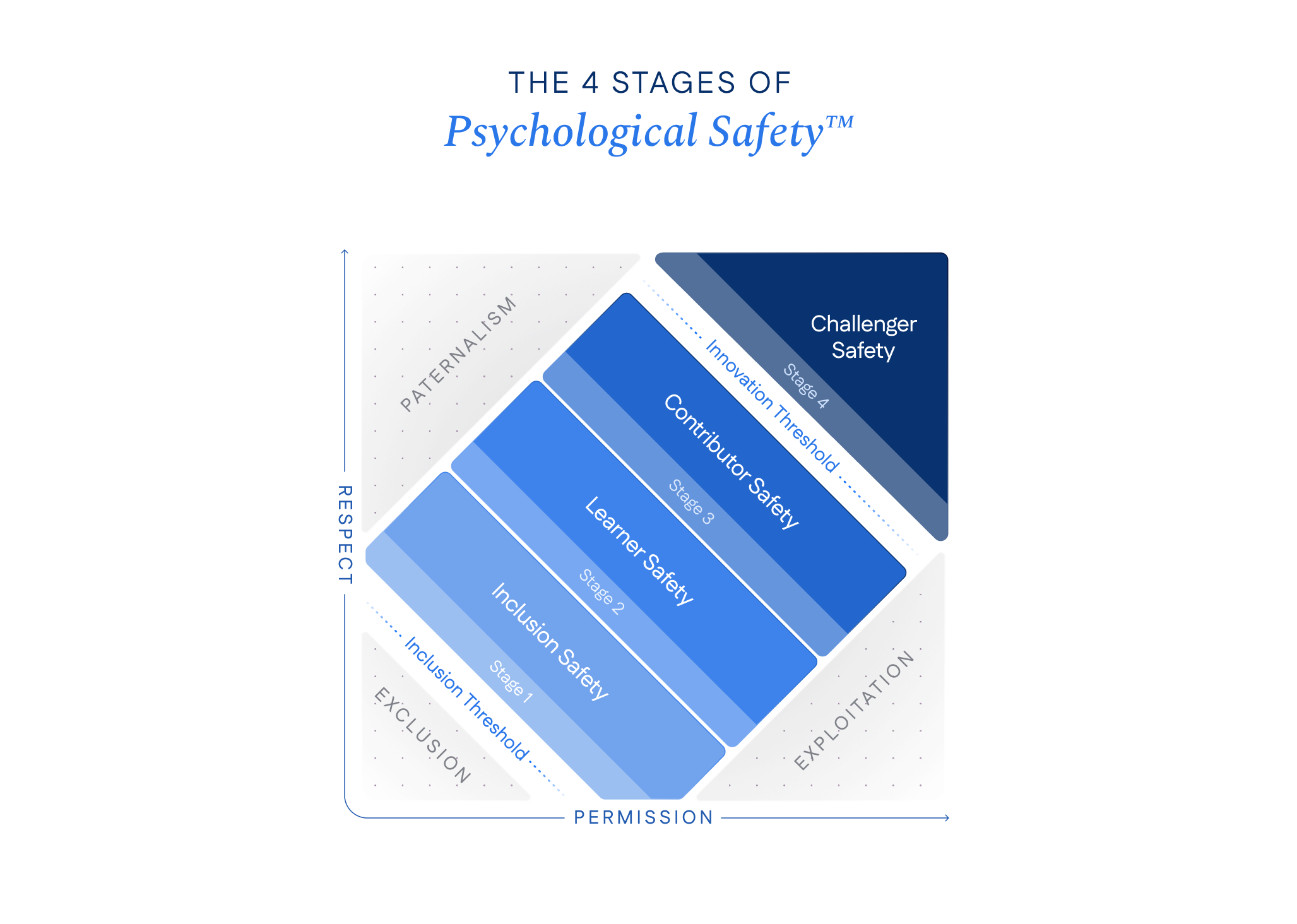
The replacement: innovation is a property of how a team interacts, present or absent in every room, every week. Innovation requires deviation from the status quo, and a team either makes deviation safe and cheap or it doesn’t. LeaderFactor’s 4 Stages of Psychological Safety™ names the enabling condition precisely: challenger safety, the fourth stage, where challenging the current way doesn’t cost standing. Teams at Stage 4 innovate as a side effect of how they talk; the framework’s own image for the stage is a team that has become an incubator of innovation. Teams below it hold innovation events.
The conditions, in order
What actually has to be true, sequenced from the floor up: people can voice a deviant observation without social cost (the safety layer — the full build is covered in building a culture of innovation); small tests are cheap to run (an experiment that needs three approvals is a proposal, not an experiment); honest failures are metabolized as information rather than scars; and wins actually replace the old way, visibly, so proposing improvements provably works here. The catalog of what blocks each condition is in barriers to innovation, and the leader tactics in how to foster innovation in the workplace.
It’s a Thursday in March at a regional grocery distributor in Boise, and the operations VP is touring a warehouse that outperforms its sisters on every metric that matters. He’s looking for the technology and can’t find it — same scanners, same WMS, same layout. What he finds instead is a shift lead who runs a ten-minute Friday ritual: “what made your week stupid?” Complaints become tickets, tickets get tested the next week, and roughly a third of the tests stick. Fourteen months of that, compounding. The innovation was never a system. It was a question, asked safely, on a schedule.
Where to start
Skip the innovation program for one quarter and instrument the precondition instead: LeaderFactor’s PSindex® baselines whether your teams have the challenger safety that day-to-day innovation runs on, and the Psychological Safety skill builds it where it’s missing. Then install one cheap deviation channel per team — a standing “what made your week stupid?” works — and let the compounding start where the work is.
Frequently asked questions
- What is innovation in the workplace?
- Workplace innovation is useful deviation from the current way of working: a changed process, an improved product, a new way to serve a customer, adopted because it's better. Most of it is incremental and happens in ordinary teams — the lab-breakthrough version is the rare special case, not the definition.
- What are the types of workplace innovation?
- The common cut is product innovation (what you offer), process innovation (how you produce and deliver it), and business-model innovation (how you create and capture value). Cross-cutting all three is the incremental-versus-radical spectrum. Most organizations' realistic innovation portfolio is heavily incremental, and that's healthy.
- What does innovation look like day to day?
- Small and unglamorous: a support rep flagging a recurring complaint pattern, a scheduler redesigning a handoff, an engineer questioning a step everyone else stopped seeing. Day-to-day innovation is a stream of speakable observations and small tests, which is why its rate depends on how safe speaking up is.
- Why do some workplaces innovate and others don't?
- Rarely because of talent or budget. Innovating workplaces make deviation cheap and safe: ideas can be voiced without social cost, small tests don't need three approvals, and honest failures don't scar careers. Non-innovating workplaces price all three high, and their people rationally stop offering.