





Fostering creativity at work: environment beats talent
Fostering creativity at work is environmental design, not talent scouting. Amabile's three components, what stifles each, and the conditions leaders control.
Fostering creativity at work gets approached as a talent problem — hire creatives, find the idea people — and forty years of research says that’s the least useful frame available. The most durable model in the field, Teresa Amabile’s componential theory, defines creativity as the product of three components: domain expertise, creative-thinking skill, and intrinsic motivation, all operating inside a work environment that amplifies or suppresses them. Note what that last clause does: it hands the lever to leaders. You mostly can’t hire your way to a creative team, but you can absolutely build or wreck the conditions your existing team’s creativity runs on.
The three components, and what feeds each
Expertise is the raw material — you can’t recombine what you don’t know. It grows through depth in the domain plus exposure across domains, which is why cross-pollination (rotations, mixed-discipline reviews, people explaining their problems to outsiders) reliably outperforms brainstorming training. Novelty usually arrives as an import: a familiar idea from an unfamiliar field.
Creative-thinking skill is the practiced habit of divergence: generating before judging, holding the problem open past the first workable answer, deliberately trying wrong-seeming frames. It’s trainable, and the highest-value training is subtractive — removing the evaluation reflex from generation. A room that judges ideas as they’re voiced converges in minutes and calls the speed rigor. (This is the diverge-then-converge discipline that also powers good decision-making; creative work just extends the divergence phase.)
Intrinsic motivation is the multiplier and the fragile one: people are most creative when they’re interested in the problem itself. Amabile’s research is blunt about what crowds it out — surveillance, micromanaged methods, and evaluation pressure convert interesting problems into performance events. The feeding regimen is equally specific: real problems (not manufactured exercises), autonomy over approach, and visible connection between the work and something that matters.
The condition underneath all three
Here’s what the componential model implies but workplaces keep missing: every component operates in public. Expertise gets shared, half-formed thinking gets voiced, motivation survives or dies based on what happens when someone offers something unfinished. Creative thinking at work is social exposure — an untested idea is a small act of vulnerability — which is why the same person is imaginative at the whiteboard with trusted peers and silent in the same meeting with a skeptical VP added.
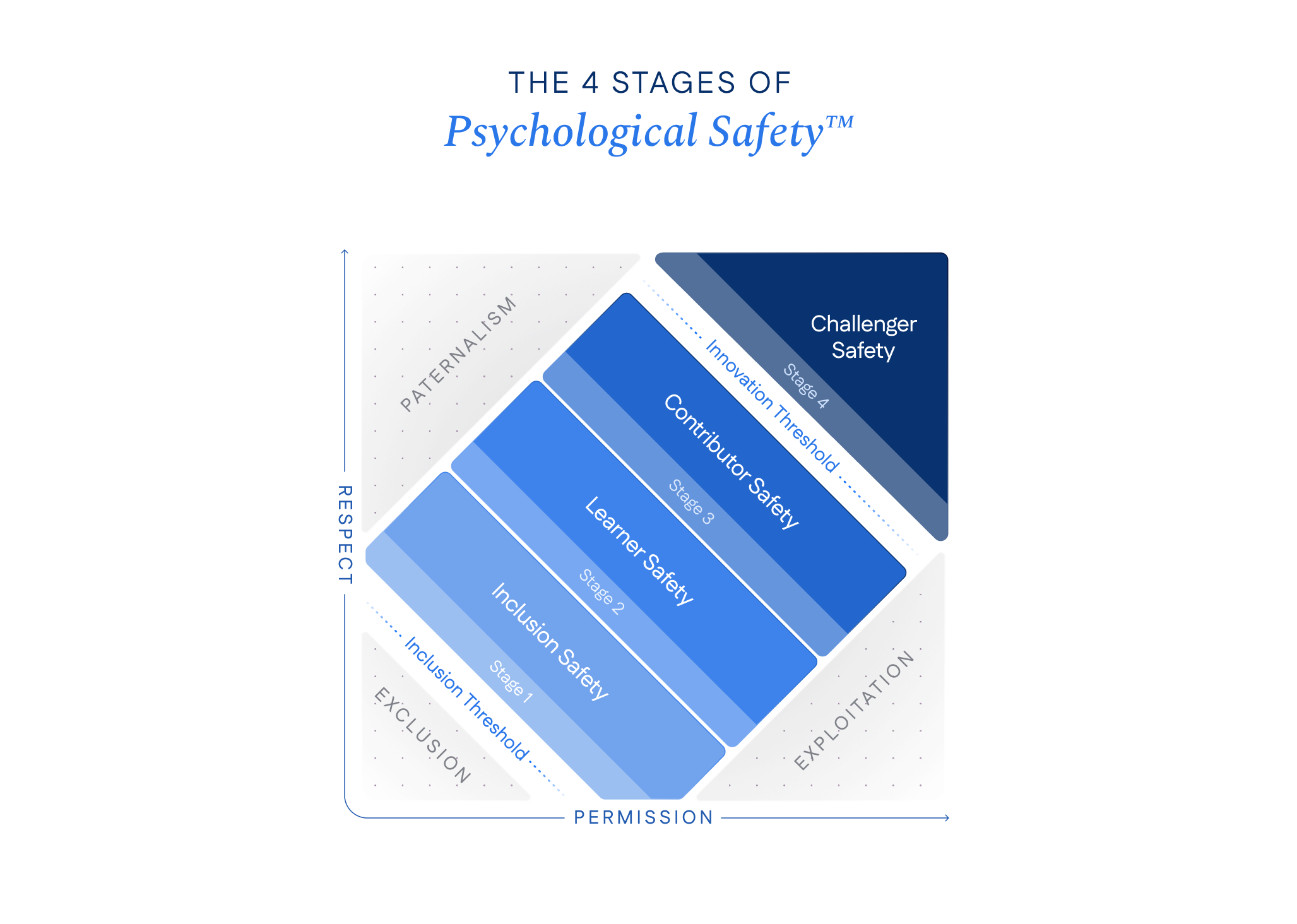
LeaderFactor’s 4 Stages of Psychological Safety™ names the stage that governs this: learner safety, the environment where you can think out loud, ask naive questions, and be publicly wrong while learning. The framework’s phrase for the stakes is exact: an emotionally bruised learner is a cognitively impaired learner. Bruise the room and you haven’t just hurt feelings — you’ve turned down its collective processing power, and the creativity components starve quietly no matter what else you invest.
The misconception: creativity needs pressure
The tough-minded version of fostering creativity says: “constraints breed creativity — add pressure and deadlines and the ideas will come.” Half true, and the half matters. Constraints on the problem (a real limit to design against) do sharpen creative work. Pressure on the person — time starvation, evaluation anxiety, the sense of being watched — does the opposite, and the research record on this is one of Amabile’s clearest findings: high-pressure days produce less creative thinking, not more, and the deficit trails into the days after. Teams remember their best ideas arriving in the shower for a reason. Incubation needs slack, and slack is the first thing utilization targets eliminate.
The replacement: constrain the problem, protect the person. Give a hard, specific, interesting limit — and the time, safety, and autonomy to work against it.
What it looks like installed
It’s a Wednesday in June at a toy company in Providence, and the design director is running her weekly concept review under new rules she adopted after losing two good designers in a year. Generation and judgment now live in separate meetings, a week apart. Wednesday is volume: every concept gets built on before it gets critiqued, her own included, and the naive question from the newest designer gets answered as a real question. The following Wednesday is convergence, on criteria the team wrote together. Nothing about the team’s talent changed between quarters. The concepts that survive to prototype now come from twice as many people — including, for the first time since anyone can remember, the engineers.
Creativity is the input; here’s the rest
Fostered creativity produces candidate ideas. Turning them into changed products and processes is the innovation half, with its own bottlenecks and its own fixes: innovation in the workplace maps the day-to-day system, how to foster innovation covers the tactical moves, and barriers to innovation diagnoses where ideas die after they’re voiced. The safety layer under all of it is measurable — LeaderFactor’s PSindex® baselines your teams’ learner and challenger safety, and the Psychological Safety skill builds the leader behaviors that raise them.
Start with the cheapest experiment in this whole cluster: split your next ideas meeting in two — generation this week, judgment next — and watch who speaks who never used to.
Frequently asked questions
- How do you foster creativity in the workplace?
- Design the environment rather than hunting for creative people: give real problems and real autonomy (intrinsic motivation), build expertise through exposure and cross-pollination, teach divergence habits like generating before judging, and make public thinking safe. Environment moves creative output more than selection ever has.
- What stifles creativity at work?
- Four suppressors do most of the damage: fear (untested ideas are vulnerable, and unsafe rooms keep them private), overloaded time (creativity needs slack and incubation), premature judgment (evaluating while generating), and extrinsic pressure that crowds out interest in the problem itself. Most workplaces run all four at once.
- What is the difference between creativity and innovation?
- Creativity is generating novel, useful ideas; innovation is implementing them until something actually changes. They have different bottlenecks: creativity is stifled by fear, overload, and premature judgment, while innovation stalls on testing friction and organizational resistance. Diagnosing which problem you have determines what to fix.
- Is creativity a talent or a skill?
- Research treats it as a capability that varies with conditions, not a fixed gift. Teresa Amabile's componential model names three ingredients — domain expertise, creative-thinking skill, and intrinsic motivation — all of which can be grown, and all of which the work environment amplifies or suppresses. The environment is the lever leaders actually hold.