





Change management: what it is and how to lead it
Change management is how organizations move people from the current way of working to a new one. What it is, the models, why initiatives stall, and what works.
Change management is the structured work of moving an organization — and the people inside it — from the way things are done today to the way they need to be done tomorrow. It covers the whole arc: the decision to change, the planning, the launch, the messy middle, and the point where the new way of working is simply how the place operates. The discipline exists because organizations do not change when a decision is announced. They change when enough people do something different, repeatedly, on purpose. That distinction is the entire game, and it is where most change management advice goes quiet.
This page is the overview. It defines the term, separates it from the two things it gets confused with, walks the process at altitude, maps the major models, and is honest about what the evidence does and does not support. Each section links down to a deeper page if you want to keep going.
What is change management?
Change management is the practice of preparing, equipping and supporting people through an organizational change so the change actually delivers its intended benefit. It sits between strategy and execution: strategy decides what should be different, project management tracks whether tasks got done, and change management makes sure the humans on the other end adopt the new way of working rather than quietly reverting to the old one.
A useful test: if the change would still be in place a year after the project team disbands, change management worked. If it faded the moment attention moved elsewhere, it did not — no matter how clean the Gantt chart looked.
Change management is not IT change control
Search the term and you will get two different disciplines wearing the same name. IT change control (the ITIL sense) is the governance process for approving, logging and releasing changes to technical systems — a ticket queue with a change advisory board. Organizational change management is about people adopting new behavior. They share a phrase and nothing else. This page is about the second one.
Change management is not the same as change leadership
The two are often used interchangeably, and shouldn’t be. Change management is the system side: scope, sequencing, communications, training, tracking. Change leadership is the human side: credibility, vision, coalition, and the emotional labor of carrying people through uncertainty. You need both, but only one of them is where initiatives usually break. For the full distinction, see change leadership.
Why change management matters
Change management matters because the cost of a failed change is rarely limited to the failed change. Every stalled initiative teaches the organization something: that announcements do not mean much, that this too shall pass, that the safest response to a new program is to wait it out. Organizations accumulate that lesson. The second transformation is harder than the first, and the third is harder still.
There is also a compounding argument. The pace of change in most industries is not slowing, which means change capability is no longer an occasional project skill — it is an operating capability. LeaderFactor’s framing is blunt about it: if you can’t lead change, you can’t lead. Either you choose change, or change chooses you.
Types of organizational change
Not all change needs the same amount of change management, and over-managing a small change burns credibility you’ll want later. The common typology splits change into three kinds: developmental (improving something that already works), transitional (replacing the old way with a defined new way — a system, a process, a structure), and transformational (a shift in strategy, identity or business model where the destination isn’t fully knowable at the start).
A more practical move is to size the specific initiative before you plan it. EPIC rates a change across six dimensions — scope, magnitude, complexity, duration, risk and criticality — and uses the average to place it on a five-level scale running from a local, incremental change at the team level up to a full enterprise transformation. The rating decides how much coalition, communication and consolidation the change actually warrants.
The change management process
Most change management processes describe the same arc in four or five stages: understand and justify the change, plan it, execute it, and embed it. The labels vary — prepare, design, implement, sustain, review is a common set — but the underlying sequence is remarkably stable across frameworks.
What matters more than the labels is that the stages are not clean or strictly sequential. Real change loops backward. You will re-evaluate during implementation. You will re-prepare a function that was not ready. Treating the process as a linear checklist is one of the most reliable ways to be surprised.
For the stage-by-stage walkthrough — what each phase produces, who owns it, and how to know you’re ready to move on — see the change management process.
Change management models
The field has no shortage of models. The ones you will encounter most:
- Lewin’s three-step model — unfreeze, change, refreeze. The oldest and simplest framing.
- Kotter’s eight steps — urgency, coalition, vision, communication, empowerment, short-term wins, consolidation, anchoring.
- ADKAR (Prosci) — an individual-level model: awareness, desire, knowledge, ability, reinforcement.
- McKinsey 7-S — an alignment diagnostic across strategy, structure, systems, shared values, style, staff and skills.
- Bridges’ transition model — the psychological journey of endings, the neutral zone, and new beginnings.
- EPIC (LeaderFactor) — Evaluate, Prepare, Implement, Consolidate, built around the leadership behavior that generates effort.
Here is the honest part: a 2022 review in TechTrends examined sixteen change management models and frameworks against what practitioners actually do, and found “little empirical evidence that supports a preferred change management model” (Phillips & Klein, 2022). Anyone selling you a model as the proven one is overstating the case. Models are useful as shared language and as a checklist against forgetting a step — not as a guarantee. Choose the one your leaders will actually use. For a side-by-side comparison, see change management frameworks.
The EPIC framework — LeaderFactor’s approach
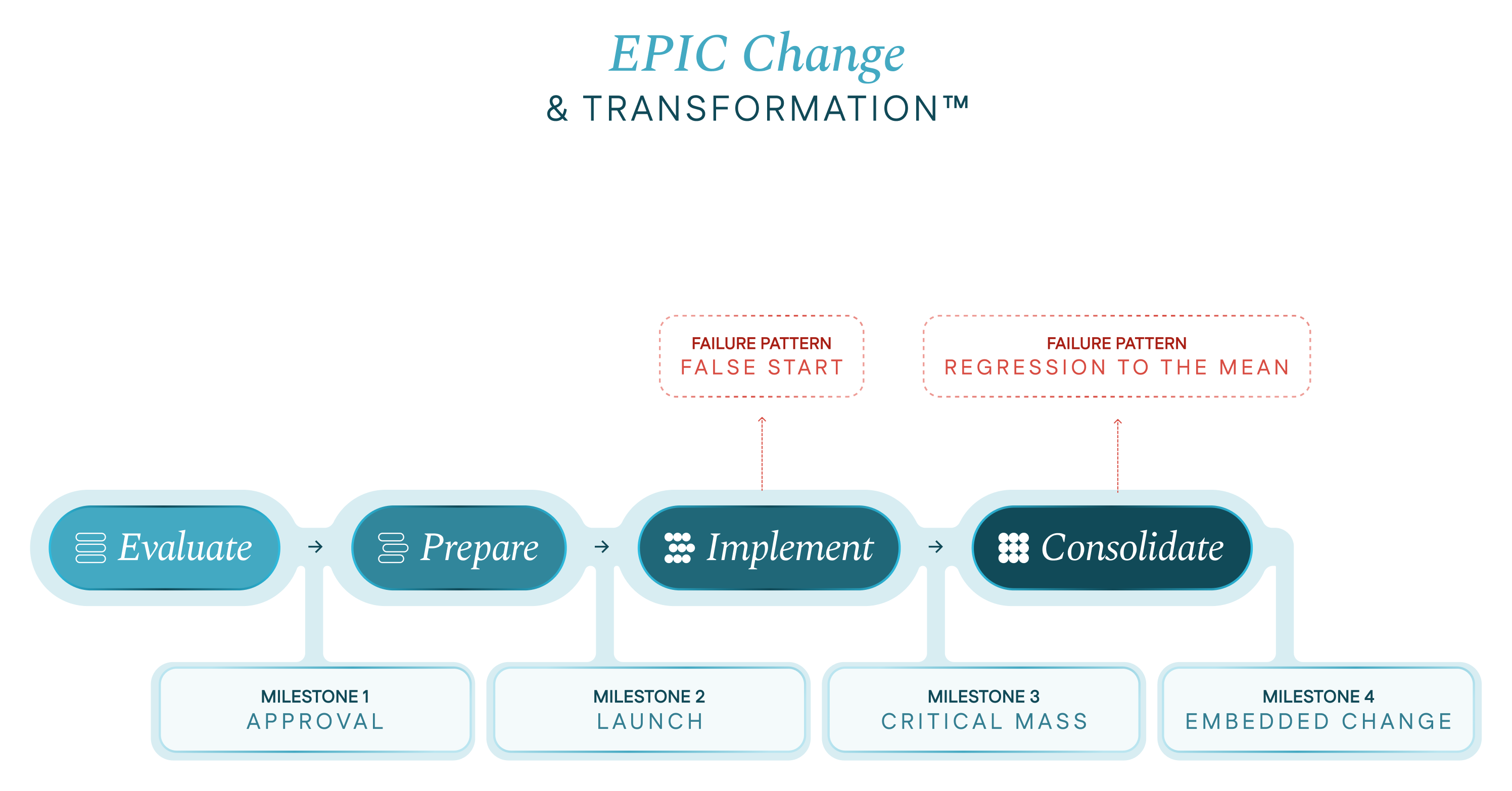
EPIC Change & Transformation™ is LeaderFactor’s change management framework, developed by Dr. Timothy R. Clark, who also wrote EPIC Change: How to Lead Change in the Global Age (Jossey-Bass, 2007). It organizes change into four nonlinear phases, each separated by a transition that has to be genuinely earned rather than assumed:
Evaluate → approval → Prepare → launch → Implement → critical mass → Consolidate → enduring change.
- Evaluate — look unflinchingly at reality. What happens if we do nothing? What is the actual case for change — cost, value, or compliance? How disruptive will this be, across which dimensions?
- Prepare — prepare the change, the organization, your coalition, and yourself. This is where the vision message and the coalition get built, and where most initiatives are quietly won or lost.
- Implement — execute while bridging the span of uncertainty: the finite window during which people will keep giving effort before they see evidence it’s working. That window always closes. Your job is to produce visible results before it does.
- Consolidate — embed the change across all three organizational layers: systems, behavior, and culture. This is the phase leaders skip.
What makes EPIC a change leadership framework rather than a project methodology is its mechanism. Change requires more work than the status quo, and that extra work is discretionary effort — effort people choose to give, which no org chart can compel. As the framework puts it, leaders must intentionally exchange motivation and inspiration for the effort required to perform change work. When leaders skip that exchange, they fall back on two failure modes: muscling the change through authority and penalties, or smuggling it in quietly and hoping nobody notices. Both produce compliance. You get their hands, some of their head, and none of their heart.
What the evidence actually says about failure rates
You will encounter a single, memorably round failure percentage attached to organizational change everywhere in this field — in consulting decks, textbooks and vendor marketing. It is worth knowing where it came from, which is: nowhere anyone can point to. A 2011 paper in the Journal of Change Management traced five separate published instances of the claim back toward their sources and concluded that while the popular narrative certainly exists, there is no valid and reliable empirical evidence supporting it (Hughes, 2011).
Treat any precise failure rate you are quoted with suspicion, including ours — we don’t publish one. What is defensible is the pattern of failure, which is consistent enough to plan around:
- The false start. The change never gains traction because no real coalition formed behind it. One leader wanted it; nobody else owned it. Progress stops before it starts.
- Regression to the mean. The change is implemented, works, and then fizzles — because the leader disengaged and moved to the next priority before the new way of working was embedded in culture. The gravitational pull of the old normal does the rest.
Both are preventable, and neither is prevented by a better project plan. A deeper breakdown lives at why change initiatives fail.
Resistance is data, not an obstacle
People do not resist change because they are irrational or lazy. They resist because change asks them to trade something known for something unknown, and because most resistance is about loss, not logic — loss of control, clarity, status, competence or comfort.
EPIC uses a U-curve to describe the emotional journey people travel: denial (“this isn’t really happening”), resistance (“I didn’t ask for this”), exploration (“okay, how could this work?”), and commitment (“let’s do this”). People move through it at different speeds and in different orders, and each stage needs something different from you — straight answers in denial, listening in resistance, a way to contribute in exploration, recognition in commitment.
Handled well, resistance is the highest-quality feedback you will get on your own plan. Handled badly, it goes underground and reappears as quiet non-adoption. See managing resistance to change for the practical version.
How to measure change management
Measure change in three places, because a change can succeed in one and fail in the others:
- Adoption — are people actually using the new process, system or behavior? Usage data beats survey sentiment here.
- Results — is the change producing the outcome that justified it? Tie this to the specific lever in your case for change rather than to general activity.
- Durability — does it hold when leadership attention moves on? This is the only measure that catches regression to the mean, and it requires you to keep measuring after the project is declared done.
On the leader side, EPICindex™ is a self-assessment used before EPIC training. It presents roughly thirty statements on a five-point scale and returns a score for each of the five gauges of credibility, plus an overall score, with an option to invite colleagues to rate you as well. It’s a structured reflection and development tool for change leaders — not a psychometric test, and not a prediction of an initiative’s outcome.
Common change management mistakes
- Communicating instead of leading. Town halls and slide decks inform people that change is coming. Information does not produce effort.
- Building the plan before the coalition. Participation builds commitment; people resist what they had no hand in creating.
- Ignoring the small stuff early. If someone bypasses the new process in week two and nothing happens, the organization learns that the change is optional. Early signals set the standard for everything after.
- Announcing without evidence. Noise is not progress. People are watching for real results, and their patience is finite.
- Leaving before it’s embedded. The most expensive mistake in change management is a leader who declares victory at implementation and moves on.
Where to go next
This page is the overview; these go deeper:
- The change management process — the stages, step by step.
- Change management frameworks — ADKAR, Kotter, Lewin and EPIC compared.
- Change leadership — what leadership adds that management can’t.
- Managing resistance to change — reading and working with pushback.
- Why change initiatives fail — the two failure patterns in detail.
- How to change organizational culture — for the specific case where the thing changing is the culture itself.
If you want the full framework, the tools and the change plan that comes out of them, that’s EPIC Change & Transformation.
Frequently asked questions
- What is change management?
- Change management is the structured practice of moving an organization and its people from a current way of working to a new one, so the intended benefits actually arrive. It spans evaluating the case for change, preparing the organization, implementing the new way of working, and consolidating it until it becomes normal practice.
- What are the types of organizational change?
- Change is usually split into three kinds: developmental (improving something that already works), transitional (replacing the old way with a defined new one), and transformational (a shift in strategy or identity where the destination isn't fully knowable at the start). Sizing the specific change first stops you over-managing a small one.
- Is change management the same as IT change control?
- No — two different disciplines share the phrase. IT change control, in the ITIL sense, is the governance process for approving, logging and releasing changes to technical systems. Organizational change management is about people adopting new behavior. They share a name and almost nothing else.
- What are the main change management models?
- The most widely used change management models are Lewin's unfreeze-change-refreeze, Kotter's eight steps, Prosci's ADKAR, McKinsey's 7-S framework, and Bridges' transition model. LeaderFactor uses EPIC — Evaluate, Prepare, Implement, Consolidate. No single model has been shown to outperform the others empirically; the fit to your situation matters more.
- How do you measure change management?
- Measure in three places, because a change can succeed in one and fail in the others. Adoption asks whether people actually use the new way, and usage data beats survey sentiment. Results ask whether it produced the outcome that justified it. Durability asks whether it holds once leadership attention moves elsewhere.