





Managing resistance to change
Managing resistance to change starts with reading it as information, not defiance. Why employees resist, what objections signal, and how to earn real buy-in.
Managing resistance to change means treating pushback as information rather than as an obstacle to be flattened. When people resist a change at work, they are rarely being difficult on purpose. They are telling you something specific: what the change costs them, what they do not understand yet, or what they have watched fail before. Leaders who learn to read that signal move faster than leaders who try to override it — because the thing that carries a change across the finish line is discretionary effort, and discretionary effort cannot be ordered.
Most advice treats resistance as friction in the machine. The more useful view — built into LeaderFactor’s EPIC Change & Transformation™ framework — is that resistance is a stage people pass through, and its content is the best intelligence a change leader will get.
What is resistance to change?
Resistance to change is the pushback, active or passive, that surfaces when people are asked to give up a familiar way of working for an unfamiliar one. It shows up as questioning, foot-dragging, withdrawal, workarounds, or open objection. It is a predictable human response to disruption — not evidence of a bad attitude, disloyalty, or a broken team.
Separate three things that get lumped together. Resistance is pushback while people are still processing. Refusal is a settled decision not to comply. Dissent is a reasoned argument that the change is wrong. Most of what leaders call resistance is the first, some is the third, and very little is the second — and treating all three as insubordination turns temporary discomfort into permanent opposition.
Worth naming early: most resistance is about loss, not logic. You can win the argument on the spreadsheet and still lose the room, because the person across from you is not doing arithmetic. They are calculating what they are about to give up.
Why employees resist change
Employee resistance to change almost always traces back to a perceived loss that the change plan never accounted for. The specific losses repeat across organizations and industries:
- Loss of control. The change was decided elsewhere and arrived fully formed. People push back on the process even when they agree with the destination.
- Loss of competence. Someone excellent at the old way becomes a beginner at the new way. That is a real status cost, rarely acknowledged out loud.
- Loss of clarity and routine. New structures blur who decides what and what “good” looks like; reorganizations break up teams that worked.
- A weak case for change. If people cannot articulate why this, why now, they fill the vacuum with their own theory — usually a cynical one.
- History. “We tried this two years ago.” Initiatives launched and abandoned are a rational reason to withhold effort.
- Change fatigue. Capacity is finite. A team already carrying three transformations does not resist the fourth on the merits.
- Values conflict. When a change appears to contradict what the organization says it stands for, resistance gets principled — the most durable kind.
Underneath all of these sits a structural problem EPIC calls the Span of Uncertainty: the stretch between the moment a change is announced and the moment people see real evidence it is working. In that gap, questions vastly outnumber answers. People want to know whether this is really happening, whether it is working, whether they are safe, and whether their effort is worth it — and the only thing available to fill the silence is speculation. Resistance breeds there, and the longer the span runs, the more of it you get.
Resistance is a stage, not a character defect
The U-Curve of Personal Change is the part of the EPIC framework that reframes this problem. It describes the emotional journey through a change in four stages: Denial → Resistance → Exploration → Commitment. The progression is not tidy — people move at different speeds and slide backward under stress — but each stage needs something different from a leader.
| Stage | What it sounds like | What the person needs |
|---|---|---|
| Denial | ”This isn’t really happening.” | Clear, repeated communication; straight answers about what is and isn’t changing; time to process |
| Resistance | ”I don’t like this. I didn’t ask for it.” | Empathy, active listening, space to vent without consequence, reconnection to purpose |
| Exploration | ”Okay… how could this work?” | A chance to contribute and shape it, clarity on roles, coaching rather than control |
| Commitment | ”Let’s do this.” | Recognition, trust, autonomy, a role helping others through |
Notice what stage two requires: listening, not persuading. The common leadership error is to meet resistance with more argument — another deck, another round of benefits. But someone in the resistance stage does not have an information deficit. They have an unprocessed loss, and arguing harder keeps them there longer.
This is where two of the Ten Interpersonal Roles of a change leader do their work. The Grief Counselor acknowledges the ending — names what is genuinely being lost and does not rush past it. The Interpreter translates strategy into what it means for this team, this role, this Tuesday. Between them they cover what resistance is usually asking for: see what this costs me, and tell me what it means for my job.
What resistance is actually telling you
Resistance carries content, and the content is diagnostic. Research has pointed this way for years: in Resistance to Change: The Rest of the Story (Academy of Management Review, 2008), Ford, Ford and D’Amelio argued that the conventional view — resistance as an irrational reaction located “over there” in the people receiving the change — is a one-sided story that flatters change agents. Their case: leaders’ own actions and inactions help create resistance, and resistance can function as a resource rather than a problem.
In practice that means translating objections instead of dismissing them:
- “Why are we doing this?” → The case for change never landed. A communication failure, not a compliance failure.
- “We tried this before.” → A credibility problem, often inherited. Address the history directly or it will follow you.
- “We don’t have the bandwidth.” → Usually literal. Ignoring this capacity signal produces a change that is agreed to and never done.
- “This will hurt customers.” → Frontline intelligence. The people closest to the work often see a consequence the plan missed.
The leaders who handle change well are not the ones who encounter less resistance. They are the ones who get it early and out loud, while it is still cheap to act on.
Active, passive, and the resistance you never hear
Active resistance is visible: open objection, pointed questions in meetings, criticism, escalation, lobbying peers. It feels worse and is far easier to work with, because it is on the table.
Passive resistance is quieter and much more common: polite agreement followed by no follow-through, missed deadlines with plausible reasons, workarounds that preserve the old process, disengagement, attrition. It rarely announces itself; it slows everything down until the initiative fades.
The third category is the dangerous one — the objections nobody voices. If people believe raising a concern will get them labeled negative or “resistant,” they will not raise it. The resistance does not disappear; it goes underground and resurfaces months later, when the change is expensive to correct. This is why psychological safety is a change-management concern and not a soft aside: a team without it cannot give you the early warning you need. A genuine speak-up culture is what converts invisible resistance into usable feedback.
A practical test: if a change has been announced and you have heard no objections, you do not have buy-in — you have a measurement problem.
Muscling and smuggling — the two ways leaders mishandle resistance
EPIC names two failed default strategies leaders reach for when resistance shows up.
Muscling the change means using formal authority — titles, mandates, procedures, penalties — to force adoption. A VP raises the quota and does not explain why. It works, briefly. It produces compliance without commitment, and compliance is a ceiling, not a floor.
Smuggling the change is the opposite move: downplaying it, rolling it out quietly, hoping nobody notices until it is done. It avoids confrontation and destroys trust when discovered — and it always gets discovered.
Both fail for the same reason. You get people’s hands, some of their head, and none of their heart — and the work of change runs on the part you did not get. Compliance can be mandated; discretionary effort cannot. Every real transformation depends on people doing things nobody assigned them — catching the edge case, retraining a peer, staying with a messy process until it works. That effort is voluntary by definition, which is why leading for commitment is not a nicer strategy than leading for compliance. It is the only one that reaches the work that matters. LeaderFactor’s change management course is built on that distinction.
How to manage resistance to change, step by step
- Surface it before launch, not after. Ask directly what people expect to go wrong. A pre-mortem conversation costs an hour; discovering the same objection mid-rollout costs a quarter.
- Listen without defending. In the resistance stage, the intervention is a conversation in which the person is not corrected. Resist the urge to answer every point.
- Name the loss out loud. Say what is ending and what it costs. Leaders skip this because it feels like conceding ground. It is the opposite — the fastest way to be believed about the rest.
- Sort the resistance. Objections reveal a flaw in the plan (fix the plan), a gap in understanding (fix the message), a capacity problem (fix the sequencing), or an unprocessed loss (fix nothing; stay present).
- Give resisters a role in shaping it. Your most vocal skeptic, brought into the design, is frequently your best implementer — and their public conversion moves more people than any executive message.
- Shorten the Span of Uncertainty. Make your first visible win land early and make it undeniable. Noise is not evidence; every week without results, resistance regains ground.
- Stay engaged past the launch. Resistance is not a one-time event you clear. It returns at every hard patch, and its return is not a sign of failure.
How to get genuine buy-in, not just compliance
Buy-in is what you have when people would carry the change even if you stopped watching. It comes from participation far more than from persuasion, and that is one of the oldest findings in organizational research. In the Harwood studies published as Overcoming Resistance to Change (Human Relations, 1948), Lester Coch and John R. P. French Jr. found that groups who took part in planning a change adapted markedly better than groups simply informed of it — evidence that resistance is produced by the context of a change, including how it is introduced, rather than by something inherent in the people.
The principle that follows is blunt: people resist what they did not help create. So the mechanism for buy-in is a coalition — a deliberately assembled group with the authority, credibility, relationships and expertise to carry the change, brought in early enough to shape it rather than just deliver it. A coalition carries the work into functions you cannot personally reach, and doubles as your intelligence network, surfacing skepticism while there is still time to adjust.
The other half of buy-in is the leader. Resistance is frequently about the person leading the change rather than the change itself, which is why EPIC frames change-leader credibility across five dimensions — character, competence, commitment, care and capacity — and profiles it with the EPICindex™, a competency-based assessment that gives a leader a personal baseline and action plan. The real measure of credibility is simple: how much risk will people take because you asked them to?
Common mistakes when overcoming resistance to change
- Treating resistance as a personality problem. It is a stage, and stages pass with the right support. Labeling someone “resistant” makes it an identity.
- Confusing silence with agreement. Quiet rollouts are the ones that unravel later.
- Over-promising. You do not have all the facts, cannot remove all the risk, and cannot promise zero losses. Saying so builds more trust than false certainty.
- Declaring victory at go-live. Adoption is not consolidation. Leaders who disengage once the system is installed watch behavior drift back.
- Ignoring the small stuff. When someone bypasses the new process and nothing happens, everyone learns the change is optional.
Where to go next
Resistance is one piece of a larger discipline. Start with the change management overview, then work through the change management process to see where resistance work fits across the four phases. If your last initiative stalled for reasons you still cannot name, why change initiatives fail covers the structural failure patterns resistance gets blamed for.
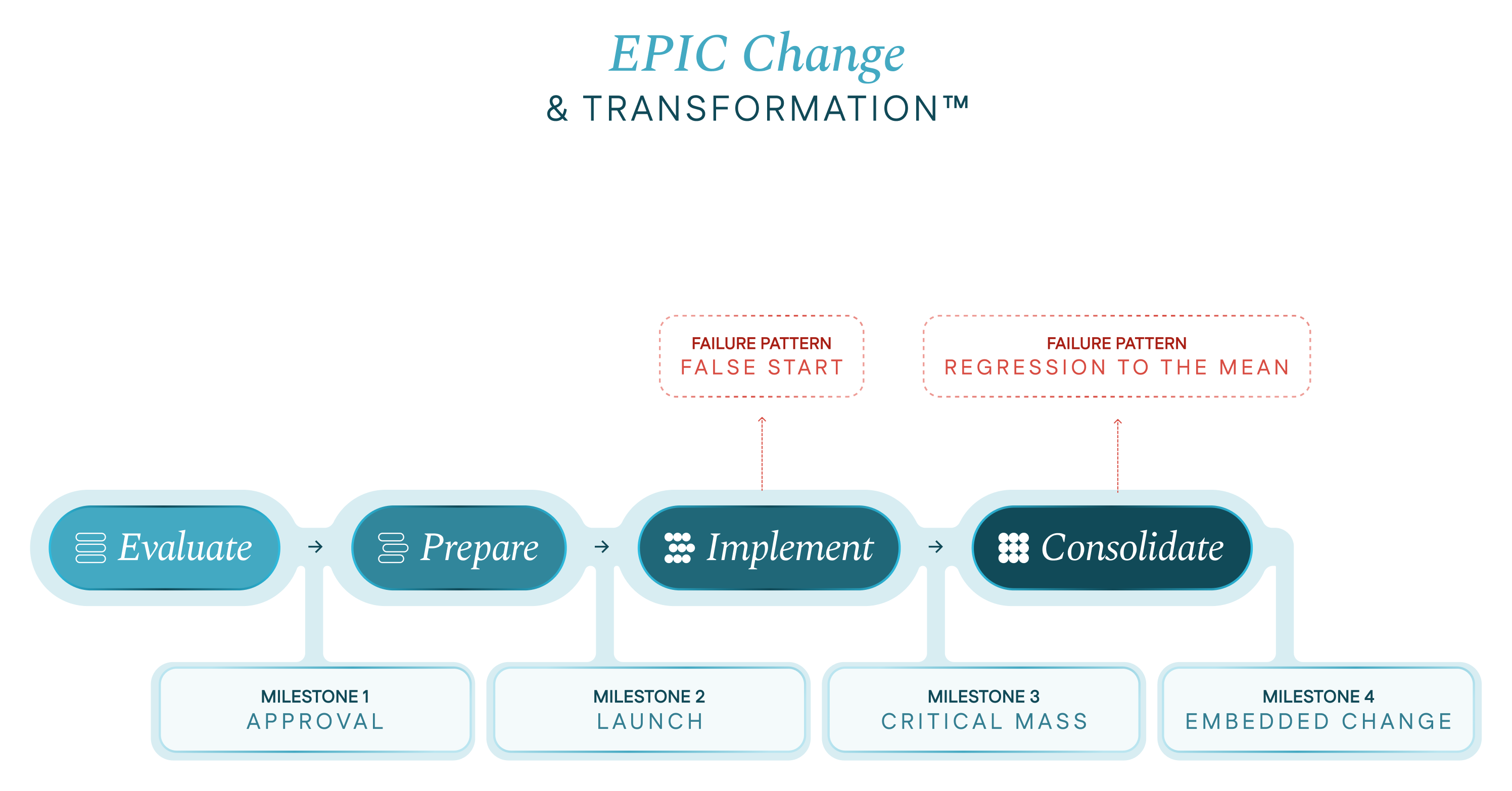
The framework here comes from Dr. Timothy R. Clark’s work on organizational change, including his book EPIC Change (Jossey-Bass, 2007) and the four-phase EPIC model — Evaluate, Prepare, Implement, Consolidate.
Frequently asked questions
- How do you manage resistance to change?
- Managing resistance to change means treating pushback as data instead of defiance. Surface objections early, listen without defending, name what people are losing, involve resisters in shaping the solution, and show visible results fast. LeaderFactor's EPIC Change framework treats resistance as a predictable stage of the U-Curve of Personal Change, not a character defect.
- Why do employees resist change?
- Employees resist change mostly because of loss, not logic. Change threatens control, competence, status, relationships, or routine, and people weigh those losses against a benefit they cannot yet see. Resistance also grows in the gap between an announcement and real evidence, when people have urgent questions and leaders have no concrete answers.
- What are the signs of employee resistance to change?
- Active resistance is visible: open objections, pointed questions, criticism, escalation. Passive resistance is quieter and more common: missed deadlines, workarounds, polite agreement followed by no follow-through, disengagement, and sudden silence in meetings. Silence is the most misread signal — it usually means people do not feel safe saying what they think.
- How do you overcome resistance to change in the workplace?
- You do not overcome resistance to change by outlasting or overpowering it. You resolve it by answering what it is actually about: unclear purpose, unacknowledged loss, missing capacity, or a leader who has not earned credibility. Address the underlying cause, give people a role in shaping the change, and produce early visible wins.
- What is the difference between active and passive resistance to change?
- Active resistance is visible — open objection, pointed questions, escalation — and easier to work with because it's on the table. Passive resistance is quieter and more common: polite agreement with no follow-through, workarounds that preserve the old process, missed deadlines. The most dangerous category is the objection nobody voices at all.