





Why change initiatives fail: the two patterns behind it
Why change initiatives fail: the two patterns behind most collapses — the false start and regression to the mean — and what leaders can do to prevent both.
Ask why change initiatives fail and you get a list: poor communication, employee resistance, weak sponsorship, unclear vision, change fatigue. Every item on that list is real, and none of them is the cause. They are symptoms. Underneath them sit two failure patterns that account for most collapses — the false start, where the change never assembles enough support to reach critical mass, and regression to the mean, where the change works and then quietly snaps back because the leader moved on before it embedded. Almost every other reason you’ll read is a variation on one of those two. This page is about the mechanics: what breaks, in what order, and what a leader can do about it.
Why do change initiatives fail?
Change initiatives fail when the organization never generates enough voluntary effort to carry the change past the point where it sustains itself. A change always costs more work than the status quo, and that surplus cannot be ordered into existence. If people don’t choose to give it, the initiative either never gains traction or loses it after launch.
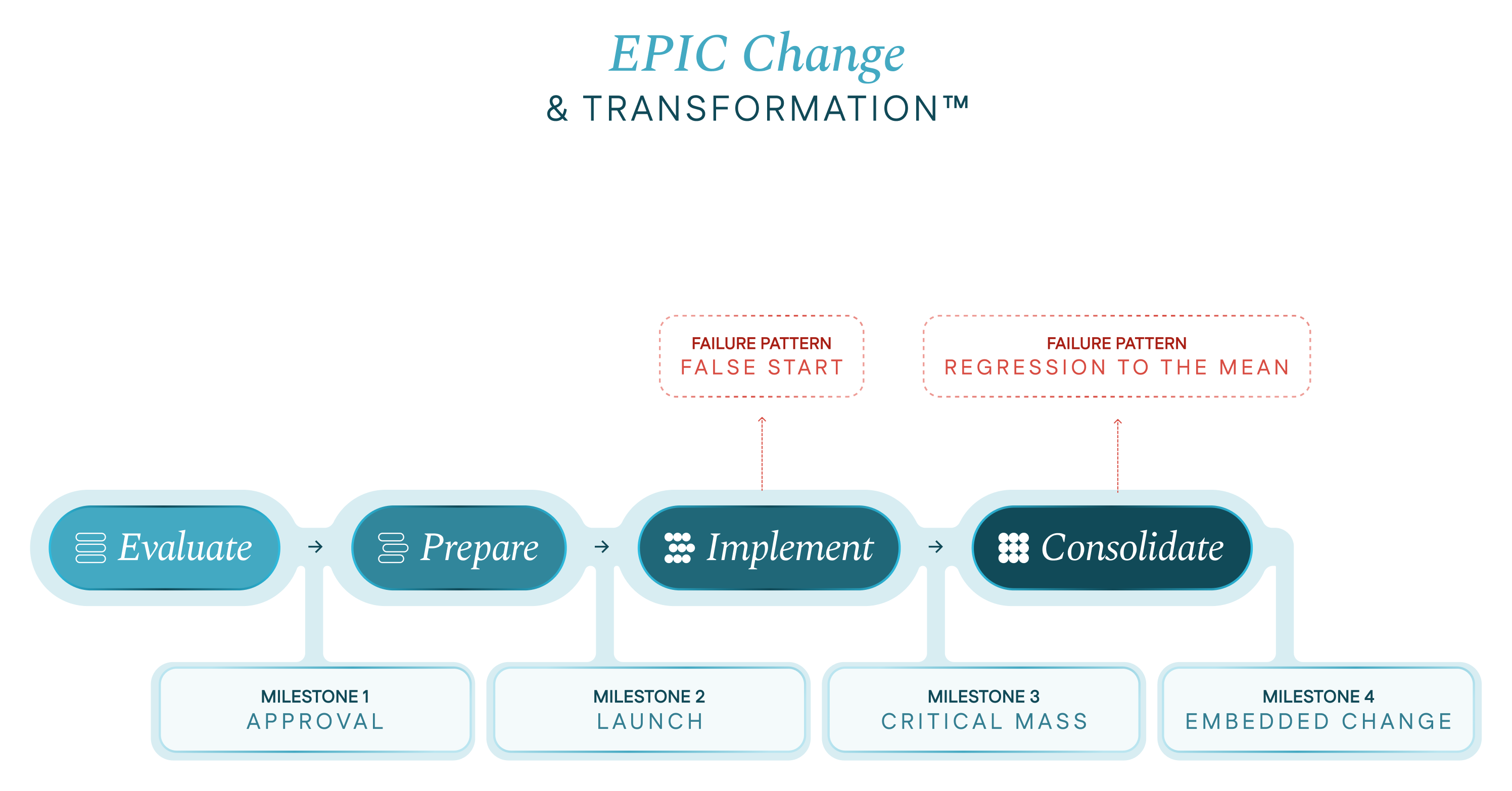
That produces two failure signatures, at opposite ends of the timeline:
- The false start — early-stage failure. The change is announced, a few people push, and it never reaches critical mass. No real coalition ever formed behind it.
- Regression to the mean — late-stage failure. The change is implemented, produces results, then fizzles. The leader disengaged before the new way of working embedded in the culture, and the gravitational pull of the old normal did the rest.
Knowing which one you’re heading for matters, because the fixes happen at different times: a false start is prevented months before launch, regression to the mean months after it.
The failure rate everyone quotes can’t be sourced
Nearly every article on this topic opens with the same memorably round failure percentage. It is worth knowing where that number came from, which is: nowhere anyone can point to.
In 2011, Mark Hughes of the University of Brighton published a review in the Journal of Change Management that took five separate published instances of the claim and traced each back toward its source. His conclusion: while a popular narrative of widespread change failure certainly exists, there is no valid and reliable empirical evidence supporting it (Mark Hughes, “Do 70 Per Cent of All Organizational Change Initiatives Really Fail?”, Journal of Change Management 11
, 451–464).The trail generally leads back to an early-1990s book on business process reengineering — a specific method, not organizational change in general — where the figure was an informal estimate, not a research finding. From there it was requoted, the qualifier fell off, and the scope widened to all change everywhere. Later citations point at earlier citations rather than at data.
Underneath the sourcing problem is a measurement problem: “failure” has never been defined consistently. Is a change that finished late a failure? One adopted by two thirds of the organization? One that worked for a year and then reverted? A credible percentage would require a shared definition of success that this field does not have.
The number survives because it’s useful: a high failure rate makes an excellent opening slide if you sell change consulting, and it’s quietly absolving if your last initiative stalled.
So we don’t publish a failure rate, including our own. Treat any precise figure you’re quoted with suspicion. What is defensible is the pattern of failure — patterns can be designed against, probabilities can’t.
Failure pattern one — the false start
A false start is what happens when a change never assembles a supporting coalition — the most common way change management fails before anything has really begun. One leader wants it. Nobody else owns it. The announcement lands, the enthusiasm is polite, and within a quarter the initiative is one more thing on a list.
The root cause is usually that the leader mistook approval for support — getting a decision approved and getting an organization to carry it are different problems. A coalition does two things a sponsor cannot: it performs the distributed work of change across functions and levels, and it generates energy by visible example, which makes the change feel possible to everyone watching.
Audit a coalition on four attributes before you launch:
- Assets — the authority, reputation, expertise, and relationships members bring. People judge the coalition’s odds, not just the leader’s.
- Effort — visible, consistent discretionary effort that signals real commitment.
- Influence — the ability to spread belief and pull others in.
- Intelligence — eyes and ears that detect resistance and cultural landmines early enough to course-correct.
The traps that produce false starts all sound reasonable at the time: everyone already sees the problem · we don’t have time to build consensus · it’ll be faster if I do it myself · people will get on board once they see results. Each skips the participation step, and participation is what builds commitment. People resist what they didn’t help create — which is why false starts get misdiagnosed as a resistance problem when they’re really an involvement problem.
Failure pattern two — regression to the mean
Regression to the mean is late-stage change failure: the change is implemented, it works, and then it reverts. Nobody cancels it. There’s no post-mortem. A year on, people are doing what they did before, and the initiative has become something the organization tried once.
The cause is leader disengagement. Results appear, attention moves to the next priority, and the change is left to hold itself up before it’s embedded anywhere durable. Embedding happens across three organizational layers, and most efforts stop after the first:
- Systems — processes, technology, structures, and the formal rules for how work gets done.
- Behavior — what people actually do day to day, including the unwritten norms nobody wrote down.
- Culture — what people believe, value, and reinforce in each other. This is the layer that makes a change survive a reorg, a bad quarter, or the leader’s departure.
Consolidation is harder than implementation, and that’s what leaders underestimate. Implementation has external urgency: a launch date, a visible plan, attention from above. Consolidation has none of it — the urgency has to be manufactured internally, by a leader who keeps showing up for something that already looks finished. That’s exactly when most leaders check out, and exactly when the outcome gets decided. If the thing you’re changing is the culture, how to change organizational culture goes deeper on the behavioral mechanism.
The mechanism underneath both — you can mandate compliance, not effort
Both patterns trace to one mechanism: change runs on discretionary effort, and discretionary effort is voluntary by definition. Working the established way is efficient because the organization already absorbed the cost of learning it. Any change re-imposes that cost — new tools, new habits, new ambiguity — and that surplus is the change work. It only gets done if people decide to do it.
Leaders who don’t make that exchange deliberately fall back on one of two approaches, both of which fail:
- Muscling the change — forcing it through formal authority, titles, or penalties. It produces motion and short-term compliance, then stalls, because the moment enforcement relaxes so does the behavior.
- Smuggling the change — downplaying or concealing it, phasing things out quietly, hoping nobody notices. It avoids the conflict and forfeits the commitment, and when people find out — they always find out — you’ve spent your credibility too.
The problem with both is identical, and the framework states it bluntly: you get their hands, some of their head, and none of their heart. Compliance can be mandated. Effort has to be earned, by exchanging genuine motivation and inspiration for the work you’re asking people to do.
Most “reasons change fails” are symptoms of the two patterns
The standard lists of reasons change management fails aren’t wrong — they’re downstream. Mapping each to its pattern tells you when to intervene:
| Commonly cited reason | What it usually is | Pattern |
|---|---|---|
| Poor or one-way communication | Announced once, never repeated enough to act on | False start |
| Employee resistance | Unacknowledged loss; people stuck mid-curve with nowhere to go | False start |
| No executive sponsorship | A sponsor was secured but a coalition never was | False start |
| Unclear vision or objectives | The case for change was never built | False start |
| Too many competing initiatives | Change capacity is spent; nothing reaches critical mass | False start |
| Training happened, behavior didn’t change | The behavioral layer was never reinforced | Regression to the mean |
| Momentum faded after launch | Leader attention moved to the next priority | Regression to the mean |
| People reverted to old workarounds | Consolidation stopped at the systems layer | Regression to the mean |
Read that way, the list stops being eight problems and becomes two.
Three moments where change efforts actually break
The span of uncertainty runs out
The span of uncertainty is the window between launch and the first visible evidence the change is working — how long people will keep giving effort on faith. It always closes. If it closes before you produce a real result, doubt returns, resistance regains legitimacy, and people start to hedge. As the framework puts it: thunder doesn’t water the crops, and people are looking for rain. Your job in early implementation isn’t to communicate harder, it’s to win something visible, fast.
A broken window goes unrepaired
Broken window theory applies directly to change. If someone ignores the new process and nothing happens, if a deadline slips with no follow-up, if a manager undermines the initiative with no consequence — each is a broken window, and each broadcasts the same message: this isn’t real, standards are optional, nobody’s watching. Consistency in the first 30 to 60 days sets the tone for everything after it.
People stall in resistance
Individuals move through a predictable arc during change — denial, resistance, exploration, commitment — and it’s neither uniform nor synchronized. Resistance is where the change becomes real, and it usually signals loss: of control, clarity, status, or comfort. A team that stalls there hasn’t rejected the change; it’s been given nothing to move toward. What people need is empathy, real listening, space to object without cost, and a reconnection to purpose. Push instead of guide, and resistance hardens into the quiet non-compliance that produces a false start.
Doing nothing is not neutral — it’s a choice
One failure mode never appears on anyone’s list, because it never gets a project name: the change you declined to make. Preserving the status quo feels like the conservative option, but its consequences are simply slower and less visible.
Map inaction across two axes — short and long term, intended and unintended. The short-term intended box fills easily: stability, familiar routines, no disruption. The box that matters is long-term unintended: eroding competitiveness, obsolete capability, the credibility a leadership team loses while a known problem goes unaddressed. The challenges you decline to solve offensively, you will eventually solve defensively.
How to keep a change initiative from failing
The prevention work maps cleanly onto the two patterns.
Against the false start
- Build the case for change on one clear lever — cost, value, or compliance — rather than arguing all three.
- Assemble a real coalition before launch, and involve them early enough to shape the change rather than just deliver it.
- Assess how disruptive the change actually is across roles, systems, behaviors, and job security, so you know where resistance will concentrate.
- Check your own credibility honestly. Under uncertainty, people take risks for leaders, not for plans.
Against regression to the mean
- Sequence a visible win inside the span of uncertainty, and communicate the result rather than the intent.
- Repair broken windows immediately, especially the ones involving other leaders.
- Keep consolidating past the point it feels necessary — into systems, then behavior, then culture. Your continued attention is the reinforcement mechanism.
LeaderFactor’s EPIC Change & Transformation™ course is built around exactly this. Its four phases — Evaluate, Prepare, Implement, Consolidate — are sequenced so the false start is prevented in Prepare and regression to the mean in Consolidate. The framework originates with Dr. Timothy R. Clark, whose book EPIC Change: How to Lead Change in the Global Age (Jossey-Bass, 2007) introduced the model. Shorter definitions live in our glossary entries for EPIC Change & Transformation™ and the EPICindex™.
Where to go next
- Change management — what it is and what it’s for.
- The change management process — the phase-by-phase sequence.
- Change management framework — how the major models compare.
- Change leadership — what the role demands of the person leading, not the plan.
- Managing resistance to change — reading pushback as data.
Frequently asked questions
- Why do change initiatives fail?
- Change initiatives fail in two recognizable patterns. A false start happens when no real coalition forms behind the change, so the effort never reaches critical mass. Regression to the mean happens later — the change works, then snaps back because the leader disengaged before it embedded in systems, behavior, and culture.
- What percentage of change initiatives fail?
- There is no reliable figure. The most-quoted failure rate in change management has been traced back through its published sources, and no valid empirical evidence was found supporting it; the number began as an informal estimate about a much narrower method. Plan against the known failure patterns instead of a probability.
- What is the most common reason change management fails?
- The most common reason is that leaders secure compliance instead of commitment. Change requires extra work, and extra work is discretionary effort that people choose to give. Authority can mandate attendance and compliance, but it cannot mandate effort — you get their hands, some of their head, and none of their heart.
- What is regression to the mean in change management?
- Regression to the mean is late-stage change failure. The initiative is implemented, produces real results, and then quietly reverts to the old way of working. The cause is leader disengagement before the change is embedded across all three organizational layers — systems, behavior, and culture. Consolidation stops too early.
- How do you stop a change initiative from failing?
- Build a real coalition before launch rather than relying on a single sponsor. Produce visible results fast, before people stop giving effort on faith. Enforce the new standard consistently from day one. Then stay engaged through consolidation until the change is embedded in behavior and culture, not just announced.