





Change management framework — the major models compared
A change management framework is a structured model for leading change. Compare Kotter, ADKAR, Lewin, McKinsey 7-S, Bridges and EPIC — and how to choose one.
A change management framework is a structured model that guides an organization from its current state to an intended future state — a named set of phases, conditions, or behaviors that tells you what to do, in what order, and what has to be true before you move on. The best-known ones are Kurt Lewin’s three-stage model, John Kotter’s 8-step process, the Prosci ADKAR® Model, the McKinsey 7-S Framework, William Bridges’ Transition Model, and LeaderFactor’s EPIC Change framework.
Most comparison articles get one thing wrong: these are not six competing answers to the same question. They are answers to different questions, built at different altitudes. Lewin was a social psychologist studying group dynamics; Kotter, a Harvard professor studying why corporate transformations stalled; Hiatt was explaining why individual employees don’t adopt; Bridges was writing about grief and identity. This page describes each framework in its originator’s own terms, then gives you a method for choosing — the part almost every list of change management models leaves out. For the discipline rather than the models, start with our change management overview.
What does a change management framework actually do?
A change management framework does three jobs: it names the phases so a sprawling initiative becomes legible, it tells you what has to be true before you advance, and it gives a shared vocabulary so a hundred people can discuss the same change without talking past each other. That third job is underrated — much of the value of adopting any credible framework is that everyone is finally using the same words for the same things.
Be equally clear about the limits. A framework cannot supply the judgment about whether the change is the right one, cannot manufacture the effort the change requires, and cannot substitute for a credible leader — applied by someone the organization doesn’t trust, it produces a well-documented failure rather than a chaotic one.
What are the major change management frameworks?
Six models dominate the field. Here they are side by side before we take each one in turn.
| Framework | Originator | Built to | Unit of analysis | Reach for it when |
|---|---|---|---|---|
| Three-stage model (unfreeze–change–refreeze) | Kurt Lewin | Explain how a stable system moves and re-stabilizes | The organization’s state | The change needs a mindset shift first |
| 8-Step Change Model | John Kotter | Sequence what leaders do to drive transformation | Leadership system | You need a defensible order of operations at scale |
| Prosci ADKAR® Model | Jeff Hiatt / Prosci | Diagnose why an individual hasn’t adopted | The individual | Adoption has stalled and you don’t know why |
| 7-S Framework | Peters, Waterman, Phillips (McKinsey) | Test whether seven org elements are aligned | The organization’s design | Parts of the business are quietly fighting the change |
| Transition Model | William Bridges | Describe the inner psychological process of change | The person’s experience | People are grieving what the change is taking away |
| EPIC Change | Dr. Timothy R. Clark / LeaderFactor | Generate and sustain the discretionary effort change requires | The leader and the coalition | The plan is fine but nobody is giving it real energy |
Lewin’s three-stage model — unfreeze, change, refreeze
Kurt Lewin’s model describes change as movement between stable states: unfreeze the existing equilibrium, change to the new way of working, then refreeze so the new way holds. Its companion tool, force field analysis, frames any situation as a balance of driving forces pushing toward change and restraining forces holding it back — Lewin’s key insight being that reducing restraining forces usually moves a system more effectively than adding push.
One caveat on attribution: the tidy three-step formulation is universally credited to Lewin, but scholars note that he died in 1947 and that the crisp packaging was largely consolidated from his broader field-theory work by later writers.
Its strength is putting readiness first. Its most cited limitation is the third stage — “refreeze” assumes a new stable state, which sits awkwardly with environments where the next change is already arriving.
Kotter’s 8-Step Change Model
John Kotter introduced his model in the 1995 Harvard Business Review article “Leading Change: Why Transformation Efforts Fail” and expanded it in Leading Change (1996). The eight steps, in Kotter’s own current wording, are:
- Create a sense of urgency
- Build a guiding coalition
- Form a strategic vision
- Enlist a volunteer army
- Enable action by removing barriers
- Generate short-term wins
- Sustain acceleration
- Institute change
Kotter later evolved the model in Accelerate (2014), reframing the eight as concurrent, continuously running “accelerators” rather than a strict linear sequence — an update many summaries omit.
Its distinguishing move is the guiding coalition: not a project team or steering committee, but a genuinely powerful alliance who collectively carry the transformation. Its scope is deliberately organizational, which is also its boundary — it tells you what the leadership system should do, not which specific person is stuck or why.
The Prosci ADKAR® Model
Developed by Prosci founder Jeff Hiatt and set out in his 2006 book ADKAR: A Model for Change in Business, Government and Our Community, ADKAR is explicitly an individual-level model. Its premise is that organizational change is the aggregate of individual changes, and that each person must achieve five outcomes in order:
- Awareness of the need for change
- Desire to participate and support it
- Knowledge of how to change
- Ability to apply the new skills and behaviors
- Reinforcement to make the change stick
Its most useful mechanic is the barrier point: progress is limited by the first element that is insufficient. If a group lacks Desire, more training — more Knowledge — will not help, and more training is exactly what a stalled program reflexively does. ADKAR sits inside Prosci’s wider methodology, which wraps it in an organizational-level process.
The McKinsey 7-S Framework
Developed around 1980 by Tom Peters, Robert Waterman and Julien Phillips at McKinsey, with Richard Pascale and Anthony Athos, the 7-S Framework holds that organizational effectiveness depends on the alignment of seven interdependent elements — three “hard” (Strategy, Structure, Systems) and four “soft” (Shared Values, Skills, Style, Staff). Shared Values sits at the center, and the central claim — captured in the founding article’s title, “Structure Is Not Organization” — is that you cannot change one element without disturbing the others.
The 7-S is not a process and does not pretend to be. It is a diagnostic of alignment: it shows which parts of the organization your change is about to contradict. That makes it excellent as a pre-mortem and unhelpful as a Monday-morning plan.
Bridges’ Transition Model
William Bridges’ contribution is a distinction rather than a sequence. Change is external — the reorg, the new system, the merger. Transition is internal — the psychological process a person goes through to come to terms with it. Change can happen on a date; transition cannot be scheduled.
Bridges describes three phases: Ending what currently is, the Neutral Zone, and the New Beginning. The Neutral Zone — the disoriented middle where the old way is gone and the new way isn’t working yet — is the model’s most valuable idea, because it reframes a period leaders usually read as failure or resistance as a predictable, necessary stage.
Like ADKAR, it is a lens on the human side rather than a project methodology, and it is the most useful of the six when managing resistance to change.
LeaderFactor’s EPIC Change framework
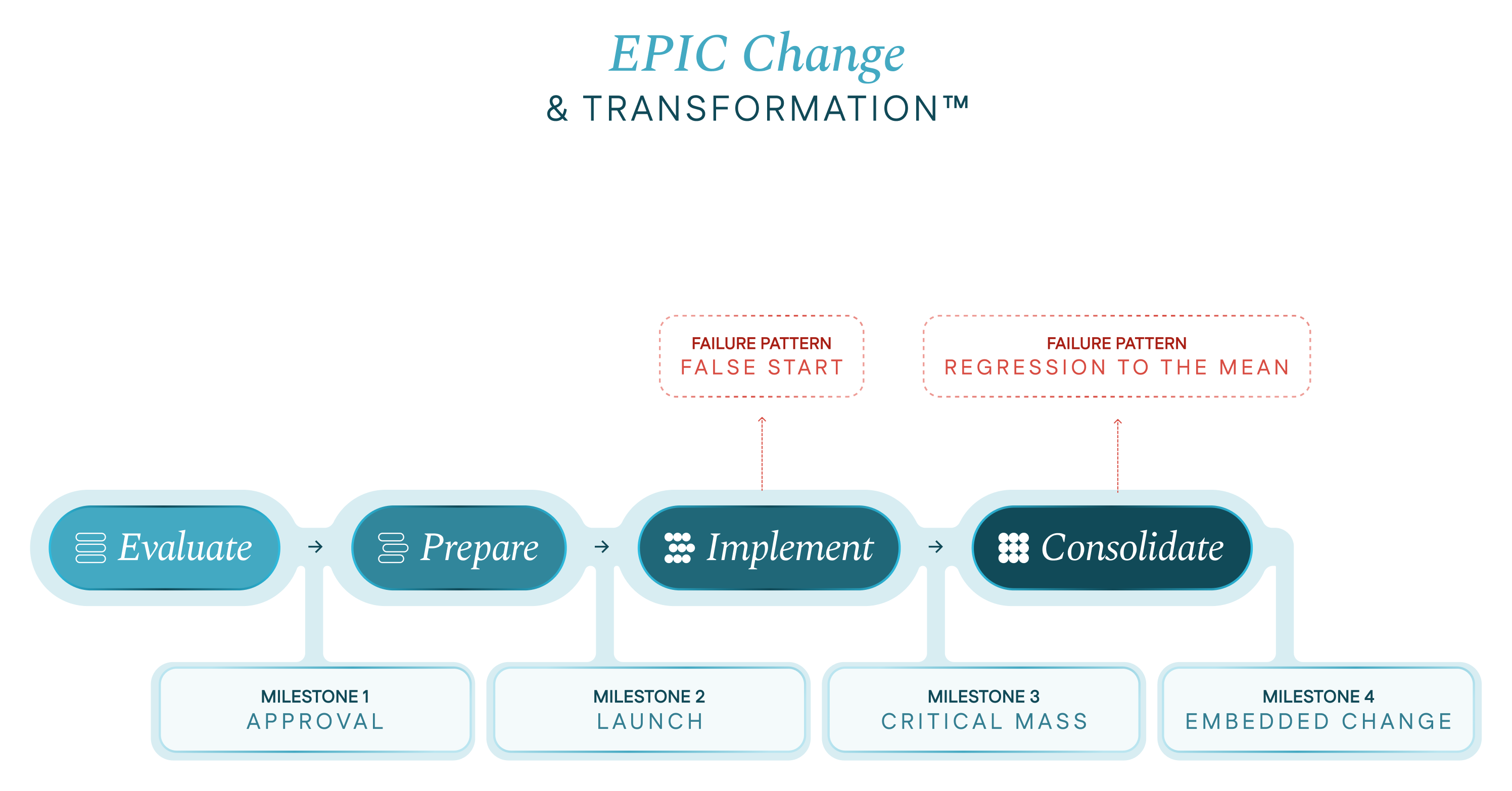
EPIC, developed by Dr. Timothy R. Clark and set out in his book EPIC Change (Jossey-Bass, 2007), organizes change into four nonlinear phases:
- Evaluate — look unflinchingly at reality: the competitive landscape, internal performance, the honest cost of doing nothing. Transition out: approval.
- Prepare — build the plan, the message, the coalition, and yourself. Transition out: launch.
- Implement — execute while navigating uncertainty and producing visible early results. Transition out: critical mass.
- Consolidate — embed the change across systems, behaviors, and culture. Outcome: enduring change.
Phases overlap, vary in length, and repeat; the framework is deliberate about not being project management. What distinguishes it is not the phases — several models have phases — but what it treats as the scarce resource.
How do you choose a change management framework?
Choose by diagnosing the failure you actually have. Almost every comparison article stops at “consider your organization’s needs,” which is not a criterion. Here is a usable one — ask what your change is stuck on:
- Sequencing — we don’t know what to do next, or in what order. → Kotter’s 8 steps or EPIC. Both give an order of operations and a definition of “ready to advance.”
- Adoption — people have been told, trained and equipped, and still aren’t doing it. → ADKAR, to find the barrier point, or Bridges, to see whether people are stuck in the Neutral Zone.
- Alignment — the change is fine on paper and the organization keeps rejecting it. → McKinsey 7-S, to find which of the seven elements contradicts the new direction.
- Energy — the plan is sound, the training happened, and nobody is putting anything extra into it. → EPIC, which treats that extra effort as the thing to be managed.
Then apply three filters. Match altitude to scope — an enterprise transformation model applied to a team-level process change produces theater. Prefer frameworks with a diagnostic — a model that only narrates a journey tells you where you are; one with an instrument attached tells you what to do. And check whether the framework accounts for the leader, because most don’t: they model the organization or the employee and treat the person driving the change as a constant.
What the EPIC framework emphasizes that the others don’t
Three things — including where EPIC is thinner than its neighbors.
1. Discretionary effort is the currency of change. EPIC’s premise is that change is additional work and additional stress on top of the day job, and that the extra effort is voluntary. People don’t give it for wages; leaders have to trade motivation and inspiration for it. Hence the two substitutes the framework names and rejects: muscling the change (authority, procedure and penalty, which buys compliance) and smuggling it (downplaying it and hoping nobody notices). Either way you get people’s hands, some of their head, and none of their heart.
2. It names two failure patterns and locates their root causes. Rather than a general theory of failure, EPIC identifies where initiatives actually die:
- False start — early-stage failure, before real progress is made. Root cause: no supporting coalition was assembled. The fix belongs in Prepare.
- Regression to the mean — late-stage failure, where a change is implemented and then quietly fizzles back to the old way. Root cause: the leader disengaged before the change embedded in the culture. The fix is the full Consolidate phase.
Both are leader-side causes, not employee-side. More on this in why change initiatives fail.
3. It measures the leader before it plans the change. EPIC opens with the Five Gauges of Credibility — Character, Competence, Commitment, Care, and Capacity — on the argument that credibility is most visible precisely when things are uncertain, and that the real question is how much risk people will take because you asked them to. The EPICindex™ scores a leader across those five dimensions on a five-point scale, with an optional multi-rater version. It is a reflective diagnostic, not a validated psychometric instrument, and LeaderFactor describes it that way.
Three further tools carry the framework’s emphases. The Disruption Profile rates a change across ten dimensions — mission and strategy through structure, technology, process, policy, behavior and personal impact — to show where the shock will land. The U-Curve of Personal Change maps the emotional journey from denial to resistance to exploration to commitment, and what people need at each stage. The Span of Uncertainty is the window between launch and first visible result during which people keep giving discretionary effort without evidence it’s working; wait too long to show something real and the energy drains, however good the plan was.
EPIC Change & Transformation™ also frames change leadership as interpersonal roles a leader moves between rather than a single style — interpreter, storyteller, sherpa, grief counselor, coach, bridge builder, energy manager, mirror holder, tailor, triage nurse. Defaulting to one mode for every person and every stage is itself a failure pattern.
Where is EPIC thinner? It is younger and less academically dissected than Lewin or Kotter, and its focus on the leader means it says less about organizational design than 7-S does.
Can you combine change management frameworks?
Yes — and most mature change functions do, because the models sit at different altitudes rather than in competition. A coherent stack runs an organizational sequence (Kotter or EPIC) as the spine, an individual diagnostic (ADKAR) to find where adoption is stuck, and a psychological lens (Bridges, or EPIC’s U-Curve) to interpret what looks like resistance.
The real risk isn’t theoretical incompatibility. It’s vocabulary sprawl: three sets of jargon in circulation and a workforce that stops tracking any of it. Pick one framework as the shared language everyone uses out loud, and treat the others as internal instruments for the change team.
About the failure statistic you’ll see on every other page
Nearly every article on this topic opens with a dramatic change-failure percentage, presented as settled fact. Worth knowing: a 2011 review in the Journal of Change Management by Mark Hughes traced the most widely cited version of that figure back through five published sources and concluded there is no valid, reliable empirical evidence behind the popular narrative.
It matters because it changes how you read framework marketing. Nobody can credibly quote a framework’s success rate when the underlying base rate isn’t established. What is well documented is the mechanism: initiatives commonly collapse early when no real coalition forms behind them, and late when leadership attention moves on before the new way is embedded. Choose on whether a framework addresses those mechanisms — not on a number.
Where to go next
A framework is the map. The next question is what you do on Monday — for that, work through the change management process step by step. To run the four EPIC phases, the coalition tools, and the credibility diagnostic against a live initiative, see LeaderFactor’s change management skill.
Frequently asked questions
- What is a change management framework?
- A change management framework is a structured model that guides an organization from its current state to a desired future state. It sets out the phases, behaviors, or conditions change requires. Common frameworks include Lewin's three-stage model, Kotter's 8 steps, the Prosci ADKAR Model, McKinsey 7-S, Bridges' Transition Model, and LeaderFactor's EPIC Change framework.
- What is the best change management framework?
- There is no single best change management framework — each solves a different problem. Kotter's 8 steps sequence organizational change, ADKAR diagnoses individual adoption, Lewin frames readiness, McKinsey 7-S tests alignment, Bridges explains the psychological transition, and EPIC focuses on the discretionary effort change requires. Choose by naming what your initiative is actually stuck on.
- What is the difference between Kotter's 8 steps and the ADKAR model?
- Kotter's 8-step model works at the organizational level, sequencing what leaders do — build urgency, form a guiding coalition, create a vision, generate short-term wins. The Prosci ADKAR Model works at the individual level, tracking the five outcomes one person needs: awareness, desire, knowledge, ability, and reinforcement. Many organizations run both together.
- How do you choose a change management framework?
- Choose a change management framework by diagnosing the problem first. If you don't know what to do next, use a sequenced model like Kotter's or EPIC. If people know but aren't adopting, use ADKAR or Bridges. If the organization is fighting itself, use McKinsey 7-S. Then match the framework's scale to your change's scope.
- Can you combine change management frameworks?
- Yes, and most mature change practices do. The frameworks operate at different altitudes, so they layer rather than compete — an organizational sequence such as Kotter's or EPIC, an individual adoption diagnostic such as ADKAR, and a psychological lens such as Bridges' Transition Model. The risk is running three vocabularies at once and confusing people.