





Change leadership: what a leader does that a process can't
Change leadership is the personal work of carrying people through change — the credibility, emotional load, and roles no change management process can supply.
Change leadership is the personal, human work a leader does to carry people through a change — setting direction, earning the right to ask for extra effort, and absorbing the emotional load that a project plan cannot absorb for anyone. Change management is the system: the phases, the schedule, the comms calendar, the training. Change leadership is the person: whether anyone actually follows. Both are necessary, and organizations routinely invest in the first while assuming the second will take care of itself.
It rarely does. A change initiative can be well-scoped, properly resourced, and beautifully project-managed, and still die quietly because nobody with authority made it feel worth the trouble. LeaderFactor’s position on this is blunt: if you can’t lead change, you can’t lead. In an era where change is continuous rather than episodic, change leadership stops being a specialist competency for transformation programs and becomes a basic requirement of the job.
What is change leadership?
Change leadership is the practice of influencing people to willingly adopt a change — supplying the vision, credibility, and emotional support that make a transition survivable and worth doing. It is a competency, not a title. The person leading a five-person process change and the executive leading an enterprise transformation are doing the same work at different scales.
That work is stubbornly personal. You can hire a change manager, stand up a change office, and buy a methodology. You cannot outsource the moment a skeptical team member decides whether to give this thing a real try, because that decision is made about you, not about the initiative.
Change leadership vs change management: what’s the difference?
Change management governs the change; change leadership governs the people doing the change. Change management is the set of tools and structures that keep an effort under control — scope, sequence, communications, training, adoption tracking. Change leadership is the set of human behaviors that make people want to be part of it. One is delegable. The other is not.
| Change management | Change leadership | |
|---|---|---|
| What it governs | The change | The people doing the change |
| Primary output | Control, coordination, predictability | Commitment, energy, discretionary effort |
| Main instruments | Plans, phases, comms, training, ownership maps | Credibility, presence, narrative, judgment |
| Typical failure | A sound plan nobody follows | Enthusiasm with no execution |
| Can it be delegated? | Yes — to a change office or PMO | No — it is personal |
The distinction was popularized by John Kotter, who drew the line between the two by describing change management as a set of controls that minimize disruption, and change leadership as the driving forces and vision that fuel large-scale transformation. Most treatments stop at that contrast. The useful question is the next one: what, concretely, does the leader do that the process cannot?
For the mechanics themselves, see the change management overview, the step-by-step change management process, and the change management frameworks that structure them. This page is about the other half.
Why the leader’s part can’t be outsourced
Every meaningful change asks people to do more work under more stress for a while, in exchange for a benefit they cannot yet see. That surplus effort is voluntary. People give it — or withhold it — based on how they read the person asking.
When leaders sense they aren’t getting it, they usually reach for one of two shortcuts, and LeaderFactor’s EPIC Change & Transformation™ framework names both:
- Muscling the change. Using position, mandate, procedure, or penalty to force adoption. It works fast and produces exactly what it demands: compliance.
- Smuggling the change. Downplaying or hiding what’s really happening in the hope that nobody objects until it’s too late to object. It avoids conflict now and buys distrust later.
Both fail the same way. As the EPIC course puts it: you get their hands, some of their head, but none of their heart. The technical change lands and the human change doesn’t, so the moment attention moves elsewhere, the old behavior returns. Leading for commitment is slower up front and is the only version that survives contact with a bad week.
The five gauges of credibility
Credibility is a change leader’s licence to lead change — and it is most visible exactly when things are uncertain. The practical test is simple: how much risk will people take because you asked them to? LeaderFactor’s EPIC framework breaks the answer into five gauges:
- Character — Are you honest, fair, and aligned between what you say and what you do?
- Competence — Have you done the homework? Do you understand the change well enough to be trusted with it?
- Commitment — Do you have skin in the game, or are you asking for sacrifice you won’t share?
- Care — Do you genuinely care what this costs the people living through it?
- Capacity — Do you have the bandwidth and protected time to actually lead this, on top of everything else?
Capacity is the gauge most leaders skip and most teams notice. A leader with impeccable character and no calendar is, functionally, an absent sponsor. Change leadership is a time commitment before it is a skill set, and a leader who cannot protect the hours should renegotiate the scope rather than pretend.
LeaderFactor’s EPICindex™ is the self-assessment that scores a leader across these five dimensions and turns the low gauge into a development plan. It is a diagnostic for personal readiness, not a psychometric instrument — its value is the conversation it starts about which gauge is currently costing you followership.
The ten interpersonal roles of a change leader
This is the part no process covers. Across a transformation, a leader has to play ten distinct interpersonal roles, and the skill is knowing which one the moment calls for rather than defaulting to a favorite.
- Interpreter — Clarify complexity. Translate strategy into what it means for this team, this week.
- Storyteller — Connect the change to purpose through narrative, not bullet points.
- Sherpa — Walk beside people through the hard part instead of pointing at the summit.
- Grief Counselor — Acknowledge what is ending. Most resistance is about loss, not logic.
- Coach — Build the skills and mindsets the new way of working actually requires.
- Bridge Builder — Unite groups whose interests the change has put in tension.
- Energy Manager — Read momentum and morale, and regulate the pace accordingly.
- Mirror Holder — Reflect back both strengths and blind spots, honestly.
- Tailor — Customize your approach to the person in front of you.
- Triage Nurse — Scan continuously for who needs help first, practically and emotionally.
Most leaders have two or three of these as natural strengths and quietly avoid the rest. The Grief Counselor is the most commonly skipped, and the most expensive to skip — a team that never got to say what it was losing will keep relitigating the decision months after it was made.
The emotional work: leading people through the U-Curve
People move through change on a predictable emotional arc, and the leader’s job is to meet them where they are rather than drag them to the end. LeaderFactor calls it the U-Curve of Personal Change, and it has four nonlinear stages:
- Denial — “This isn’t really happening.” What they need: clear, repeated communication, straight answers about what is and isn’t changing, and time to process.
- Resistance — “I don’t like this. I didn’t ask for it.” What they need: empathy, active listening without defensiveness, room to vent without consequence, and reconnection to purpose.
- Exploration — “Okay… how could this work?” What they need: opportunities to shape the thing, clarity on their role, and coaching rather than control.
- Commitment — “Let’s do this.” What they need: recognition, autonomy, and a role helping others across.
The two operational implications matter more than the model. First, people are on different points of the curve at the same time, so a single all-hands message will land as reassurance for some and as tone-deaf for others. Second, resistance is a stage, not a verdict — treating it as insubordination pushes people back to denial. For the specific plays, see managing resistance to change.
How to hold the line when energy dips
Every change has a span of uncertainty: the window between launch and first visible proof, during which people will keep giving discretionary effort on faith. It always runs out. If the evidence doesn’t arrive before the goodwill does, doubt hardens back into resistance. The EPIC course captures it in a farmer’s phrase — thunder don’t water the crops. You can make all the noise you want; people are looking for rain. Real results.
Two leader behaviors keep the window open:
- Engineer visible early wins. Implementation is less a slog than a race to show something worked. Sequence for proof, not just for logic.
- Fix the broken windows. When someone ignores the new system and nothing happens, when a deadline slips with no follow-up, when a leader undermines the change publicly and there’s no response — every unattended signal tells the organization the change is optional. Consistency in the first 30 to 60 days sets the standard for the whole initiative.
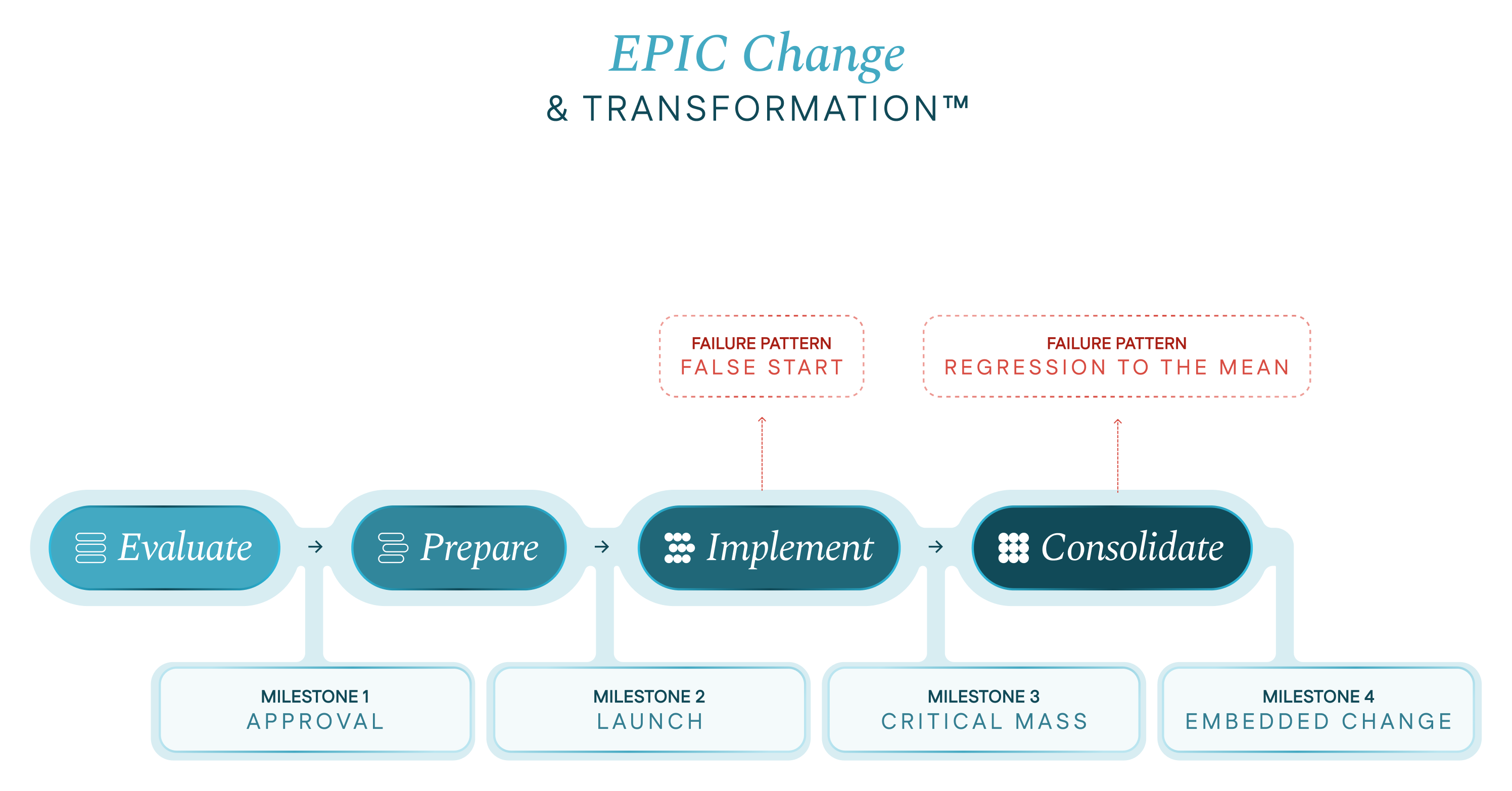
Then comes the failure that is specifically a leadership failure: regression to the mean. The change gets implemented, results appear, attention moves to the next priority, and the leader disengages before the new behavior embeds in culture. Consolidation is harder than implementation precisely because the external urgency is gone and the leader has to manufacture it internally. This is the moment most leaders check out, and it is the moment that decides whether the work holds. See why change initiatives fail for the fuller pattern.
Common change leadership mistakes
- Leading with false certainty. You don’t have all the facts, you can’t remove all the risk, you can’t promise zero losses, and you can’t eliminate the pain. Saying so builds more trust than a confident forecast that turns out wrong.
- Borrowed conviction. If you inherited the change, do the ownership work privately — rate your real commitment, name your concerns, take them to whoever can answer them — before you lead publicly. People can tell.
- Announcing instead of involving. Participation builds commitment. People resist what they had no hand in creating, which is why a coalition of credible colleagues outperforms a flawless directive.
- Playing one role. Defaulting to Interpreter or Coach for every situation leaves the grief, the energy, and the triage unattended.
- Confusing activity with progress. Meetings, decks, and status updates are thunder.
Where to go next
Change leadership is learnable, and it develops through carrying a real initiative rather than studying the topic. Start by locating your weakest credibility gauge, then pick the interpersonal role you habitually avoid and use it deliberately this month.
- Change management — the discipline as a whole
- The change management process — the steps, end to end
- Change management frameworks — the models and when to use each
- Managing resistance to change — what to do when people push back
- Why change initiatives fail — the failure patterns worth designing against
- EPIC Change & Transformation™ — LeaderFactor’s change leadership course and the EPICindex™ readiness assessment
The EPIC framework was developed by Dr. Timothy R. Clark, who also wrote EPIC Change (Jossey-Bass, 2007) on leading transformational change.
Frequently asked questions
- What is change leadership?
- Change leadership is the personal work a leader does to carry people through a change — setting direction, earning the credibility to ask for extra effort, and absorbing the emotional load of transition. It is distinct from change management, which supplies the plan, phases, and tools. Leadership supplies the commitment that makes the plan work.
- What is the difference between change leadership and change management?
- Change management governs the change itself — the phases, timelines, communications, and training that keep an initiative under control. Change leadership governs the people doing the change — vision, credibility, and emotional engagement. Change management can be delegated to a project office. Change leadership cannot; it is personal, and people follow the leader, not the plan.
- What makes a good change leader?
- Good change leaders have credibility across five gauges LeaderFactor calls character, competence, commitment, care, and capacity. Character and competence earn the right to be believed; commitment and care earn the right to ask for sacrifice; capacity is the protected time to actually lead. Skills matter, but credibility determines how much risk people will take because you asked.
- What is the leader's role during organizational change?
- A leader's role during organizational change is to convert a plan into willing effort. That means interpreting complexity, telling the story, acknowledging what people are losing, coaching new skills, managing energy, and staying visibly engaged long after launch — through the phase when the change embeds in culture and most leaders disengage.
- How do you lead a change you didn't choose?
- Inherited change requires doing the ownership work privately before leading publicly. Rate your genuine ownership, list your real concerns, take them to the people who can answer them, and test your assumptions. People detect borrowed conviction quickly, and a leader who is visibly unconvinced gives their team permission to wait the change out.