







Change management training for leaders.
Change doesn't fail at the announcement. It fails in the messy middle, in ways a leader could have seen coming. This program teaches the four phases of EPIC Change & Transformation™ on a change you're actually running, and measures the leader with the EPICindex™ before and after.
 EPICindex™ results in the LeaderFactor platform
The learning platform at leaderfactor.app, sample data.
- Format
- Cohort-based with self-paced modules, applied to a live initiative. Live-virtual, on-demand, or in person.
- Length
- Six weeks, then the 90-day milestone plan.
- Instrument
- EPICindex™ change-leader credibility, baseline and re-measure.
- Built for
- Change that keeps stalling. The kickoff was great; month three is where it always dies.
Change management training is a structured program that teaches leaders how to take an organization from the current way of working to a new one, so the benefits the change was supposed to deliver actually arrive. Done well, it gives a leader four things: a method with named phases, a read on their own credibility with the people being asked to change, a set of tools for the predictable failure points, and a way to measure whether any of it worked. Done poorly, it is a day on a framework, a good kickoff, and a change that stalls in month three the same way the last one did.
This page covers what effective change management training teaches, why most of it fails, which format fits which rollout, and the questions to ask any provider before you buy.
What change management training teaches a leader to do
Most change management training teaches a model. That is necessary, and it is the smaller half of the job. A model gives a team shared language and a checklist against skipping a step. It does not, by itself, make anyone willing to follow.
LeaderFactor’s training is built on EPIC Change & Transformation™, a framework based on 20 years of research across industries that says all successful change initiatives pass through four phases in sequence:
- Evaluate. Look unflinchingly at reality: the competitive landscape, internal performance, and the real cost of doing nothing. The phase ends with a go or no-go decision.
- Prepare. Build the plan, the message, and the coalition before you launch, so the change starts on solid ground.
- Implement. Execute through the span of uncertainty, capture momentum, and steer clear of the predictable landmines. This phase often looks like failure in the middle, and it ends when the change begins to generate more energy than it consumes.
- Consolidate. Embed the change in systems, behaviors, and culture so it holds after the urgency fades.
The second half of the curriculum is the leader. Where change management training focuses on the plan and the process, change leadership training focuses on the leader: the credibility, communication, and coalition-building that determine whether people actually follow. EPIC treats them as one discipline. People decide how much risk they are willing to take with you before they decide anything about your plan, and that willingness is something a leader can measure and build.
Why most change management training stalls in month three
Training fails for the same reason change fails: it is designed as an event rather than a practice. A leader learns a model on a Tuesday, returns to the same calendar and the same incentives, and runs the next change the way they ran the last one. The kickoff is strong because kickoffs reward energy. Month three is where it dies, because month three rewards credibility, follow-through, and a coalition that was supposed to be built before launch.
Two failure patterns account for most of it, and good training names both:
- The false start is a failure of adoption. The change launches and never takes. The root cause, more often than any other, is a coalition that was never properly built. Managers nod in the rollout meeting and then protect the old way.
- Regression to the mean is a failure of completion. The change takes, then quietly reverts, because the leader took their hands off the wheel too soon and the old norms were still underneath.
Training that only teaches a model prepares leaders for neither. Training that teaches a leader to see the false start coming in the Prepare phase, and to hold on through Consolidate, is the difference between a program that changes how your organization changes and one that produces a binder.
There is a quieter failure in how leaders get people to move. Muscling uses formal authority, procedures, or penalties to create compliance. Smuggling tries to slip a change in and pretend it was always the expectation. Both produce compliance, and compliance gives you people’s hands, some of their heads, and none of their hearts. Good training teaches leaders to invite commitment instead, and gives them the tools to earn it.
What the curriculum should include
Beyond the four phases, look for three things in any change management curriculum.
Credibility, made measurable. People read five things before they follow a leader into disruption: character, competence, commitment, care, and capacity. A leader who is principled under pressure, visibly capable, personally invested, attentive to people during the disruption, and actually has the bandwidth to start will be followed. A leader missing one of those will be waited out. Training should give leaders a baseline on all five before the change starts, not a theory about them.
Tools for the predictable failure points. EPIC comes with a toolkit a leader uses on their real change: the do-nothing scenario, which answers what happens if nothing changes over one year and five; the disruption profile, which shows where the change will hurt and who will feel it; the change-message stack, built so a vision educates, motivates, and activates; the coalition builder, aimed at the single most common cause of a false start; and the 90-day milestone plan, with one early, visible win in each 30-day window. A curriculum without tools leaves leaders to improvise exactly where improvisation fails.
Application to a live change. Leaders should leave with a finished plan for a change they are actually running, not a case study. Training that is applied to a live initiative gets used; training that is applied to a hypothetical gets filed.
Which format fits your rollout
Format should follow the change you are facing, not the training calendar.
- Leader cohort. A group of leaders from across the organization learns together, each applying the phases to their own initiative and holding one another to the milestone plan. This is the default for most organizations, because it builds a shared method across functions and because leaders are more candid about a stalling change among peers than in front of their own teams.
- Intact leadership team. One executive or divisional team works the framework on a single large change together. Best when the change is enterprise-scale and the coalition that has to hold is the team in the room.
- Self-paced learning. On-demand modules that teach the model and the tools. Useful as pre-work or for reaching a wide audience with the language, and not sufficient on its own, because there is no live initiative, no peer accountability, and no re-measure.
Delivery runs live-virtual, on-demand, or in person, and the program runs on leaderfactor.app with org-level reporting, so an administrator can roll leaders through in waves and see results across the organization. Organizations that want to run it themselves certify their own facilitators through the Certified Facilitator License.
How you know the training worked
Measure the leader, before and after, on a change they are actually leading. LeaderFactor’s EPICindex™ scores change-leader credibility across the five gauges at baseline and again after the practice window. The comparison answers the question that matters: did this person become someone people are more willing to follow through disruption, or did they attend a good workshop?
There are no invented ROI figures in that. The measurement mechanism is the baseline and the re-measure, on your own people, against your own change. If a provider cannot tell you what your leaders will do differently in week three and how you will know, you are being asked to take the result on faith.
Where to start
Start with the change you have, not the training catalog. If your changes launch and then stall, the problem is adoption and the training needs to live in Prepare. If they take and then quietly revert, the problem is completion and the training needs to live in Consolidate. If the organization is on its third transformation and people are waiting it out, the problem is credibility, and no model fixes that until the leaders do.
Then ask the diagnostic question EPIC puts to every leader: how much risk are people willing to take to follow you right now? Readiness isn’t inherited or announced. It is demonstrated, and it is where change management training that works begins. For the framework itself, read the change management process; for how it compares with the other major models, see change management frameworks.
What the program covers
Four phases, five gauges, nine tools.
All successful change initiatives pass through four successive phases. The curriculum walks each one on the leader's own initiative, with the tools that make the predictable failure points visible early.
-
Evaluate
Look unflinchingly at reality: the competitive landscape, internal performance, and the real cost of doing nothing. The phase ends with a go or no-go decision.
-
Prepare
Build the plan, the message, and the coalition before you launch. Four domains: yourself, the change, the team, the organization.
-
Implement
Execute through the span of uncertainty, capture momentum, and steer clear of the landmines. It often looks like failure in the middle, and it ends at critical mass.
-
Consolidate
Embed the change in systems, behaviors, and culture so it holds after the urgency fades. Technical, behavioral, then cultural.
-
The five gauges
Character, competence, commitment, care, and capacity: what people check before they decide to move with you, measured by the EPICindex™.
-
The toolkit
The change classifier, the do-nothing scenario, the disruption profile, the change message stack, the coalition builder, and the 90-day accelerator plan with one visible win per 30 days.
Assess, learn, apply, prove. One platform.
The program runs on leaderfactor.app: the baseline, the cohort and self-paced modules, the application tools, and the re-measure, with org-level reporting for the people who bought it.
EPICindex™ baseline 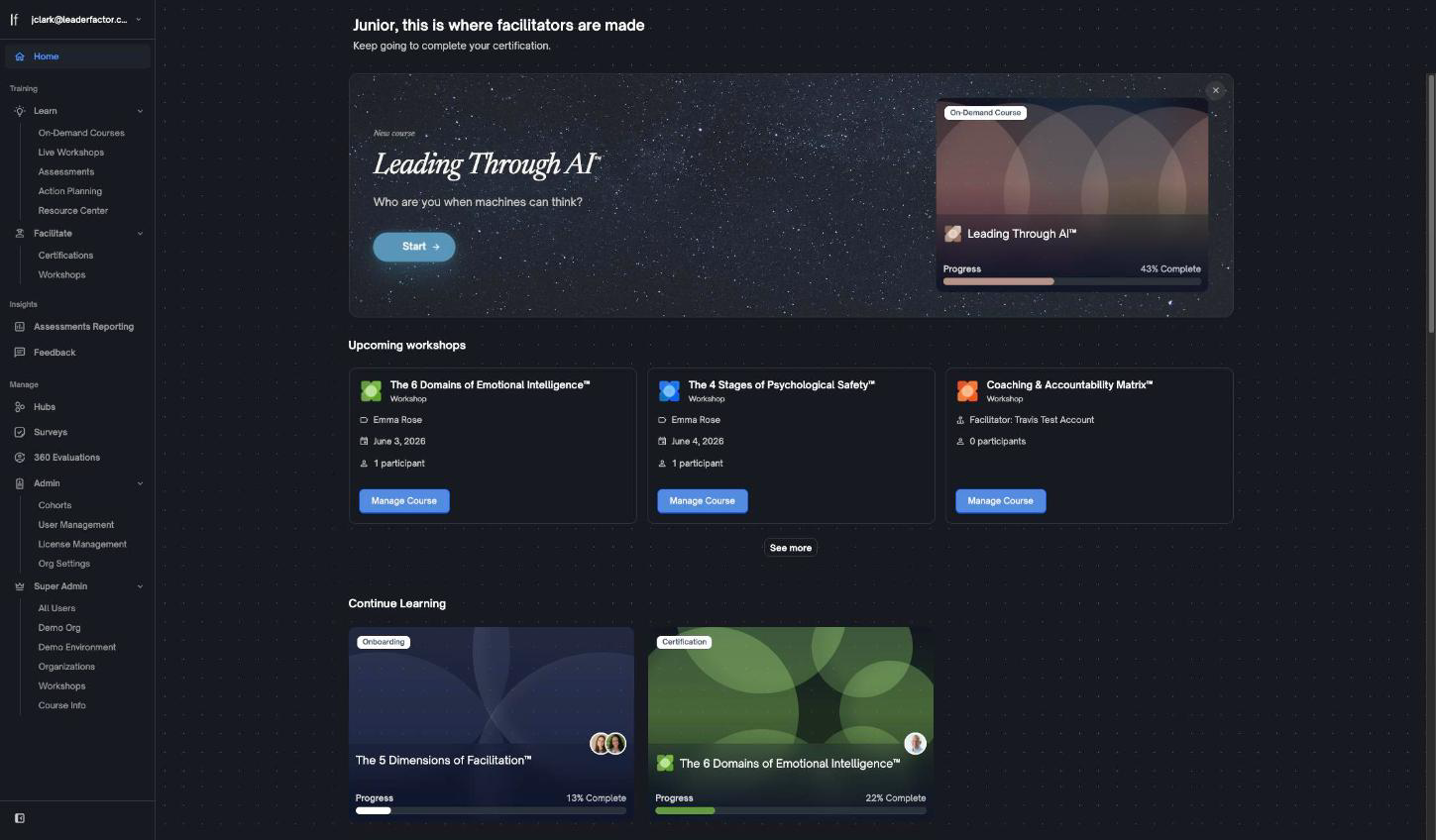 The learner home in the LeaderFactor platform
 EPICindex™ re-measure
Screens from leaderfactor.app with sample data. Not client results.
Not sure this is the skill you need?
If nothing ever gets decided in the first place, the gap is Critical Thinking. If the problem is 'it's always been like this' rather than a change with a start date, start with Psychological Safety. An AI rollout stalling on mechanics is this skill; one that needs the work redesigned is AI Leadership.
See the Critical Thinking programFrequently asked questions
- What is change management training?
- Change management training teaches leaders a repeatable method for taking an organization through change: evaluating whether the change is worth doing, preparing the plan and the coalition, implementing through the uncertain middle, and consolidating so the change holds. The best programs also build the leader's credibility, because people decide whether to follow a person before they decide whether to follow a plan.
- What is the difference between change management training and change leadership training?
- Change management training focuses on the plan and the process. Change leadership training focuses on the leader: the credibility, communication, and coalition-building that determine whether people actually follow. LeaderFactor's EPIC Change & Transformation treats them as one discipline, because a plan nobody follows is not a plan.
- How long does change management training take?
- A concentrated program runs about six weeks: a baseline assessment, sessions across the four phases of change, and application to a live initiative the leader is already running. The habits form in the 90 days after, through milestone plans, visible early wins, and a re-measure to see what moved.
- Do we need a certification to run change management training in-house?
- Not a public certification. LeaderFactor offers a Certified Facilitator License so your own people can deliver the EPIC program at your own cadence while keeping the framework and the EPICindex assessment intact. That is different from individual change-practitioner certifications, which credential a person rather than equip an organization.
- How do you measure whether change management training worked?
- Measure the leader before and after, against a change they are actually leading. LeaderFactor's EPICindex scores change-leader credibility across five gauges, character, competence, commitment, care, and capacity, at baseline and again after the practice window. The comparison shows whether the leader changed, which is the only result that predicts whether the next change will hold.
Run the change instead of absorbing it.
See the program run in a free one-hour Skill Preview, assessment included. Or talk with us about a cohort for your leaders.
or start with the free guide, How to overcome a legacy culture →