





The change management process, step by step
The change management process in order: the four phases, the gates between them, what each phase produces, who does what, and how long each part takes.
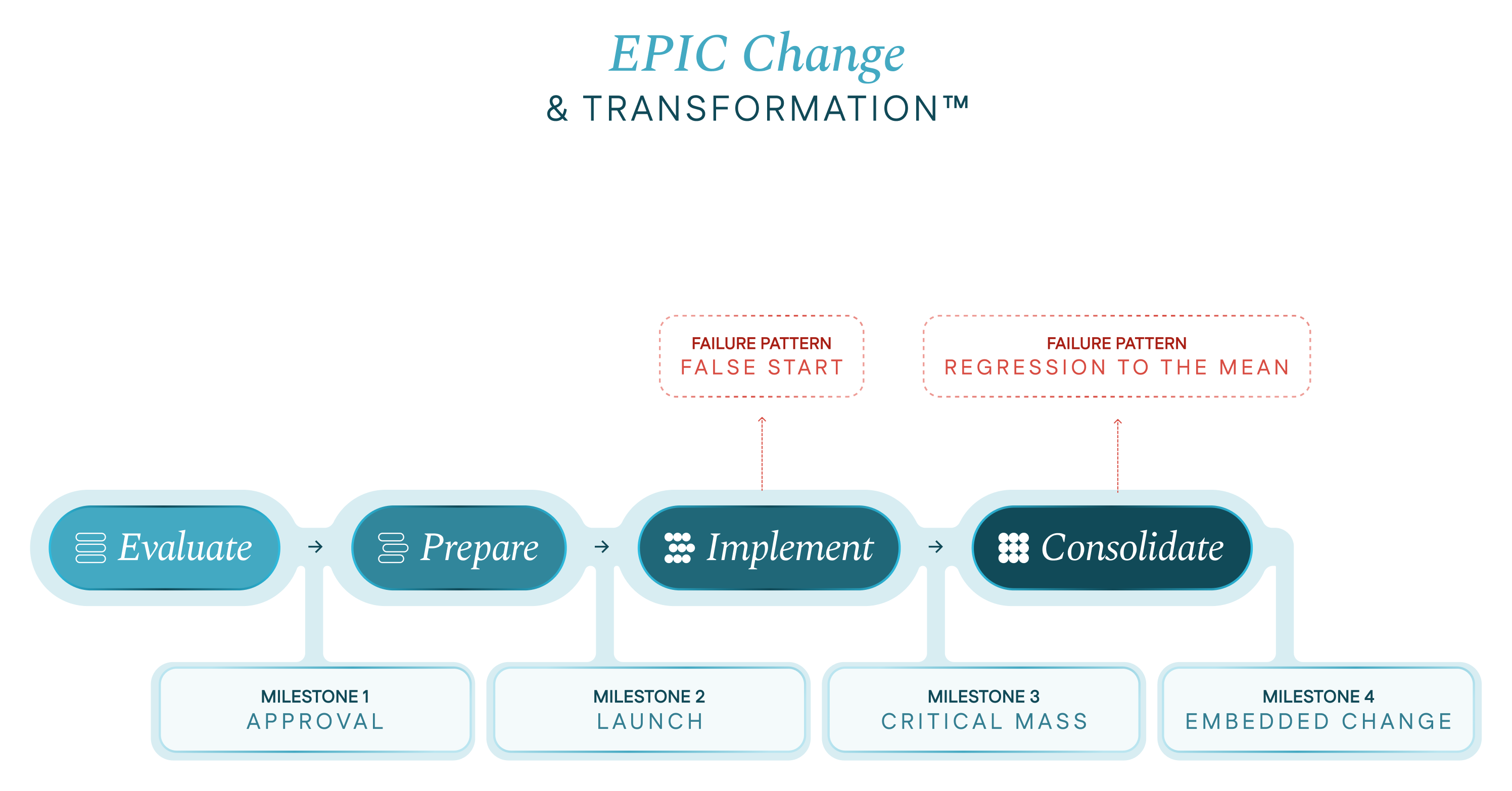
The change management process is the ordered sequence of work an organization moves through to take a change from someone noticed a problem to this is simply how we work now. A complete change management process has four phases — evaluate, prepare, implement, consolidate — separated by three decision points: approval, launch, and critical mass. The phases are ordered but not tidy; they overlap, stretch, and occasionally repeat. What can’t be reordered is the logic underneath them, because each phase earns the thing the next phase spends.
Most step-by-step guides describe the same broad arc and stop there. What decides outcomes is the rest: what each phase produces, who does the work, how long to hold the line, and why the order is the order. This guide covers all four.
What is the change management process?
The change management process is a structured sequence for planning, executing, and embedding organizational change so that people actually adopt it. It differs from project management: a project plan tracks tasks, dependencies, and dates, while a change management process tracks belief, effort, and adoption. The technical work of change — the new system, structure, or policy — is usually the easier half. The process exists to manage the harder half, which is human.
That distinction explains a common pattern: a change ships on time, on budget, and still fails, because nobody used it. A change management process is the discipline that prevents delivery from being mistaken for adoption.
The steps of the change management process, in order
There are four phases and three gates between them. The gates matter as much as the phases — each is a real decision that either happens deliberately or happens by accident.
| Phase | The question it answers | What it produces | The gate that ends it |
|---|---|---|---|
| 1. Evaluate | Is this change worth doing, and what happens if we don’t? | A defensible case for change and a clear-eyed read on how disruptive it will be | Approval — the organization commits |
| 2. Prepare | Are the plan, the message, and the people ready? | A change plan, a message that lands, and a working coalition | Launch — planning becomes doing |
| 3. Implement | Is it visibly working, fast enough? | Early results, sustained momentum, widening participation | Critical mass — enough people are in that it carries itself |
| 4. Consolidate | Has it become the default way of working? | New systems, new behaviors, new norms | Enduring change — the change stops being an initiative |
This is the spine of LeaderFactor’s EPIC Change & Transformation™ framework, developed by Dr. Timothy R. Clark, who wrote about leading organizational change in EPIC Change (Jossey-Bass, 2007). If you want the comparison against named models like ADKAR, Kotter’s eight steps, and Lewin’s unfreeze-change-refreeze, that belongs on a different page: see change management frameworks. Here we’re staying on what actually happens, in sequence. For the wider topic, start at the change management overview.
Step 1 — Evaluate: decide whether the change is worth doing
Evaluation is the phase where you look unflinchingly at reality before committing anyone else’s effort to it. Three pieces of work happen here, and they happen in this order.
Map the cost of doing nothing. Most organizations treat the status quo as the safe option. It isn’t — it’s a choice whose consequences are simply deferred. Work through the consequences of inaction across both the short and long term, intended and unintended. The short-term intended ones look reassuring: stability, familiar routines, no disruption. The long-term unintended ones are where the damage sits — obsolescence, erosion, competitors who moved while you didn’t.
Build the case on one lever, not three. A case for change gets weaker, not stronger, when it tries to promise everything. Pick a single strategic lever and build the argument there: cost reduction, value differentiation, or compliance, safety, and security. Organizations that try to pursue two at once tend to get stuck in the middle and deliver neither convincingly.
Profile the disruption before you cause it. A change lands differently across mission, strategy, culture, structure, technology, products, processes, policies, skills, and personal impact. Rating your initiative across those dimensions tells you where the spikes are — and the spikes predict exactly where resistance will show up and where you’ll need to spend communication and support.
Output of this phase: a case for change specific enough to be argued with, plus a realistic picture of what it will cost the organization in disruption.
The Approval gate. Evaluation ends with an explicit decision. Approval isn’t a signature on a budget line — it’s the moment the organization says yes, we’re moving forward, let’s get ready. Changes that skip this gate fail early, because there was never a clear commitment to point back to when things got hard.
Step 2 — Prepare: build the plan, the message, and the coalition
Preparation determines how hard implementation will be. It’s also the phase leaders most often compress, because it produces no visible progress. Three tracks run in parallel.
Prepare the change. A change plan covers scope, objectives, measures, milestones, resources and budget, roles and responsibilities, schedule, meeting and reporting cadence, communication, and how progress will be recognized. Nothing exotic — but the gaps in this document become the arguments you’ll have in month three.
Prepare the message. A change message has three jobs. Educate — teach people where the organization is going and how this fits. Motivate — give them a reason to care rather than comply. Activate — give them enough clarity to decide without asking. Then it has to survive three filters: clarity (simple and repeatable), relevance (connected to what people are living now), and memory (repeatable without notes). A message that fails the memory filter dies in the retelling.
Prepare the coalition. This is the highest-leverage move in the entire process. A coalition is a deliberately assembled group who carry the change with you, and it does two things a solo leader cannot: it performs the distributed work, and it generates energy by example. Choose members for four attributes — assets (credibility, authority, expertise, relationships), effort (visible, voluntary work others can see), influence (the ability to bring others along), and intelligence (eyes and ears that spot resistance before it hardens). Involve them early enough to shape the change rather than receive it. People resist what they didn’t help create.
Output of this phase: a plan, a message that passes all three filters, and a named coalition that has already been briefed and consulted.
The Launch gate. Launch is not a kickoff meeting. It’s the moment planning becomes execution and the organization’s attention turns on. Once you launch, a clock starts.
Step 3 — Implement: produce visible results before belief runs out
Implementation is not a long slog; it’s a race to visible evidence. The reason is a constraint worth naming: the span of uncertainty — the amount of time people will keep giving discretionary effort to a change before they need proof it’s working. That span is finite and it always runs out. When it does, doubt returns, resistance regains its footing, and people quietly start hedging.
So the discipline of this phase is sequencing for early, visible, credible wins — not the easiest wins, but the ones that answer what people are actually asking: is this real, and is it working? Announcements don’t do it. Results do.
Two practical rules govern the first months:
- Plan the first 90 days deliberately. Week-by-week milestones, a defined first visible win, a communication cadence, the coalition activated on a schedule, and metrics that make progress legible. Ninety days is roughly the horizon within which most organizations need to see something real.
- Fix broken windows immediately. If someone ignores the new process and nothing happens, that silence is a message: standards are optional. Early inconsistency compounds. The follow-through in the first weeks sets the tone for everything after.
This is also the phase where resistance to change becomes visible and needs to be worked rather than overridden, and where most of the reasons change initiatives fail show up in practice.
Output of this phase: demonstrated results, sustained momentum, and a widening group of people participating voluntarily.
The Critical mass gate. At some point enough people are participating that the change stops depending on the leader’s daily push and starts carrying itself. That shift — from leader-driven to self-sustaining — is the real signal to move into consolidation. It is not the same thing as go-live.
Step 4 — Consolidate: embed it in systems, behaviors, and culture
Consolidation is where change becomes permanent, and it’s the phase most leaders abandon. The reason is structural: by this point the urgency is gone, the attention has moved to the next priority, and nothing external is forcing the issue. You have to manufacture the urgency internally.
Embedding happens across three layers, and a change that only reaches one or two will regress:
- Systems — processes, technology, structures, and formal rules now assume the new way.
- Behaviors — daily habits and routines have actually changed, including for people who were never enthusiastic.
- Culture — what people believe, expect, and reinforce in each other has shifted. The change is no longer described as a change.
The work is unglamorous and specific: continued recognition, integration into standard practice, sustained and visible measurement, scaling to teams that came late, onboarding new hires into the new way rather than the old one, and — most of all — leaders who stay visibly engaged. Plan it as a six-to-twelve-month set of milestones, not a vague intention to “keep it up.”
Output of this phase: enduring change. The new way is simply how work gets done.
Who does what in the change management process
Published versions of the process rarely say who owns what. In practice, four groups carry it:
- The change leader owns the process end to end. Their credibility is the currency the whole thing runs on, and it has five components: character, competence, commitment, care, and capacity — that last one meaning protected bandwidth, which leaders most often lack. The EPICindex™ is a self-assessment that describes a leader’s readiness across these dimensions; it’s a development tool, not a psychometric instrument. Leading a change is a different job from administering one — see change leadership.
- The coalition does the distributed work and supplies the feedback loop. Without one, changes fail early — the classic false start.
- Managers of affected teams meet people where they are emotionally. Individuals move through a predictable arc — denial, resistance, exploration, commitment — at different speeds, and each stage needs something different: straight answers, then listening, then a chance to contribute, then recognition.
- Everyone affected supplies the discretionary effort. That’s not a footnote; it’s the resource the entire process is trying to secure.
Two approaches consistently fail here and are worth naming so you can catch yourself doing them. Muscling the change — using authority, procedure, or penalty — produces compliance and never commitment. Smuggling the change — downplaying it and hoping nobody notices — produces suspicion. Both get you people’s hands and none of their heart.
How long does the change management process take?
The honest answer is that the process doesn’t set the duration; the change does. Before estimating, classify the initiative across six dimensions — scope, magnitude, complexity, duration, risk, and criticality — which places it somewhere between a local process improvement and a full enterprise transformation. Those two extremes run the same four phases at completely different scales.
Three planning anchors hold across sizes:
- Implementation needs a visible result inside roughly 90 days. Not completion — evidence.
- Consolidation runs six to twelve months past go-live, longer for cultural change.
- Prepare and Consolidate are the two phases people compress, and they’re precisely where the two dominant failure patterns live: failing early for lack of a coalition, and fading late because leadership disengaged.
Budget more time for those two than instinct suggests. The measure of a change management process is not how fast it reaches launch; it’s whether anyone is still working the new way a year later.
What to do first
If you’re standing at the start of a change right now, do these three things in order: write down what happens if nothing changes, over one year and over five. Pick your single strategic lever and write the case in a paragraph a skeptic could argue with. Then list six people whose visible support would change how everyone else reads this — and go talk to them before you announce anything.
That’s the first week of a real change management process. Everything else in EPIC Change & Transformation builds from there.
Frequently asked questions
- What is the change management process?
- The change management process is the ordered sequence an organization follows to take a change from first recognition to permanent practice. It runs through four phases — evaluate, prepare, implement, and consolidate — separated by three decision points: approval to proceed, launch into execution, and the critical mass where the change becomes self-sustaining rather than leader-driven.
- What are the steps in the change management process?
- Evaluate the case for change against the cost of doing nothing. Secure approval. Prepare the plan, the message, and a coalition of people who will carry it. Launch. Implement, producing visible results quickly enough to hold people's effort. Reach critical mass. Consolidate by embedding the change in systems, behaviors, and culture until it endures.
- How long does the change management process take?
- Duration depends on the size of the change, not the process. A local process improvement can move through all four phases in a quarter; an enterprise transformation takes years. A useful planning rule is that implementation needs visible results within roughly 90 days, and consolidation runs six to twelve months beyond go-live.
- Who is responsible for the change management process?
- A named change leader owns the process end to end and carries the credibility that makes people willing to move. A coalition of respected colleagues does the distributed work and reads the organization's reaction. Frontline managers guide their own teams. Everyone affected supplies the voluntary effort the change actually runs on.
- What is the first step in the change management process?
- The first step is honest evaluation — examining what happens if nothing changes. Mapping the short- and long-term consequences of the status quo makes the real cost of inaction visible, which is what converts a leader's conviction into an organizational case. Only then is it worth building the argument for a specific change.