





How to lead organizational change
How to lead organizational change when the announcement is the easy part: the credibility that decides it, the coalition, and the phases where change dies.
How to lead organizational change is a different question from how to manage it, and the difference is where most initiatives are actually decided. Change management focuses on the plan and the process. Change leadership focuses on the leader: the credibility, communication, and coalition-building that determine whether people follow. The models you’ve heard of — Kotter’s eight steps, Prosci’s ADKAR — map the process side well, and they agree more than they differ. What they quietly assume is a leader people are already willing to follow into uncertainty. That assumption is the part you have to build.
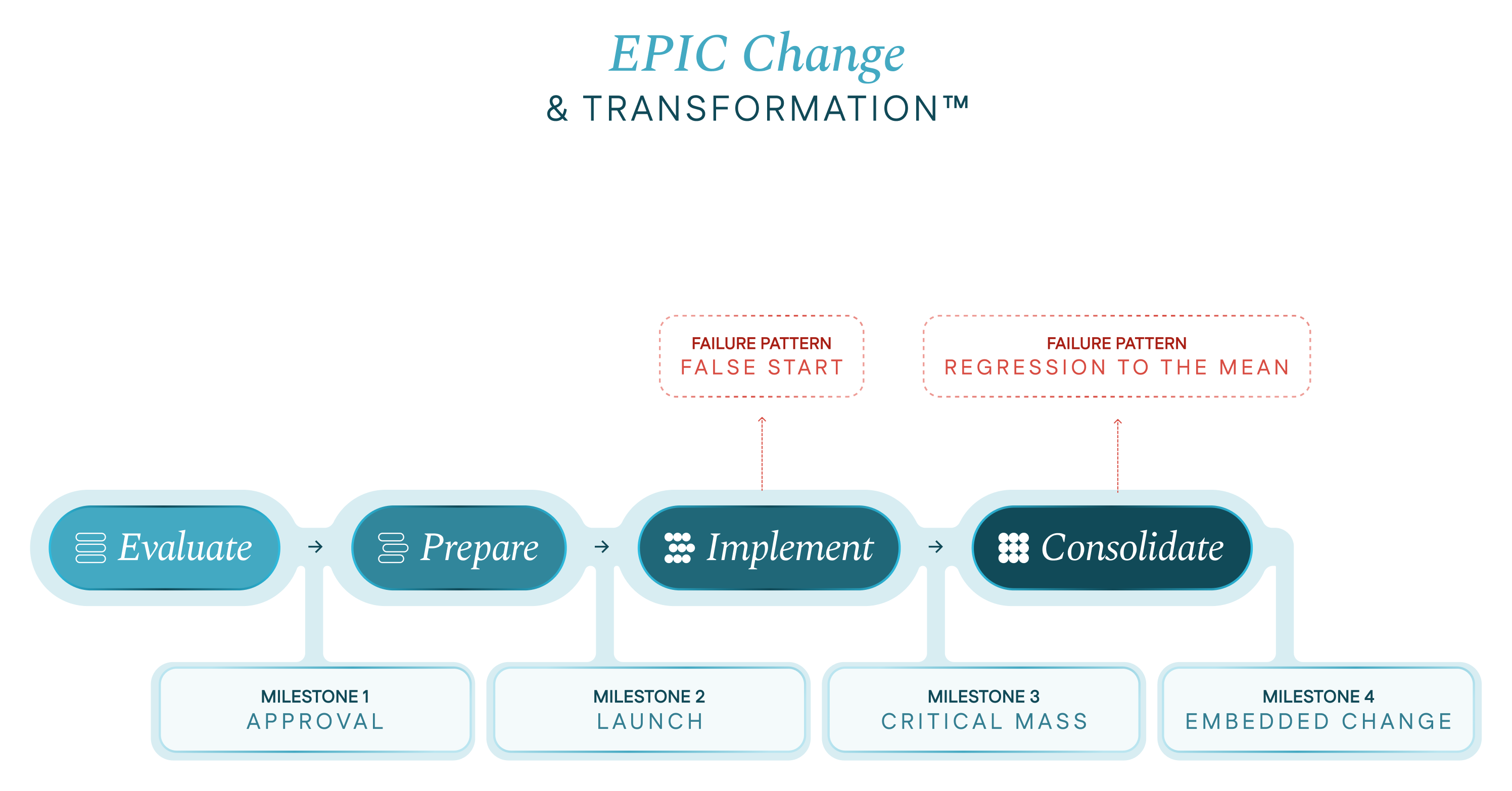
Here’s the arc, phase by phase, with the leadership work each phase actually requires.
Evaluate: earn the right to launch
Leading change starts before the change exists, with an unflinching look at reality: the competitive landscape, internal performance, and the real cost of doing nothing. The do-nothing scenario is the sharpest tool here. Ask it honestly (“if we change nothing, what happens in eighteen months?”) and one of two things follows: a case for change strong enough to survive scrutiny, or the discovery that this change isn’t worth the disruption. Both are wins. Evaluation ends in a genuine go/no-go decision, and leaders who skip it launch changes their own logic can’t defend in month three.
This phase also sets the honesty contract. There are four things you cannot promise people: that you have all the facts, that the risk is removable, that nobody loses anything, and that it won’t hurt. Leaders who pretend otherwise buy a smoother announcement at the cost of the credibility they’ll desperately need later.
Prepare: the coalition before the announcement
The most common cause of a false start — a change that never achieves adoption at all — is failing to properly build a coalition. Not a weak message, not a bad plan: launching alone.
Preparation covers four domains: yourself, the change, the team, and the organization. The coalition is the center of it. Before anything is announced, the leaders and informal influencers whose teams must live the change should have argued about it, shaped it, and signed on where the organization can see them. Kotter called this the guiding coalition decades ago, and the SERP-topping advice still treats it as a communications step. It isn’t. It’s the difference between a change with owners and a change with an audience.
The credibility that decides it
Here’s the correction this topic needs. The standard advice says: communicate the vision, more often and more clearly. But people don’t follow announcements. They follow leaders they’re willing to take a risk with, and readiness isn’t inherited or announced — it’s demonstrated. The EPICindex™ measures the five gauges people are actually reading:
- Character — principled under pressure; principles over politics.
- Competence — visible capability to lead this, shown in preparation and clear reasoning.
- Commitment — skin in the game; personal follow-through.
- Care — proactive attention to people during disruption, and a fair share of the load.
- Capacity — the bandwidth to actually see it through, with priority conflicts resolved.
If people trust who you are, believe you can do the job, see your skin in the game, feel that you care, and know you have the bandwidth, they move with you. If any gauge reads empty, no communication plan compensates. This is why identical change plans succeed under one leader and die under another.
Implement: through the messy middle
It’s February at a regional health system, five months into a new clinical documentation workflow, and the chief nursing officer is watching the metrics sag. Kickoff went beautifully. Now the strongest resistance and the biggest obstacles have arrived at the same time, adoption looks like failure from the inside, and two department heads are quietly reverting their units. What she does next decides the initiative, and the deciding factor isn’t the project plan. It’s whether the floor still believes her.
Implementation runs on the span of uncertainty: the amount of time people will give discretionary effort to a change without seeing evidence that it’s working. You can’t extend it by asking. You extend it with early wins — one visible, symbolically important win in each 30-day window of the first 90 days — until the change hits critical mass and starts generating more energy than it consumes.
Two temptations get strongest exactly here, and both are fatal. Muscling uses formal authority and penalties to force compliance. Smuggling slips the change in and pretends it was always the expectation. Don’t muscle, don’t smuggle: invite commitment. Compliance gives you people’s hands, some of their head, and none of their heart, and changes run on the heart part. The tactics for this stretch are covered in depth in managing resistance to change.
Consolidate: past the finish line that isn’t
Regression to the mean is a failure of completion, and it has one root cause: the leader takes their hands off the wheel too soon. Consolidation embeds the change through three layers — technical (systems and tools), behavioral (what people actually do), and cultural (norms and assumptions). Only when it reaches the cultural layer does the change withstand the pull back toward the old way. The test isn’t whether the dashboard looks good at launch plus six months. It’s whether the new way survives the leader’s attention moving elsewhere.
Where to start
If you have a change in flight, place it honestly in a phase and do that phase’s work; the most common self-deception is running Implement-stage urgency on a change that never got Prepare-stage foundations. If the change is still ahead of you, start with the do-nothing scenario and the coalition list. For the wider discipline, the change management pillar maps the whole territory, change leadership goes deeper on the leader’s side, and why change initiatives fail catalogs the failure patterns. Then take the measurement seriously: baseline your five gauges before the launch, because the time to find an empty one is now, while it’s still cheap to fill.
Frequently asked questions
- What does it mean to lead organizational change?
- Leading organizational change means taking people from the current way of working to a new one, and being the person they're willing to take that risk with. It covers evaluating whether the change is worth making, preparing the plan and coalition, implementing through the resistance, and consolidating the new way until it holds.
- What is the difference between change management and change leadership?
- Change management focuses on the plan and the process; change leadership focuses on the leader — the credibility, communication, and coalition-building that determine whether people actually follow. The distinction matters because most stalled changes have adequate plans. LeaderFactor's EPIC Change & Transformation™ treats the two as one discipline.
- What is a change coalition and why does it matter?
- A change coalition is the group of leaders and informal influencers who shape a change and visibly sign on before it's announced. It matters because the most common cause of a false start is launching without one: a coalition gives the change owners across the organization instead of an audience.
- What are the phases of leading organizational change?
- LeaderFactor's EPIC framework names four sequential phases: Evaluate (look honestly at reality and decide go or no-go), Prepare (build the plan, message, and coalition before launch), Implement (execute through the span of uncertainty), and Consolidate (embed the change in systems, behaviors, and culture so it lasts).