





AI leadership: the discipline behind the tools
AI leadership is an operating discipline, not tool fluency: what it demands of leaders, the five disciplines that structure it, and the judgment AI can't do.
AI leadership gets defined, in most of what ranks for the phrase, as a literacy problem: learn the vocabulary, understand the models, stay current on the tools. Necessary, and nowhere near the job. AI leadership is the discipline of leading an organization through AI — redesigning how work gets done, driving adoption that’s real rather than reported, and proving the value in business terms — while personally holding the class of judgment machines can’t make. Leading through AI is a leadership challenge before it’s a technology one. The tools change every quarter. The operating discipline doesn’t, and the discipline is what this page maps.
The distinction that organizes everything else
Start with what AI actually took over, because the honest answer organizes the whole topic. AI now does computational cognition superbly: processing, pattern-finding, analysis at speed and scale. What it doesn’t do is evaluative cognition — judgment under conditions of incomplete data, asymmetric stakes, and human consequence. An AI system can run a maze with increasing brilliance. Only the leader can decide which maze is worth running.
That line divides every leadership task you have. Summarizing the market data: computational, and increasingly not your job. Deciding what the organization should want given the data, whose trust you’ll spend to get it, and what it means for the people involved: evaluative, and more your job than ever. AI doesn’t change what leadership is. It changes the conditions under which you have to do it — faster, with less cover, and with your judgment exposed as the part you actually contribute.
The misconception: fluency is the finish line
The belief driving most executive AI education: “leaders need to understand AI — get them fluent and adoption will follow.” Organizations run the workshops, leaders learn to prompt, and eighteen months later the licenses are deployed, usage is a vanity metric, and no workflow has actually changed.
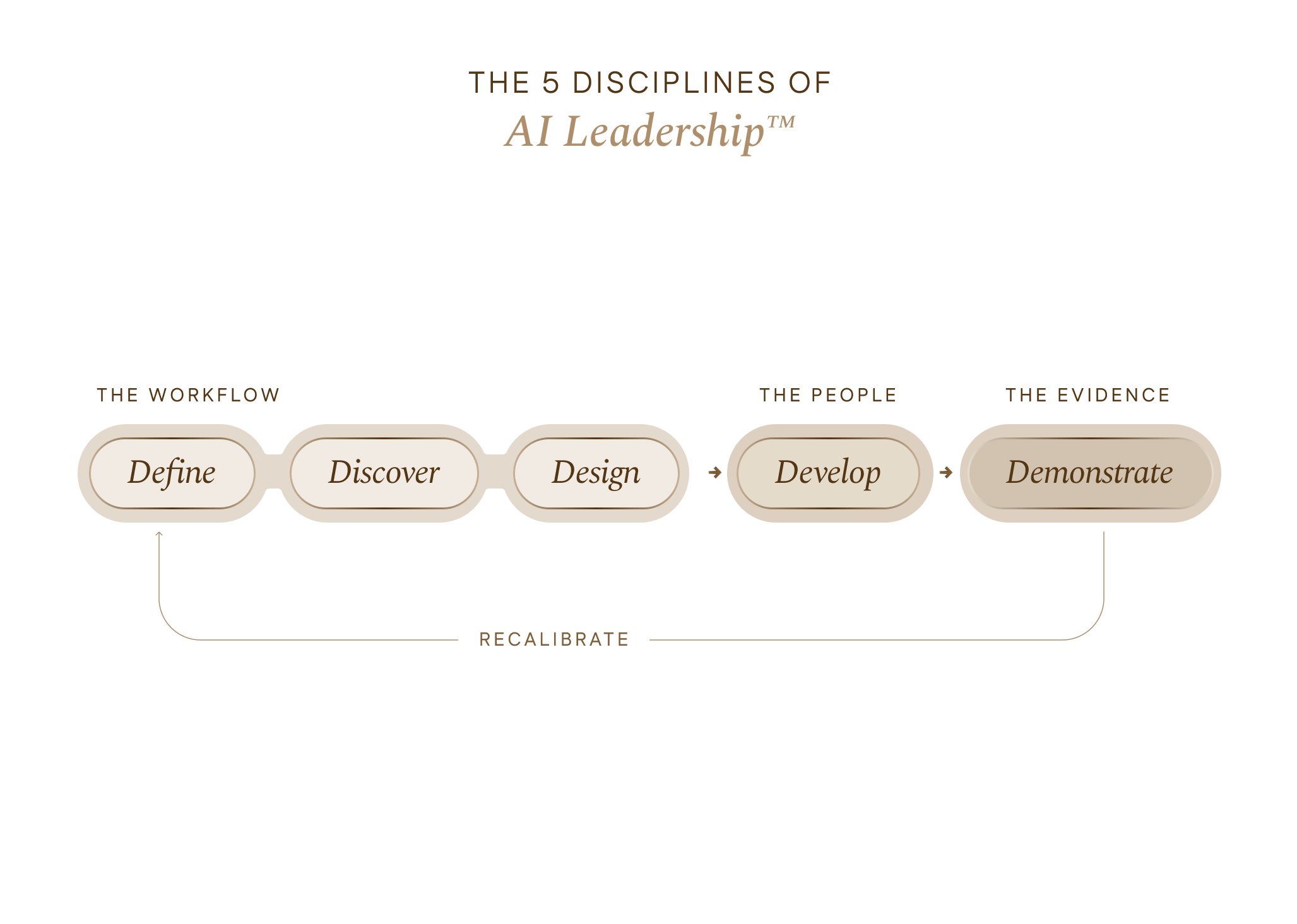
Fluency failed because fluency was never the bottleneck. The bottleneck is that someone has to redesign the work (not sprinkle AI onto the existing process), get human beings to genuinely adopt the redesign, and prove the value to a CFO in the language of the business. That’s not knowledge; it’s an operating discipline, practiced. Which is why the replacement for the literacy curriculum is a sequence.
Each discipline exists because a predictable failure lives there. Define exists because most AI initiatives name a tool instead of an outcome. Discover exists because the official process map and the actual Tuesday diverge. Design exists because bolting AI onto a human-designed process is decoration, not redesign — you didn’t speed up the horse; the point was to design a car. Develop exists because the best pilot design fails if the people executing it aren’t prepared. Demonstrate exists because you build the proof before anyone asks for it, and someone will ask.
The human system underneath
None of the five disciplines survives contact with an unready team, and readiness is layered. LeaderFactor’s readiness hierarchy puts psychological safety at the base — can people be bad at this, publicly, without being punished? — then willingness, understanding, skill, and identity at the top. Two notes from the field on that stack. Skill is the variable leaders over-invest in, because training is purchasable and visible. And identity is the one that actually stalls rollouts: for the analyst whose expertise a model now approximates, what looks like resistance is often grief, and grief doesn’t respond to a workshop. The adoption side of this is covered in AI adoption in the workplace and managing employee resistance to AI; the safety mechanics live in LeaderFactor’s 4 Stages of Psychological Safety™, which is not a detour from AI leadership but its precondition.
It’s a Thursday in March at a commercial insurer in Chicago, and the claims VP is six months into what her slide deck calls an AI transformation. Every adjuster has a copilot license. The workflow is unchanged since 2019. Usage reports look healthy because opening the tool counts as usage, and her best adjuster quietly stopped after week two, when his manager joked about a hallucinated citation in front of the team. Nothing in that story is a technology problem. Every part of it is a leadership problem with a technology costume — which is the ordinary condition of AI initiatives, and the reason this discipline exists.
Where to go deeper
The cluster around this page takes each front in turn: AI strategy for leaders covers choosing where AI creates value; AI change management and how to lead teams through AI change cover the organizational and team-level change work; upskilling your workforce for AI covers capability; AI governance culture covers making responsible use an actual behavior; and AI and the future of leadership takes the long view. The AI Leadership skill is where the discipline gets practiced: five weeks, a real workflow, and the AI Leadership Index — a self-assessment taken before and after, so you measure the shift instead of the attendance.
Start where the discipline starts: name one workflow that matters, and audit where its work actually happens. The teams winning with AI aren’t the ones with the best tools. They’re the ones with the best operating discipline — tools are a commodity now, and judgment isn’t.
Frequently asked questions
- What is AI leadership?
- AI leadership is the discipline of leading an organization through AI: redesigning how work gets done, driving real adoption, and proving the value — while holding the judgment calls machines can't make. It's distinct from AI literacy. Knowing the tools is table stakes; the leadership work is what happens around them.
- What skills do leaders need in the age of AI?
- The skills that concentrate where AI stops: judgment under incomplete data and asymmetric stakes, setting objectives worth pursuing, building trust, making meaning of change for people, and designing work. AI handles processing, patterns, and analysis at speed; leaders decide what's worth doing with that capability and carry the human consequences.
- What is the 5 Disciplines of AI Leadership framework?
- The 5 Disciplines of AI Leadership™ is LeaderFactor's operating discipline for leading through AI: Define the outcome and workflow, Discover where the work really happens, Design the workflow around the capability, Develop through piloting and reps, and Demonstrate value in the language of the business. It's tool-agnostic by design.
- What is the difference between AI leadership and AI literacy?
- AI literacy is knowing the tools and the vocabulary — necessary, and table stakes. AI leadership is the operating discipline around them: redesigning workflows, driving genuine adoption, proving business value, and holding the evaluative judgment machines can't make. Fluent leaders with unchanged workflows have literacy without leadership, which is the common stall.
- How do I start leading AI adoption in my organization?
- Start with a workflow, not a tool. Pick one team, audit where its work actually happens, sort tasks into what humans should own, what AI augments, and what gets automated, then run one bounded pilot with explicit roles and a 90-day plan to prove value. Adoption follows demonstrated proof, not mandates.