





AI and the future of leadership: the distillation
AI and the future of leadership, past the platitudes: what machines take, what concentrates in the leader, and why judgment is about to be the whole job.
AI and the future of leadership is usually written as prophecy — org charts of 2035, agentic everything, the executive as prompt-whisperer. The honest version is closer to metallurgy. AI is a leadership blast furnace: it applies heat, it accelerates separation, and what remains is the metal. The heat is already on. The interesting question was never whether leadership survives the furnace; it’s what the furnace burns off, and what it leaves.
What the furnace takes
Be specific about the subtraction, because vagueness is where the panic lives. What AI absorbs is computational cognition: processing, pattern-finding, analysis, drafting, monitoring — at speed and scale no human matches, and improving quarterly. A large fraction of what filled a leader’s calendar was exactly this, dressed as leadership: consolidating the reports, summarizing the meeting, watching the dashboard, producing the first draft of nearly everything.
It was real work. It was useful, difficult, and often identity-forming. But it was not ultimate. It was scaffolding — and the furnace takes scaffolding first.
That’s the uncomfortable, clarifying accounting every leader now runs: how much of my contribution was computational, and how much was the thing computation can’t reach? For some, the answer is bruising. For all, it’s newly relevant, because AI does not change what leadership is. It changes the conditions under which you have to do it — with the padding gone.
What remains is the metal
What the furnace can’t take, LeaderFactor calls evaluative cognition: judgment under conditions of incomplete data, asymmetric stakes, and human consequence. An AI system can run a maze with increasing brilliance. Only the leader can decide which maze is worth running — and deciding which maze, for whom, at whose expense, is the job description that survives.
The evaluative core has five elements, and they read like a curriculum for the next decade: objectives — choosing what’s worth pursuing when the machine can pursue anything you name; judgment — the calls where data runs out and consequences don’t; trust — the resource no model generates and every change spends; meaning-making — helping people locate themselves inside disruption, which is grief work as much as strategy work; and work design — deciding how humans and machines divide the labor, which quietly becomes one of leadership’s largest levers. Notice what the list doesn’t include: anything AI does well. The future of leadership isn’t a competition with the machine. It’s everything the competition reveals by contrast.
The identity question arrives for leaders too
The future-of-leadership genre loves to discuss employee anxiety, but the sharper version visits the corner office. The question the distillation forces — who are you in a world where machines can think? — lands on leaders first, because their currency was so often being the smartest processor in the room: fastest read of the numbers, best synthesis, the memo everyone waited for. The gap AI opens is personal before it is technological, and leaders who feel it aren’t behind; they’re paying attention.
The productive response isn’t defense of the old contribution — that’s how organizations end up with a copilot on every desk and a hierarchy designed for 2015, the fastest horse of all. It’s the deliberate reallocation of the self: hand the computational layer over faster than feels comfortable, and reinvest the recovered hours in the five elements above, practiced explicitly. Judgment, it turns out, improves like anything else improves — with reps, review, and honest scorekeeping.
It’s a Sunday evening in January, and the CFO of a Midwest manufacturer is doing the accounting on her own calendar — the audit she’s been assigning to everyone else. Of last week’s fifty hours, she marks maybe nine as evaluative: two real decisions, one hard conversation that only she could have had, the workforce-design question she keeps deferring. The other forty-one were computational — consolidation, review, reporting — and most of them, she concedes, a machine could draft today. She doesn’t feel replaced, sitting there. She feels located: for the first time, she can see exactly which nine hours are the job, and what the other forty-one were hiding.
The future arrives as Mondays
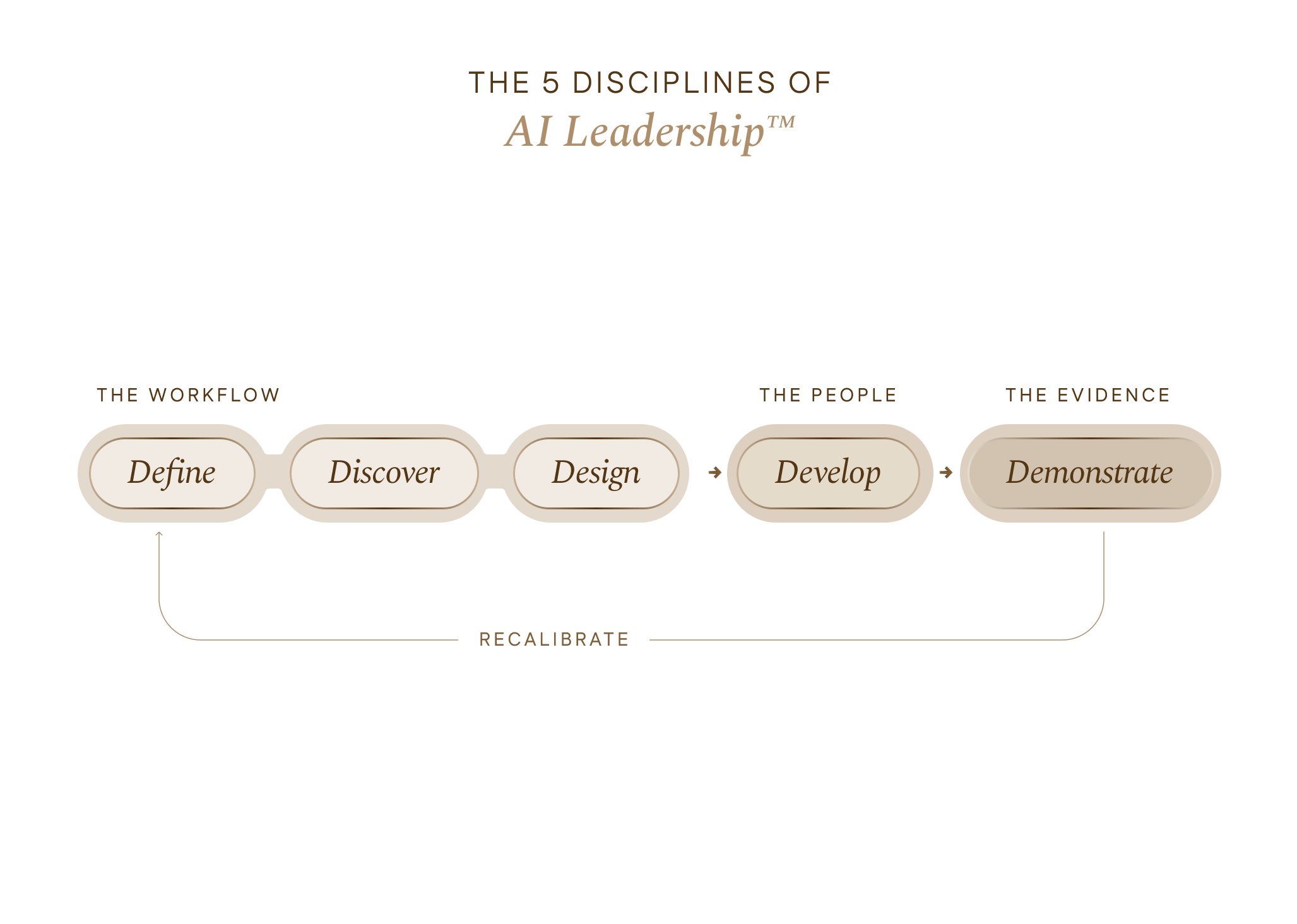
The distillation won’t announce itself with an org-chart redesign. It arrives the way every structural change arrives — as ordinary Mondays, each one slightly more distilled than the last, until the leaders who practiced the evaluative core and the leaders who defended the scaffolding are visibly different animals. The practicing version of this future is already available: the operating discipline in AI leadership, the team-level craft in how to lead teams through AI change, the strategy rhythm in AI strategy for leaders. The AI Leadership skill — Leading Through AI™ — trains the whole distillation on a leader’s real workflows, which is where futures are actually rehearsed.
The furnace is indifferent to forecasts; it only responds to what you’re made of when the heat arrives. Run your own calendar audit this week — the nine hours are in there, and they’d like the other forty-one back.
Frequently asked questions
- How will AI change leadership?
- By subtraction and concentration. The computational parts of the job — analysis, drafting, monitoring, reporting — migrate to machines, and what remains concentrates around evaluative judgment: setting objectives, deciding under uncertainty, building trust, making meaning of change, and designing work. Leadership doesn't shrink; it distills.
- What leadership skills will matter most in the AI era?
- The evaluative core: choosing which objectives are worth pursuing, judgment under incomplete data and asymmetric stakes, earning and spending trust, helping people make meaning of disruption, and designing how humans and machines divide the work. Every one is a skill machines expose by contrast rather than replace.
- Will AI replace leaders?
- It replaces the fraction of leadership that was always management-by-processing: consolidating reports, monitoring dashboards, routing information. Leaders whose contribution was mostly that fraction are exposed. Leaders whose contribution is judgment, trust, and direction find those scarce skills suddenly carrying a premium.
- How should leaders prepare for the future of AI?
- Practice the parts that concentrate. Audit your own week for computational work to hand off, then deliberately build the evaluative muscles: run more explicit decisions, own more consequential judgment calls, and lead one real AI workflow redesign now — the future arrives as ordinary Mondays, and the discipline compounds.