







AI leadership training for leaders.
Leading through AI is a leadership challenge before it's a technology one. The tools change every quarter. The operating discipline, how you redesign work, drive adoption, and prove value, doesn't. That is what this program teaches, and the AIAdoptionindex™ measures the shift.
 AIAdoptionindex™ results in the LeaderFactor platform
The learning platform at leaderfactor.app, sample data.
- Format
- Self-paced, facilitator-led cohort, or certify your L&D team to deliver it.
- Length
- Five weeks, ending with a 90-day proof plan.
- Instrument
- AIAdoptionindex™ self-assessment, baseline and re-measure.
- Built for
- Leaders driving AI adoption. You bought the licenses, and usage tells a different story.
AI leadership training teaches leaders how to lead the redesign of work when machines can think, not how to use this quarter’s tools. The gap most organizations have is personal before it is technological. Leaders are under two pressures at once, the economic one (redesign the workflow, prove the return, move faster than the organization was built to move) and the identity one (what is my judgment for, now). A program that only addresses the first produces fluent demo-watchers. A program that addresses both produces leaders who change what happens on Monday morning.
This page covers what a program should teach, why tool training doesn’t move adoption, which format fits which rollout, and how to tell before you buy whether anything will change.
Why tool training doesn’t change adoption
The usual program teaches the application. People learn prompts, leave with a cheat sheet, and the usage dashboard rises for three weeks. Then the model updates, the vendor changes, and the organization is back where it started, with every team experimenting and nobody redesigning the work. You bought the licenses, and usage tells a different story.
The misconception is that AI adoption is a skills gap. It is usually a readiness gap, and skill is the one variable most leaders over-invest in. The readiness hierarchy runs safety, willingness, understanding, skill, and identity, in that order. Safety first: can people be bad at this without being punished? Identity last and heaviest: a senior analyst whose expertise is now a prompt away does not have a skills gap. They have an identity gap, and that is not resistance. That is grief. Speed without safety produces surface compliance, and adoption and compliance look the same from a dashboard.
The second failure is design. Bolting AI onto human-designed processes is not design; it is decoration. Giving every employee a copilot while keeping the same hierarchy is the fastest horse of all. You did not speed up the horse. The job is to design the car.
What the training should teach: five disciplines
LeaderFactor’s program is built on The 5 Disciplines of AI Adoption™, five disciplines that run in sequence and compound on every pass.
Define names the outcome and the workflow you are actually changing. Not the job description, the actual week. Its deliverable is a partnership audit that sorts the work into three zones. Own is irreducibility, work only a human can hold. Augment is complementarity, human and machine together outperforming either alone. Automate is bounded repeatability. The honesty check is built in: if everything lands in Own, you are probably protecting identity rather than describing reality.
Discover finds where the work really happens, not where the org chart says it does, and asks the only question that matters: not what can AI do, but what can you do, given what AI can now do. Design redesigns the workflow around the capability, not the demo, as one bounded pilot with explicit roles, clear handoffs, and real guardrails. Develop builds, pilots, and instruments it, with the people who have to execute it prepared first. Demonstrate proves value in the language of the business, then scales it.
Proof before anyone asks for it
Demonstrate is where most AI initiatives die, because the proof was never designed. The program builds the evidence chain into the pilot. Leading indicators are not the goal; they are the confidence. Lagging indicators take sixty to ninety days minimum. Story indicators are the ones leaders forget: a spreadsheet gets you the budget, a story gets you the culture. Three dimensions of value are available, and most leaders stop at the first. Efficiency improves what exists. Insight reinterprets what exists. Innovation creates what did not exist.
Consider a claims director at a regional insurer with a copilot licensed to every adjuster and a dashboard that says 31 percent weekly use. Her partnership audit puts first-notice intake in Automate, coverage judgment in Own, and the reserve estimate in Augment. Her pilot is one bounded workflow, reserve estimation on one product line, with the adjusters who were most hesitant on the design team rather than on the receiving end. Her 90-day proof plan names the leading indicator (estimate turnaround), the lagging one (reserve accuracy at sixty days), and the story she will tell the CFO. The dashboard never told her any of that. The discipline did.
Which format fits your rollout
- A facilitator-led cohort is the default for executive and senior-manager groups, who pressure-test each other’s partnership audits and discover together where “everything is Own” is hiding.
- Self-paced fits distributed leaders and works as the first pass through the disciplines before a cohort.
- Certify your L&D team to deliver the program at your own cadence. The disciplines are tool-agnostic by design, so the program outlives any single model or vendor rather than teaching this quarter’s app.
How you’ll know it worked
Measure the leader before and after, and read the proof plan. The AIAdoptionindex™ is a self-assessment taken up front to set a baseline and re-taken at the end, so you can measure the shift and see where leaders moved, not just whether they attended. It is a self-assessment: it measures behavior frequency across the five disciplines, and it makes no larger claim than that.
The second measure is the pilot. Within ninety days every leader has a bounded workflow in production with evidence the business recognizes, or a clear scale-or-refine call. Implementation failure is usually a readiness failure, not a design failure, and the proof plan makes that visible early enough to fix.
Where to start
Start with the leaders who own a workflow, not the ones who own the AI strategy. Put them in the first cohort, have each bring the week they actually live, and let the partnership audits be the first thing the organization learns about itself. Ninety days later, read the proof plans against the baseline and decide the second cohort on evidence.
What the program covers
Five disciplines, each with a question and a deliverable.
The 5 Disciplines of AI Adoption™ run in sequence, and each one ends with something a leader can put in front of their team. Tool-agnostic by design: it outlives any single model or vendor.
-
Define
Name the outcome and the workflow you're actually changing. Not the job description. The actual week. Deliverable: the partnership audit, sorting the work into own, augment, and automate.
-
Discover
Find where the work really happens, not where the org chart says it does. The question is not what AI can do but what you can do, given what AI can now do. Deliverable: the possibility map.
-
Design
Redesign the workflow around the capability, not the demo. Deliverable: one bounded AI pilot plan with explicit roles, clear handoffs, and real guardrails.
-
Develop
Build, pilot, and instrument. Reps, not theory. The best pilot design fails if the people who have to execute it are not prepared. Deliverable: the stakeholder support plan.
-
Demonstrate
Prove value in the language of the business, then scale it. Leading, lagging, and story evidence. Deliverable: the 90-day proof plan.
-
The spiral
After Demonstrate, you return to Define with data. Every pass sharpens the practice. Courses end; disciplines compound.
Assess, learn, apply, prove. One platform.
The program runs on leaderfactor.app: the baseline, the cohort and self-paced modules, the application tools, and the re-measure, with org-level reporting for the people who bought it.
AIAdoptionindex™ baseline 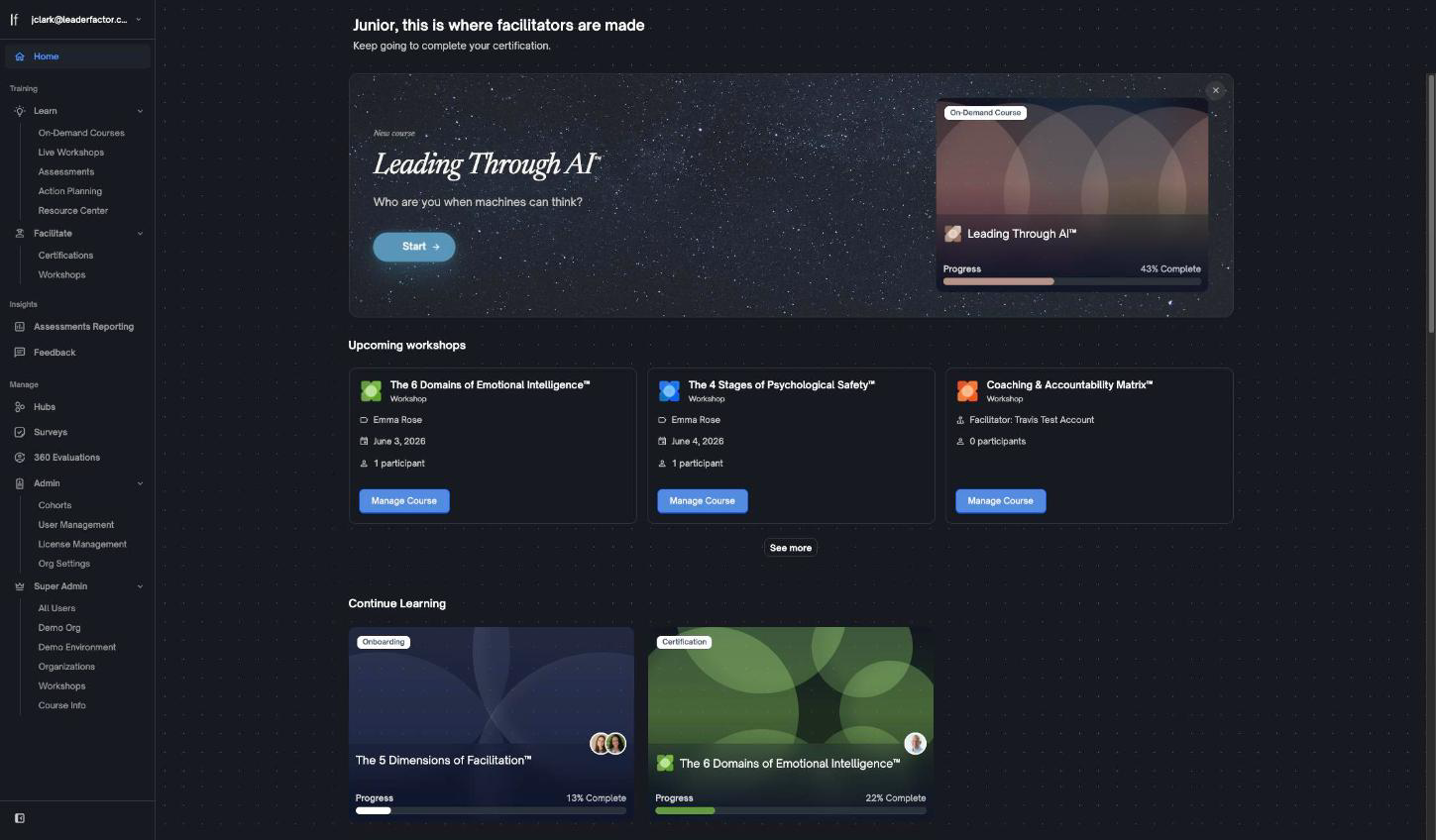 The learner home in the LeaderFactor platform
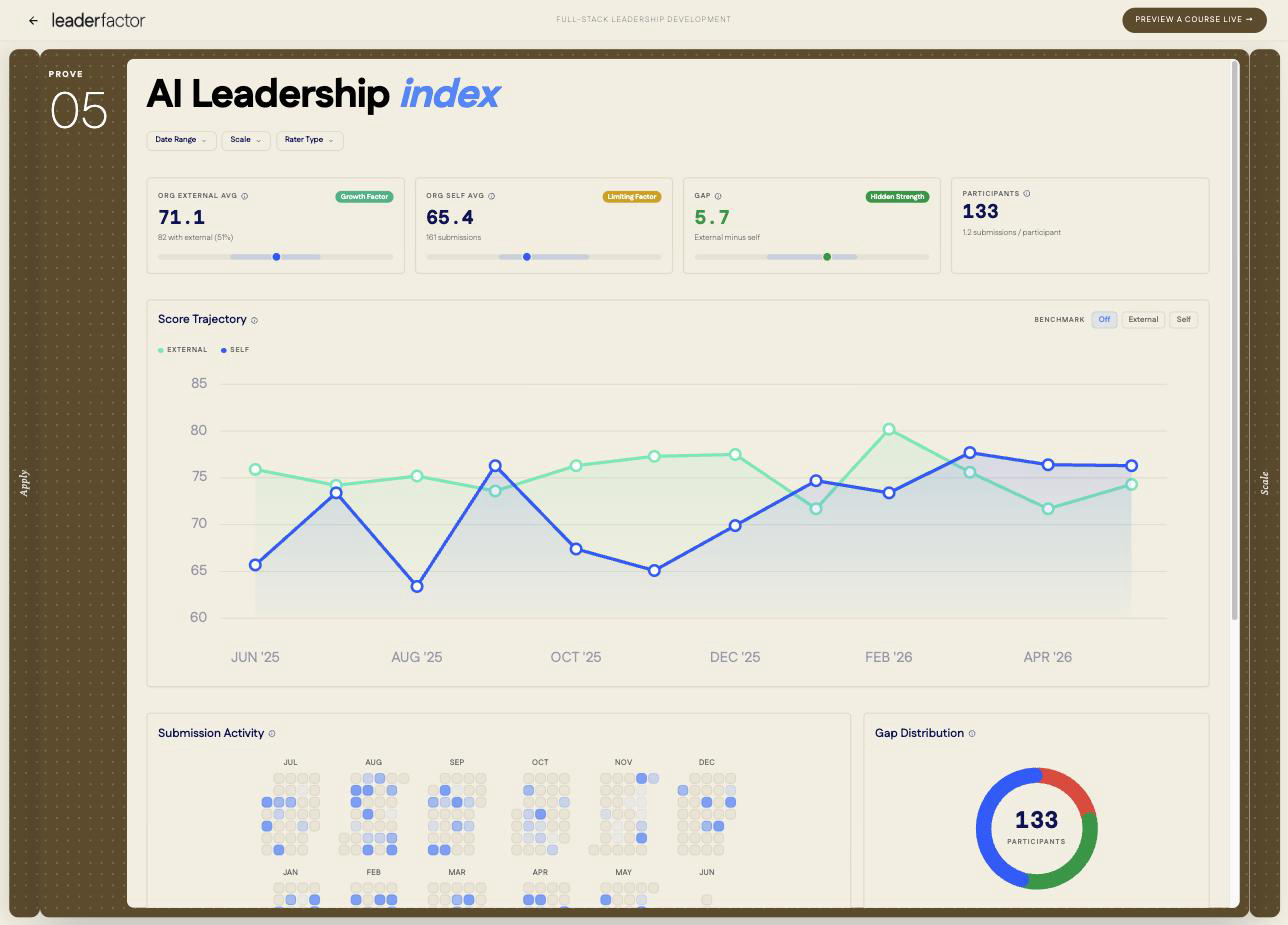 AIAdoptionindex™ re-measure
Screens from leaderfactor.app with sample data. Not client results.
Not sure this is the skill you need?
If the struggle is rollout mechanics more than AI itself, the gap is Change Management. This program is for redesigning the work and proving the value, not for pushing a stalled rollout.
See the Change Management programFrequently asked questions
- What is AI leadership training?
- AI leadership training teaches leaders an operating discipline for AI: how to redesign work around what the technology can now do, how to drive real adoption rather than surface compliance, and how to prove the value in the language of the business. It is distinct from tool training, which teaches this quarter's application and goes stale with it.
- What should AI training for leaders cover?
- Five disciplines, in order. Define the outcome and the workflow. Discover where the work actually happens. Design the workflow around the capability, not the demo. Develop through a bounded pilot with prepared people. Demonstrate value with leading, lagging, and story evidence. Each discipline should end with a deliverable a leader can take to their team.
- Why do AI rollouts stall even when the tools are good?
- Because adoption is a readiness problem before it is a design problem. The people closest to the work often have the most to gain and the most hesitation, and speed without safety produces surface compliance that looks like adoption on a dashboard. Leaders have to work the readiness hierarchy, safety first, and treat identity concerns as real rather than as resistance.
- How long does AI leadership training take?
- LeaderFactor's program runs five weeks, as a self-paced track, a facilitator-led cohort, or delivered by your own certified L&D team. Leaders take the AIAdoptionindex™ up front to set a baseline, work each discipline on a real workflow, and leave with a 90-day proof plan and a re-measure.
- How do you measure whether AI leadership training worked?
- Two ways. The AIAdoptionindex™ is a self-assessment taken at the start and again at the end, so you can measure the shift and see where leaders moved, not just whether they attended. And the proof plan: within 90 days each leader has a bounded pilot with evidence the business recognizes, or a clear scale-or-refine call.
Redesign your human-AI partnership.
See the program run in a free one-hour Skill Preview, assessment included. Or talk with us about a cohort for your leaders.
or start with the free guide, The convergence playbook →