





AI adoption in the workplace: usage is not the metric
AI adoption in the workplace stalls in a predictable place: between licenses and changed behavior. The adoption paradox, the compliance trap, and what to measure.
AI adoption in the workplace has a measurement problem before it has a change problem: the thing that’s easy to count (licenses, logins, completion rates) and the thing that matters (people working differently, by choice, with results) have almost nothing to do with each other. Adoption surveys keep finding the same shape — investment up, usage reported, productivity gains real but modest and strikingly uneven — and the unevenness is the tell. Somewhere in your organization, AI has genuinely changed how a team works. Three doors down, the same tools are an expensive login. This page is about what separates those two rooms.
The four things that get called adoption
Deployment: the licenses are distributed. Activity: the logins happen. Compliance: mandated usage gets performed, because it’s checked. Adoption: the work itself has changed shape, and people would keep the new shape if the mandate vanished. Every stalled AI initiative you’ll meet is a case of one of the first three wearing the fourth’s name — and the disguise is good, because you bought the licenses, and usage tells a different story only if you interrogate it. Speed without safety produces surface compliance, and adoption and compliance look the same from a dashboard.
The distinction isn’t pedantry; it decides what you fix. Deployment gaps need procurement. Activity gaps need awareness. Compliance-dressed-as-adoption needs the human layers — and that’s the common case, and the expensive one to misdiagnose.
The adoption paradox
Here’s the mechanism at the center of the uneven map: the people closest to the work often have the most to gain and the most hesitation. Your best adjuster, your fastest analyst, your most trusted recruiter — AI offers them the most leverage, and threatens them the most precisely. Their expertise is the thing the model approximates; their competence is the thing on display while they fumble through the learning curve in front of colleagues who expect them to be the capable one.
So the adoption front line isn’t your laggards. It’s your experts, deciding whether visible beginnerhood is survivable here. Which is why the misconception — “we deployed it, we trained it, adoption is now the employees’ job” — reliably fails. Adoption isn’t an act of compliance the org can require; it’s a risk people take, and the leader’s job is making the risk rational. The conditions that do that: safety to be bad at it in public, involvement in redesigning the workflow rather than receiving it, and a respected early adopter whose fumbles were visibly survived. (The full readiness stack is covered in upskilling your workforce for AI; the deeper resistance layer in managing employee resistance to AI.)
What real adoption is downstream of
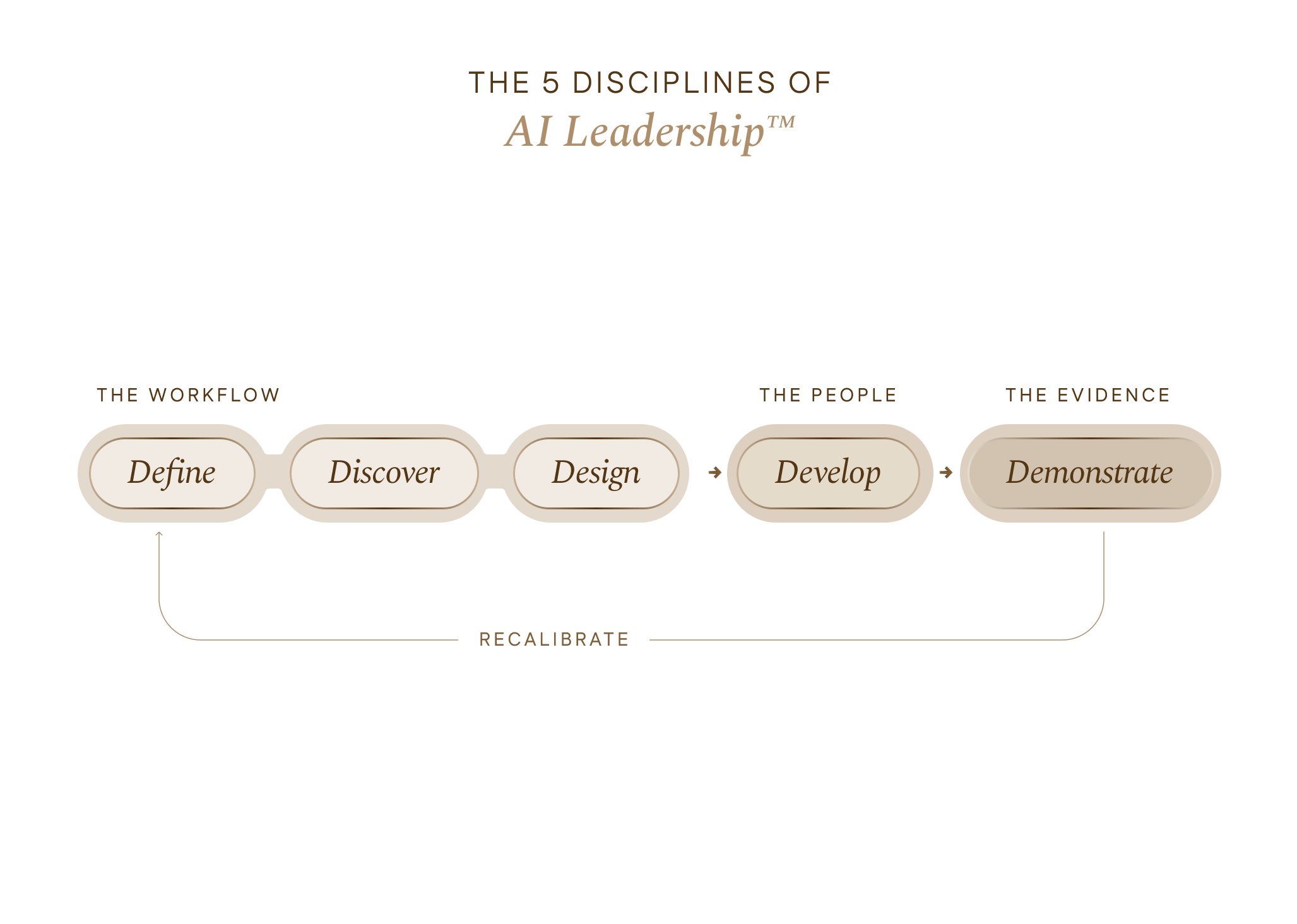
Adoption is the third act of a sequence, and skipping the first two is the classic failure. First the work gets audited (where does it actually happen, not where the process map says). Then the workflow gets redesigned around the capability — genuinely redesigned, because giving everyone a copilot while keeping the same process is decoration, not design. Only then is there something worth adopting. Most “adoption problems” are actually design problems: people are being asked to adopt AI on top of an unchanged workflow, which makes their skepticism correct. The redesign discipline is the heart of AI leadership, and the change mechanics around it are in AI change management.
Measuring it honestly
The measurement that distinguishes adoption from its impostors is a chain, not a dashboard. Leading indicators come first and come fast: workflows redesigned, experiments run, the behaviors that predict value before value lands — not the goal, the confidence. Lagging indicators need 60 to 90 days of patience: cycle time, quality, cost, the numbers a CFO will accept. And story indicators carry the culture: the specific, named, before-and-after account of the Tuesday that got four hours shorter. A spreadsheet gets you the budget. A story gets you the culture — and adoption spreads along stories, team to team, faster than any mandate travels.
It’s a Friday in April at a commercial real-estate firm in Atlanta, and the COO is staring at two floors of the same company. Fourth floor: the lease-abstraction team redesigned intake around AI in the fall, cut their turnaround from days to hours, and their team lead has given the same lunch-table demo eleven times because other teams keep asking. Sixth floor: same licenses, same training, usage dashboards technically green, every abstract still hand-built after hours. The difference isn’t talent, tooling, or training. Fourth floor redesigned the work and made fumbling safe; sixth floor mandated a tool onto an untouched process after an early mistake drew a public rebuke. The COO’s real adoption program starts when she stops averaging the two floors.
Where to start
Find your fourth floor — the pocket where adoption is real — and study it as evidence: what was redesigned, who modeled it, what made the risk feel safe. Then pick one more team and run the sequence deliberately: audit, redesign together, pilot with a 90-day evidence chain, and put the story to work. The AI Leadership skill trains that full arc, with the AI Leadership Index baselining leader behavior before and after. The unevenness you have today isn’t the problem. It’s the map.
Frequently asked questions
- What does AI adoption in the workplace actually mean?
- Adoption means changed behavior: workflows genuinely redesigned around AI capability, used by choice, producing measurable value. It's distinct from deployment (licenses distributed), activity (logins recorded), and compliance (mandated usage performed). Most organizations reporting high adoption are measuring one of the other three.
- Why is AI adoption so uneven across teams?
- Because adoption tracks local conditions, not corporate strategy. It concentrates where a respected person modeled real use, where early fumbles were safe, and where the workflow was actually redesigned. It stalls where AI was bolted onto old processes or where the first visible mistake got punished. The variance is diagnostic.
- What is the adoption paradox?
- The people closest to the work often have the most to gain from AI and the most hesitation about it. Their competence is the thing on display while they fumble through the learning curve, and they can see exactly which parts of their expertise the tool approximates. Mandates don't resolve that tension; safety and involvement do.
- How do you measure AI adoption?
- With a chain of evidence rather than a usage dashboard: leading indicators (workflows redesigned, experiments run), lagging indicators over 60 to 90 days (cycle time, quality, cost), and story indicators — the concrete before-and-after accounts that travel through an organization. Logins alone can't distinguish adoption from compliance.