





AI change management: why this change is different
AI change management differs from classic change: no end state, continuous tools churn, and identity stakes. What ADKAR-era playbooks keep, what they miss.
AI change management is where two mature disciplines collide and both get humbled. The change-management canon — Prosci’s ADKAR, Kotter’s eight steps, the coalition and communication playbook — assumed a change with a shape: a start, a rollout, a new steady state to consolidate. AI declines to hold still for that. The tools change quarterly, the capability frontier moves while your pilot is still running, and the “end state” you’d consolidate toward keeps dissolving. Meanwhile the AI-adoption literature keeps rediscovering what change management always knew: the technology is the easy half.
So the honest version of this topic is neither “run ADKAR on it” nor “everything is different now.” It’s a sorting exercise: what carries over, what breaks, and what AI adds that the classic playbooks never priced.
What carries over
More than the AI-hype cycle admits. Individuals still move through the arc ADKAR describes — you can’t reinforce a behavior someone was never made aware of or never learned. Kotter’s discipline still holds: a coalition before the announcement, a felt case for change, early wins that keep effort credible. The U-curve of personal change (denial, resistance, exploration, commitment) still describes what each person walks, and the leader still has to be further along it than the people they’re leading. And the two classic failure patterns — the false start from launching without a coalition, and regression to the mean from letting go too early — kill AI initiatives exactly the way they kill ERP migrations. The general discipline is covered in the change management pillar, and it applies.
What breaks
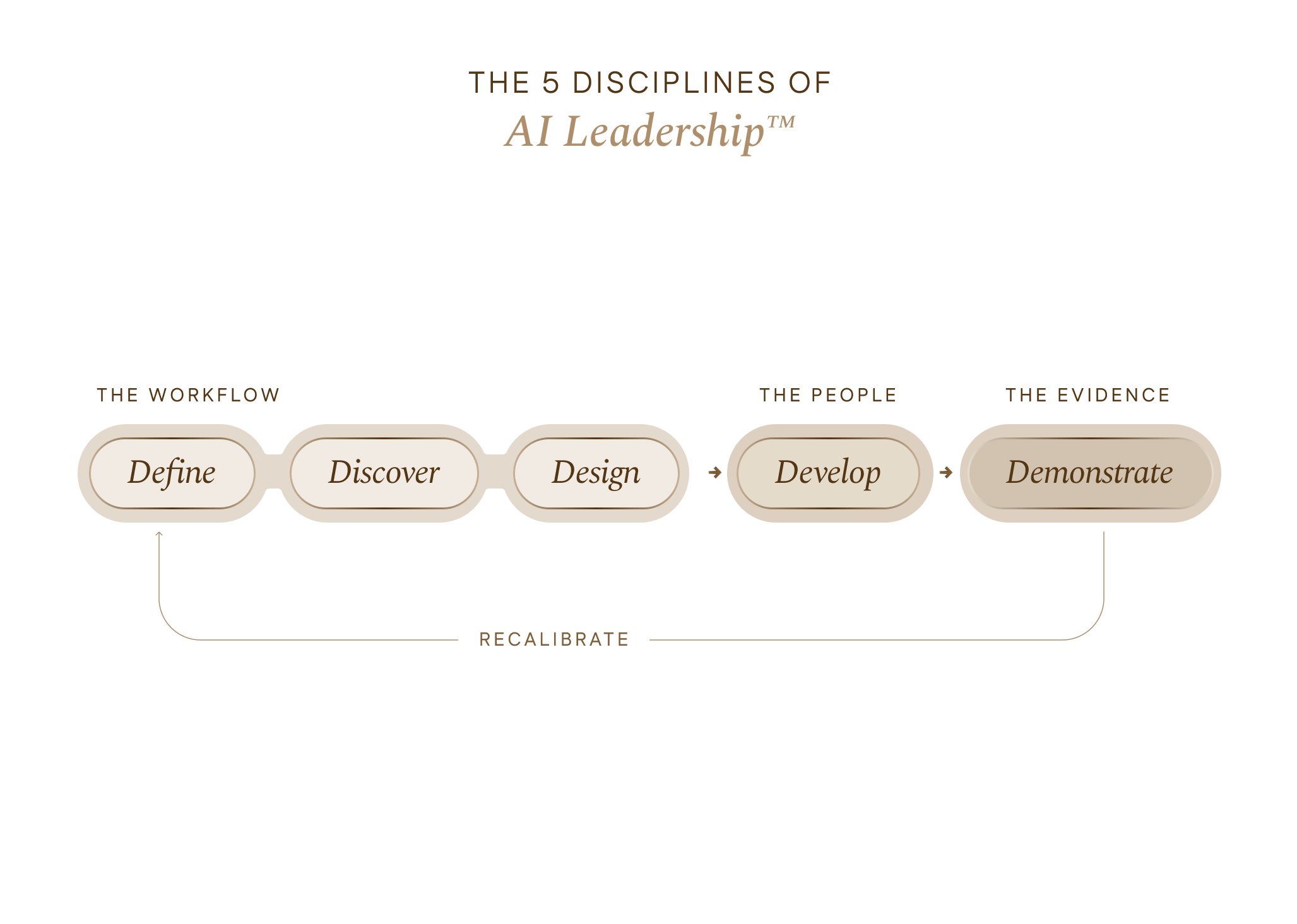
The end state. Classic change consolidates toward a defined new normal. AI change doesn’t finish: this quarter’s redesigned workflow meets next quarter’s model release. That shifts the goal from landing a change to building change capability — a team that can absorb the next capability without a fresh transformation program. A playbook assumes the environment will hold still. AI does not hold still, which is why the work is a discipline rather than a project.
The visibility of failure. Traditional change fails loudly: the system isn’t used, the process reverts, someone escalates. AI change fails politely. People attend the training, open the tool, and quietly keep working the old way, because usage is cheap to perform. Adoption and compliance look the same from a dashboard, which means your rollout can be dead for two quarters before anything reports it.
The depth of the resistance. Process changes threaten habits. AI touches what people believe makes them valuable, and that produces a resistance that information can’t reach — covered fully in managing employee resistance to AI.
The layer the classic models under-price
The misconception, inherited honestly from the frameworks: “resistance means people don’t understand the change yet — communicate the why.” For AI, comprehension is rarely the gap. The gap is readiness, and it’s layered: psychological safety at the base (can people be visibly bad at this new thing without being punished?), then willingness, understanding, skill, and identity at the top. Two field notes on that hierarchy. Leaders over-invest in the skill layer, because training is easy to buy and easy to report. And the adoption paradox sits underneath everything: the people closest to the work often have the most to gain and the most hesitation — they’re the ones whose competence is on display while they fumble through the learning curve.
Implementation failure is usually a readiness failure, not a design failure. Which is why the practical sequence runs safety-first: make experimenting survivable, then build willingness with involvement, then teach.
What it looks like from the inside
It’s a Wednesday in January at a national staffing firm in Dallas, and the COO is reading week-40 numbers on the AI-assisted candidate-screening rollout. Training completion: 94%. Tool logins: healthy. Time-to-fill: unmoved. It takes a skip-level lunch to learn why — her recruiters run the AI screen because it’s required, then redo every shortlist by hand, because six months ago a recruiter got publicly grilled over a model-suggested candidate who bombed. One meeting, one story, and the whole region concluded the same thing: the tool is mandatory, trusting it is dangerous. Her rollout doesn’t have a technology problem or even a training problem. It has a memory.
That’s the texture of AI change: the blocker is almost never on the project plan, and it’s usually cheap to fix once it’s visible — and invisible until someone feels safe saying it.
Running it
Treat the classic discipline as your chassis: coalition before announcement, involvement before mandate (getting employee buy-in for change covers that half), early wins on a 30-day cadence, and reinforcement long past the launch glow. Then add the AI-specific layer: baseline readiness before training anyone, work the safety and identity layers deliberately, and instrument actual behavior change rather than logins — the team-level tactics are in how to lead teams through AI change, and the proof mechanics in AI strategy for leaders.
And accept the reframe the situation forces: you’re not managing an AI change. You’re building an organization that can keep absorbing them, because the next one is already shipping.
Frequently asked questions
- What is AI change management?
- AI change management is the people side of AI adoption: moving an organization from its current way of working to AI-augmented workflows that people genuinely use. It applies classic change discipline — coalition, communication, reinforcement — to a change that's continuous, identity-touching, and never quite finished, which is what makes it distinct.
- How is AI change management different from traditional change management?
- Three ways. There's no end state: models and tools keep changing, so you're building change capability, not landing one change. The stakes are identity-level: AI touches what people believe makes them valuable. And the failure mode is quieter: surface compliance looks identical to adoption on every dashboard.
- Do frameworks like ADKAR and Kotter apply to AI change?
- Largely, yes. ADKAR's insight that individuals move through awareness to reinforcement, and Kotter's coalition and early-wins discipline, both transfer. What needs supplementing is the readiness layer — psychological safety, willingness, understanding, skill, and identity — because AI resistance runs deeper than the information gaps those models address best.
- Why do AI rollouts stall?
- Most often at the readiness layer, not the technology layer. People closest to the work have the most to gain and the most hesitation; if experimenting with AI feels like exposing incompetence, they comply visibly and revert privately. Implementation failure is usually a readiness failure, not a design failure.