





AI strategy for leaders: workflow first, tools last
AI strategy for business leaders without the vendor pitch: the three kinds of AI value, the possibility map, and the 90-day proof that earns the next dollar.
AI strategy for leaders, as the market currently sells it, is mostly a procurement plan with a vision statement on top: pick the platform, deploy the copilots, fund a center of excellence. All of which can be sensible, and none of which is a strategy — because it never decided the only questions that matter: where does AI create value in this specific business, in what order, and how will you know? Those are leadership questions, not technology ones, and they stay stable while the tool landscape churns underneath them. Here’s the leader-first version.
Start with the thesis, not the tools
Every AI strategy rests on a leadership thesis, stated or not: a claim about where this organization’s advantage will come from as AI commoditizes capabilities you used to pay for. The lazy default thesis is “we’ll be more efficient,” and it’s a real but small idea. LeaderFactor’s framing names three classes of AI value, in ascending order: efficiency improves what exists, insight reinterprets what exists, and innovation creates what did not exist. Most leaders stop at the first — and the first is also the most symmetrical, since your competitors are buying the same efficiency from the same vendors. The strategic question is which workflows in your business hold insight or innovation value, because that’s where AI advantage compounds instead of leveling.
The misconception to clear at the threshold: “our AI strategy is choosing the right platform.” Tools are a commodity now; every vendor demo is equally impressive and equally available to your competitors. What isn’t commodity is the redesign of your specific work and the discipline to prove it paid — a strategy that outlives any single model or vendor, because it was never about the vendor.
The map before the bets
Strategy needs a possibility map: a survey of your actual workflows against what AI can now do, sorted honestly. The sort LeaderFactor teaches runs three zones — work humans should own (irreducible judgment, trust, consequence), work AI should augment (human plus machine beating either alone), and work to automate (bounded, repeatable, checkable). Run it on real workflows with the people who do the work, and two things fall out: the pilot candidates (augment-zone workflows with visible pain and measurable output), and the reassurance your people actually need (a concrete answer to what stays human, which the identity conversation depends on).
The discipline question isn’t “not what can AI do” — the vendors will tell you that all day. It’s what can you do, given what AI can now do? Different question, and only you can answer it.
Prove it in the language of the business
The half of AI strategy that separates the funded from the quietly cancelled: the proof plan, built before the pilot runs. You build the proof before anyone asks for it, because someone will ask, usually in a budget cycle, and “the team likes it” is not an exhibit.
The plan has three layers with different clocks. Leading indicators move in weeks — workflows redesigned, experiments completed, the behavior changes that predict value; they’re not the goal, they’re the confidence. Lagging indicators need 60 to 90 days minimum and must arrive in business terms: cycle time, quality, cost, revenue per whatever your CFO already counts. Story evidence is the third layer and the most underrated — the named, specific, before-and-after account that travels through the organization. A spreadsheet gets you the budget; a story gets you the culture.
And the plan ends in a decision, made in advance: scale or refine. Naming that fork before the pilot removes the ambiguity where zombie initiatives breed — the pilot that neither proved out nor died, consuming attention indefinitely.
It’s a Monday in August at a mid-market logistics company in Louisville, and the CEO is choosing between two AI strategies that cost the same. The first is a platform rollout: every employee licensed, enterprise agreement signed, adoption to follow. The second is smaller and stranger: one workflow (carrier exception handling), one team, a possibility map built with the dispatchers themselves, and a 90-day proof plan with the scale-or-refine call already on the November board agenda. A year later, the first strategy would have produced a usage report. The second produced a 90-day exhibit, a team of advocates, and a repeatable method — which is to say, it produced the second workflow.
The strategy is a rhythm, not a document
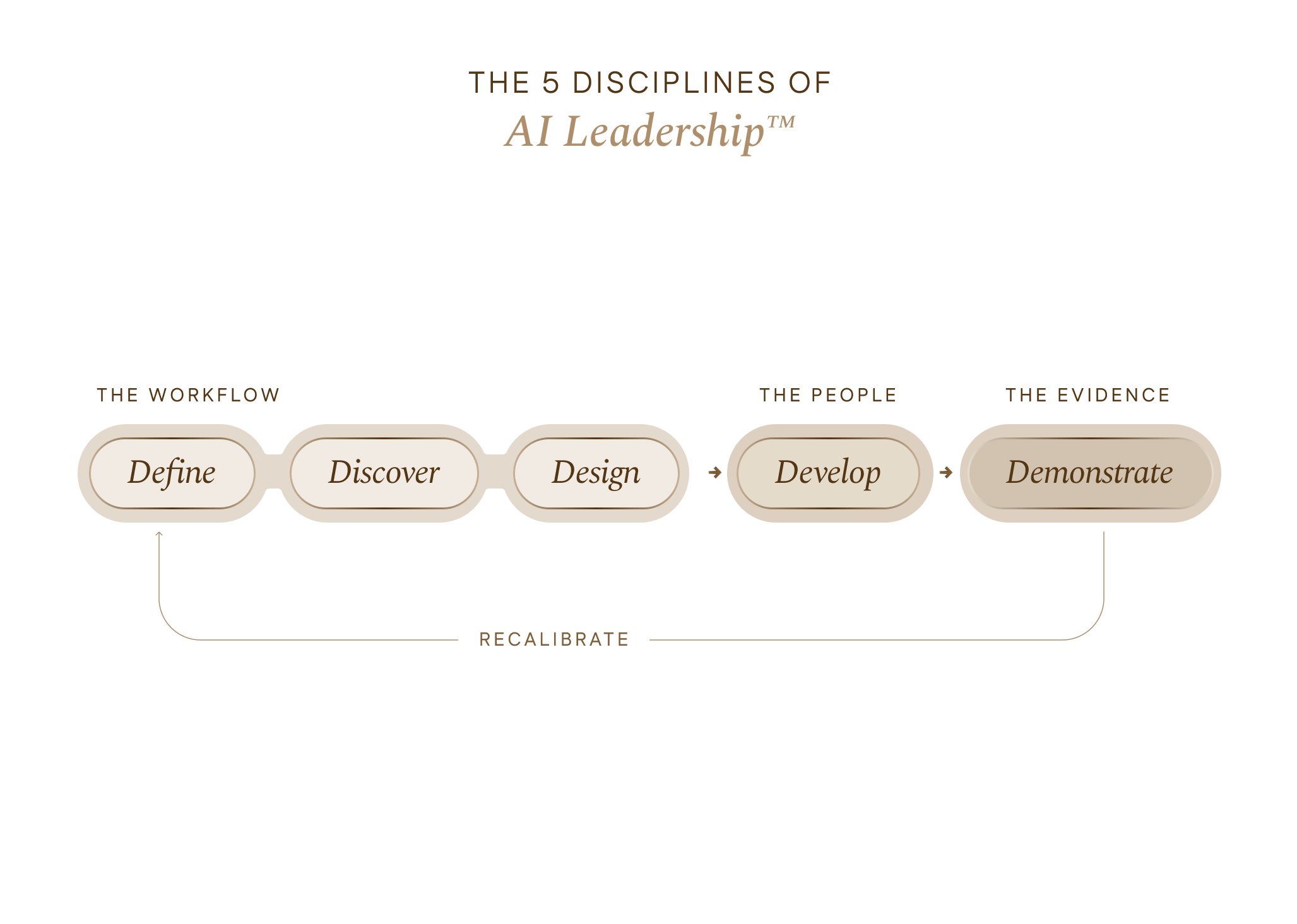
After Demonstrate, you return to Define — with data. Every pass sharpens the practice: the next workflow, the next proof, the next scale call. That spiral is what an AI strategy actually is once it’s working — not a binder, a rhythm the organization runs quarterly. The adjacent disciplines are covered across this cluster: AI leadership for the full operating discipline, AI adoption in the workplace for the human side of the bets landing, and AI change management for the organizational wrapper.
Start by writing the thesis sentence your current spending implies, and see if you’d defend it: we believe AI’s value to us is ___, and we’ll know because ___. If the blanks are hard to fill, that’s not a writing problem. That’s the strategy work, still undone — and one workflow, one map, and one 90-day proof is how it starts.
Frequently asked questions
- What is an AI strategy?
- An AI strategy is a leadership decision about where AI creates value in your business and how you'll prove it: which workflows change, in what order, measured how. It is not a tool roadmap. Tools are commodities that change quarterly; the strategy is the sequence of workflow bets and the evidence discipline around them.
- How do leaders build an AI strategy?
- Start from outcomes, not capabilities: name the business result, find the workflows that produce it, and map what becomes possible now that AI can do what it does. Sort the work into what humans own, what AI augments, and what gets automated, then pilot one bounded change with a 90-day proof plan.
- What are the three types of AI value?
- Efficiency improves what exists — the same work, faster and cheaper. Insight reinterprets what exists — seeing patterns and options you couldn't see. Innovation creates what didn't exist. Most leaders stop at the first, which is also the smallest and the easiest for competitors to match.
- How do you measure whether an AI strategy is working?
- With a proof plan set before the pilot starts: leading indicators that show behavior changing, lagging indicators over 60 to 90 days in business terms — cycle time, quality, cost, revenue — and story evidence that travels. Then an explicit scale-or-refine call. Strategy without a measurement plan is a tools budget.