





How to lead teams through AI change, Monday included
How to lead teams through AI change at the level frameworks skip: the manager's moves, the bounded pilot, and the 90-day arc from first fumble to proof.
How to lead teams through AI change is a different question from how organizations should manage AI transformation, and the difference is altitude. The organizational level has frameworks and steering committees, and its playbook is covered in AI change management. This page is the other altitude — the manager with eight people, a mandate that arrived by email, and a Monday. At that height, AI change is made of specific moves in a specific order, and the frameworks compress into one operating question: what actually changes on Monday morning?
First move: buy the team’s learning curve
Before any tool discussion, your team is running a private calculation: what happens to the first person who looks incompetent with this? Every subsequent week is downstream of how that question gets answered, because learning AI means a stretch of public clumsiness, and adults don’t volunteer for public clumsiness in unsafe rooms.
You answer it by going first, badly. Use the tools on your own real work, in front of the team, and let them watch a fumble land and get survived — the hallucinated paragraph you caught, the prompt that took four tries. That’s not a loss of authority; it’s the purchase of everyone else’s learning curve. The mechanism underneath is learner safety, applied to the one domain where your best people feel most exposed, and no rollout artifact substitutes for it.
Second move: redesign one workflow, together
The misconception at team level is inherited from the org level: “the tools are deployed and training’s scheduled — the team will figure out how to work them in.” They won’t, and they shouldn’t, because AI bolted onto an unchanged workflow is decoration. What produces value is redesign — and at team scale, redesign is a working session, not a program.
Run the audit with the team, not on them: where does our work actually happen (the actual week, not the job descriptions), and for each chunk, is it work a human should own, work AI should augment, or work to automate? Then pick one workflow — visible pain, measurable output, bounded scope — and redesign it together, with the skeptics holding the marker. A bounded pilot needs four things on paper: explicit roles (who does what now), clear handoffs (where the machine’s draft becomes the human’s responsibility), real guardrails (what always gets verified, what never goes out unchecked), and a definition of better you can measure.
The people who design the new workflow don’t resist the new workflow. That sentence is most of team-level change management.
Third move: run the 90-day arc
A team pilot earns its future in about 90 days, and the arc has a shape worth keeping deliberately:
- Weeks 1–2: reps. Everyone runs the new workflow on real work, expectations explicitly at “learning,” not “performing.” Daily friction gets captured somewhere visible; the workflow gets adjusted weekly. Reps, not theory.
- Weeks 3–6: leading indicators. You’re watching behavior, not outcomes yet — are the steps actually being run, are experiments happening, is usage by choice growing? These aren’t the goal; they’re the confidence.
- Weeks 7–12: proof. Cycle time, quality, cost — the before-and-after in numbers the business already counts, plus the story version: the specific Tuesday that got four hours shorter, with names. You build the proof before anyone asks for it.
- Day 90: the call. Scale it, refine it, or kill it — decided on the date you set before the pilot started. Teams trust a process that visibly ends in an honest decision, and the next pilot inherits that trust.
It’s a Monday in October at a benefits-administration company in Milwaukee, and a claims team lead is running week one of exactly this arc. Her kickoff wasn’t a deck; it was fifteen minutes of her own screen, including the model confidently mis-citing a plan document and her catching it. By Thursday her most skeptical senior processor has rewritten the verification step to be stricter than she’d drafted it — his standard now, his name on it. The pilot’s first leading indicator isn’t in the tracker. It’s that the skeptic is editing the workflow instead of outlasting it.
The part that doesn’t end
Here’s what makes AI change structurally different from the rollouts you’ve led before: day 90 isn’t the finish line, because the capabilities won’t hold still. The next model release will make some augment-zone work automatable and some owned work augmentable, and the team that just finished its first arc is the team that can run the second one in half the time. You return to the audit with data. Every pass sharpens the practice — the goal was never this workflow; it was a team that can keep absorbing what’s coming.
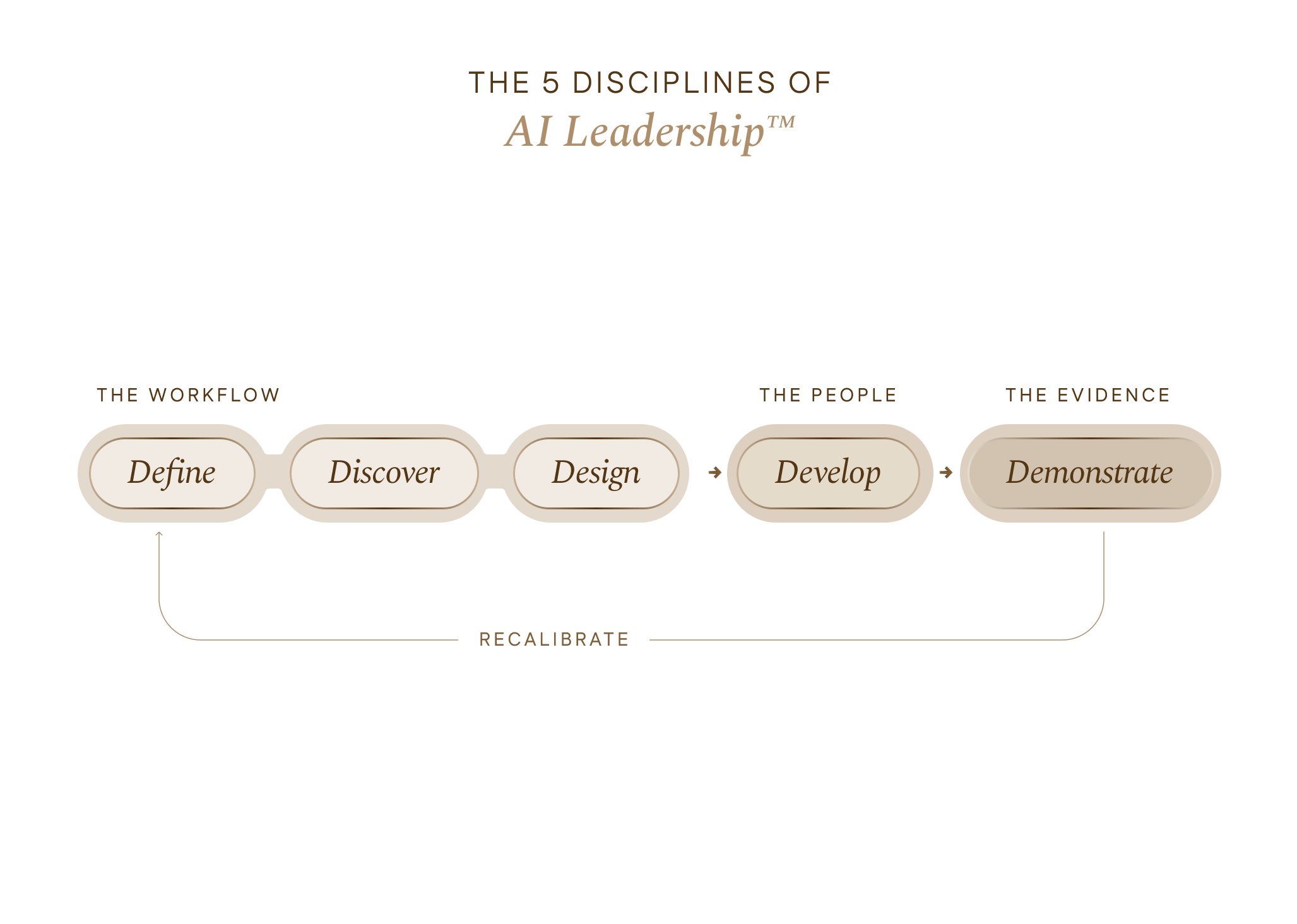
Individual resistance that persists through good process gets its own treatment in managing employee resistance to AI; the skills question in upskilling your workforce for AI; the full leadership discipline in AI leadership. The AI Leadership skill trains managers through this exact arc on a live workflow, with the AI Leadership Index measuring the leader’s own behavior shift pre and post.
Start smaller than feels strategic: one workflow, one team, your own visible fumble first. Monday morning is the unit of AI change, and you only have to lead one of them at a time.
Frequently asked questions
- How do you lead a team through AI change?
- At team level, in this order: make experimenting safe by fumbling first yourself, audit where the team's work actually happens, redesign one workflow together, run it as a bounded pilot with explicit roles and handoffs, and prove the result within 90 days. The sequence matters more than the enthusiasm.
- What should a manager do first when AI tools arrive?
- Use them on real work, visibly, before asking the team to — including the failures. The team's first question isn't about the tool; it's whether being publicly bad at this is survivable here. A manager's demonstrated fumble answers it cheaper than any kickoff deck, and nothing else answers it at all.
- How is leading AI change different from a normal rollout?
- There's no finish line — capabilities keep shifting, so the team is building a repeatable absorb-and-redesign rhythm rather than landing one change. The resistance is also deeper than habit: AI touches what people believe makes them valuable, which makes safety and role clarity the manager's real workload.
- How long should an AI pilot run before judging it?
- Give behavior a few weeks and business results 60 to 90 days. Leading indicators (experiments run, workflow steps actually changed) show up fast and build confidence; lagging indicators (cycle time, quality, cost) need the longer window. Set the scale-or-refine decision date before the pilot starts, and keep it.