





Getting employee buy-in for change
Getting employee buy-in for change takes more than a better announcement. Why compliance masquerades as commitment and what actually earns the real thing.
Getting employee buy-in for change is usually treated as a communications problem: sharpen the why, repeat the vision, show people what’s in it for them. Do all of that and you’ll often still watch the rollout stall, because buy-in isn’t a message that lands. It’s a risk people accept. Buy-in means voluntary commitment — effort given by choice — and people extend it based on what the change might cost them and who’s asking, not on how well the deck explained it.
That reframe changes the work. Here’s what actually earns commitment, and the two shortcuts that reliably destroy it.
Compliance is not buy-in, and silence is not agreement
First, know what you’re looking at. Compliance gets you people’s hands, some of their head, and none of their heart. It looks like success in week one: attendance is full, nobody objects, the new system gets logged into. Commitment looks the same at kickoff and completely different in month three, when the novelty is gone and the change needs discretionary effort to survive.
It’s a Monday in October at a mid-sized insurance carrier, two months into a new claims platform, and the VP of claims can’t find the problem. Training completion sits at 96 percent. Nobody has complained. And throughput keeps sliding, because her adjusters are working the new system exactly as required while quietly keeping their real workflow in the old spreadsheets, waiting to see if this initiative outlasts the last three. Every dashboard says adopted. The floor says: prove it’s worth our effort first.
That’s the span of uncertainty at work — the amount of time people will give discretionary effort without seeing evidence the change is working. Buy-in isn’t won once at the announcement. It’s won inside that window, or lost there.
Explaining harder doesn’t work, because comprehension was never the problem
The standard playbook (articulate the vision, communicate transparently, show the personal benefit) isn’t wrong; Kotter put a compelling vision near the center of change work for good reason. It’s just aimed at the wrong bottleneck. Your people understood the change the second time you explained it. What they’re doing now is math: what does this cost me in competence, standing, or autonomy, and is this leader someone I’d take that risk with?
That second question is answerable, and not with words. People read a change leader on five gauges — character, competence, commitment, care, and capacity — and move when the readings are strong. A leader with visible skin in the game buys more commitment with one staffing decision than with a quarter of town halls. The full credibility model is covered in how to lead organizational change; the short version is that buy-in is mostly a deposit against trust the leader has already built, which is also why borrowed slide decks don’t transfer results.
The two shortcuts that backfire
Under deadline pressure, leaders reach for one of two substitutes for earned commitment, and both convert possible supporters into determined resisters.
Muscling uses formal authority, procedures, or penalties to force compliance. It works, briefly, and it caps the change at compliance forever: you’ll get exactly what’s inspected and nothing more, from people who now have a reason to want the change to fail.
Smuggling slips the change into the organization and pretends it was always the expectation — no announcement, no acknowledgment that anything is being asked. People notice, always, and what they learn is that the leader either didn’t think they’d agree or didn’t think they mattered. Both lessons outlast the initiative.
Don’t muscle. Don’t smuggle. Invite commitment, which is slower at the start and the only path that compounds.
What earns commitment
Four moves do most of the real work:
- Involve before you announce. People support what they helped shape. Give the teams who must live the change genuine influence over how it lands in their world (the sequence, the tooling, the edge cases they understand better than you do). Participation isn’t a courtesy; it’s where ownership starts.
- Build the coalition first. A change coalition of respected leaders and informal influencers, visibly signed on before launch, answers the question every employee silently asks: is anyone I trust already on board?
- Be honest about the four things you can’t promise. You don’t have all the facts, you can’t remove all the risk, you can’t guarantee zero loss, and you can’t make it painless. Leaders fear this honesty and it works in their favor: people extend far more trust to a leader who names the costs than to one whose pitch has no downside.
- Deliver early, visible wins. One symbolically important win in each 30-day window of the first 90 days keeps effort feeling justified while the bigger results are still forming. Wins extend the span of uncertainty; promises don’t.
And underneath all four: keep listening after launch. Buy-in decays without feedback loops, because the people doing the work discover problems the plan didn’t predict, and whether those discoveries are welcomed or punished determines if you hear the next one. Resistance that can speak becomes course correction; the mechanics of that conversation are in managing resistance to change.
Where to start
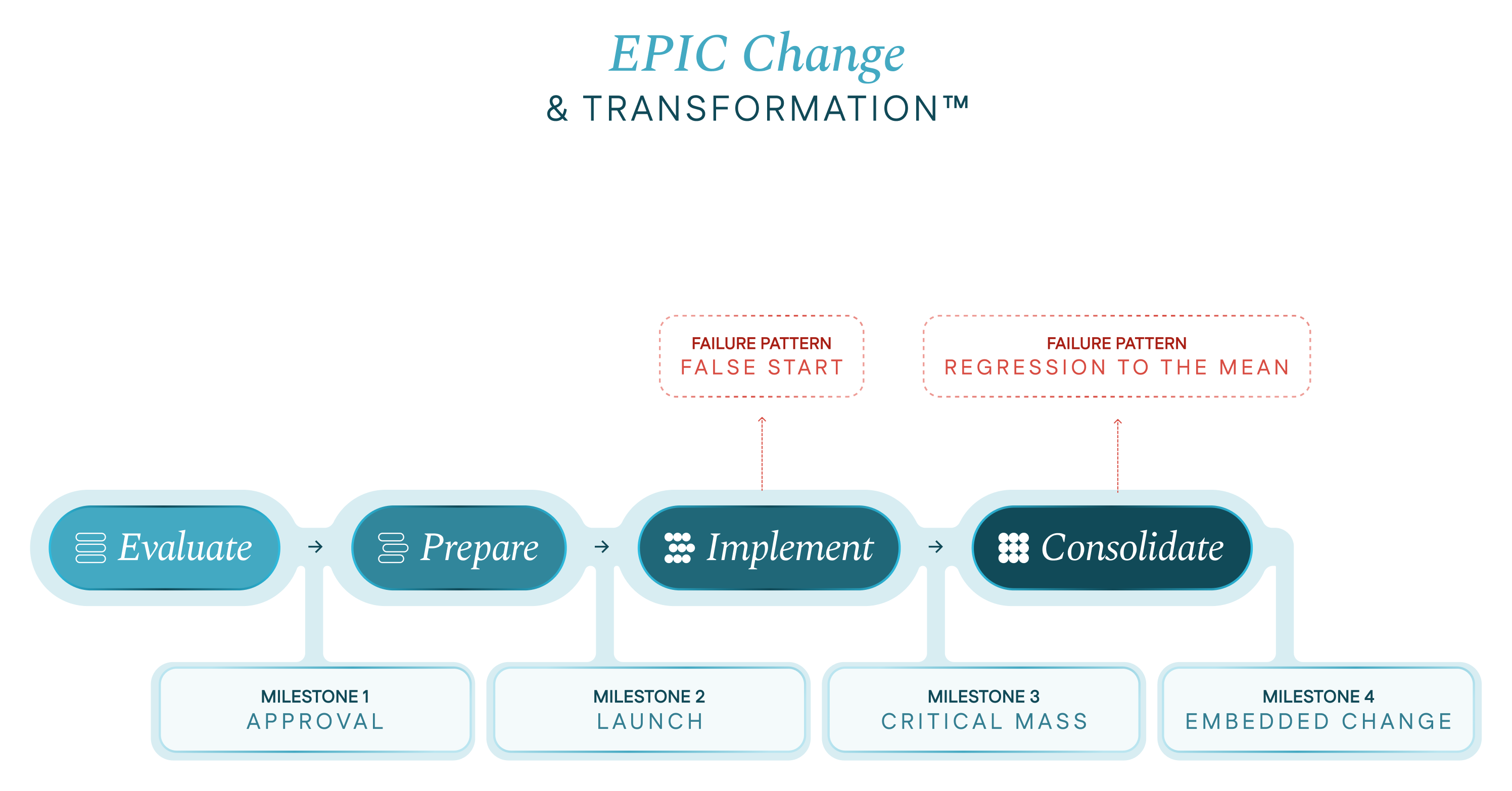
Diagnose before you campaign. If your change is live, find out which you actually have — commitment or well-behaved compliance — by looking at what happens where nobody’s checking. If you’re pre-launch, spend the next two weeks on the coalition and the involvement plan before spending another hour on the announcement. The change management pillar covers the full arc, and the EPIC Change & Transformation™ framework in the Change Management skill gives leaders the phase-by-phase practice, applied to a change they’re actually running. Start with the honesty: name what this change asks of people, out loud, before they have to ask you.
Frequently asked questions
- What is employee buy-in for change?
- Buy-in is voluntary commitment: people choosing to give a change their effort, not just their attendance. It's different from compliance, which gets you people's hands, some of their head, and none of their heart. Changes run on discretionary effort, which is why compliant-but-uncommitted rollouts stall in the middle.
- How do you get employees to buy into change?
- Earn it rather than message it. Involve the people who must live the change in shaping it, build a visible coalition before the announcement, be honest about what you can't promise, and deliver early visible wins so effort feels justified. Buy-in follows the leader's demonstrated credibility more than the quality of the pitch.
- What is the difference between compliance and commitment?
- Compliance is doing what's required while it's being watched; commitment is owning the change when nobody is checking. The two look identical in week one and completely different in month three. A team can be fully compliant and quietly waiting the change out, which is why silence during a rollout isn't agreement.
- Why do employees resist change even when it's explained well?
- Because resistance is usually about risk, not comprehension. People weigh what the change might cost them (competence, standing, autonomy) and whether the leader asking is someone worth taking that risk with. Explaining harder addresses the part they already understood and skips the part that's actually stopping them.