





What makes a good team? 8 characteristics that actually hold a team together
What makes a good team? Eight characteristics, grouped by the four dimensions of team cohesion — social, task, identity, and commitment — and how to spot them.
A good team is one where people genuinely care about each other, agree on what they’re trying to accomplish, feel like they belong, and choose to keep giving real effort. That’s four things — and what makes a good team is almost never a matter of raw talent. It’s whether all four are present at the same time. Teams of very capable people come apart every week because one of them quietly went missing.
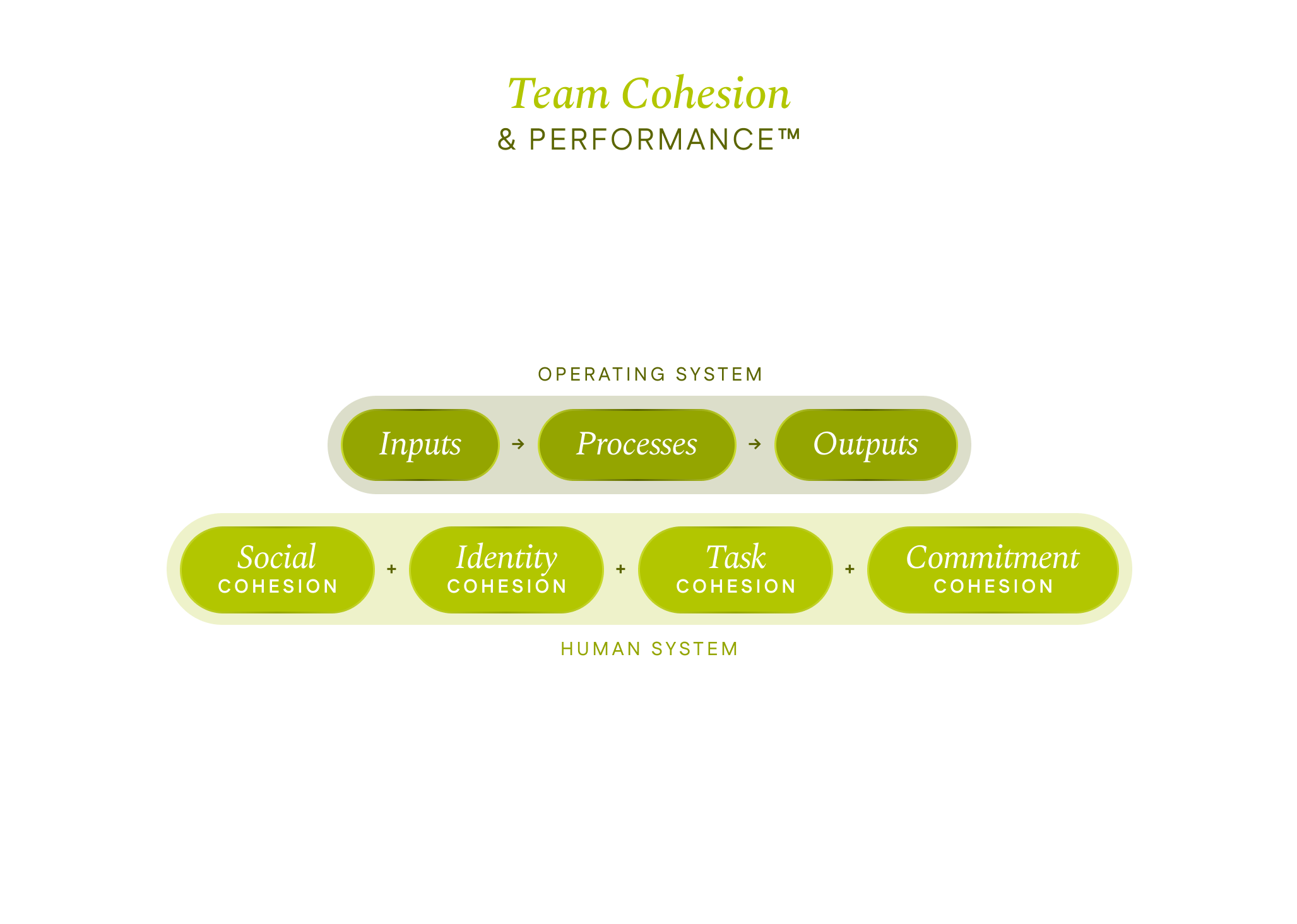
Most articles on this question hand you a list of adjectives: communication, trust, respect, accountability. All true, all hard to act on, because a list of adjectives can’t tell you which item is your problem. LeaderFactor organizes them around the Four Dimensions of Team Cohesion — social, task, identity, and commitment. Below are eight concrete characteristics of a good team, grouped by the dimension each belongs to, with what each looks like day to day and, just as usefully, what it does not mean.
What makes a good team? The 8 characteristics
A good team shows eight characteristics: members care about each other’s well-being, feel safe being open about problems, share the same understanding of the goal, know exactly who owns what, feel a genuine sense of belonging, take pride in a purpose they can point at, want to stay, and give extra effort when the work gets hard.
Grouped by the dimension each belongs to:
Social cohesion — the relationships
- People genuinely care about each other’s well-being.
- People feel safe being open about mistakes, gaps, and difficulty.
Task cohesion — the work 3. Everyone describes the team’s goal the same way. 4. Roles, ownership, and decision rights are unambiguous.
Identity cohesion — the belonging 5. People feel they belong and are proud to be on this team. 6. The team has a shared purpose bigger than the deliverable.
Commitment cohesion — the effort 7. People want to stay on the team. 8. People give discretionary effort and persist when the work is hard.
Grouping them this way is diagnostic. Teams are rarely uniformly good or bad — they’re strong in two dimensions and hollow in a third, which is exactly why the problem is so hard to name from the inside.
Why the four dimensions matter more than the list
Team cohesion is multidimensional, which means a team can be genuinely strong in one dimension and genuinely broken in another at the same time. That’s the single most useful idea on this page.
A team with warm relationships and no goal clarity feels pleasant and ships nothing. A team with sharp goals and no social cohesion executes fine until the first hard quarter, then fractures. A team that’s aligned and friendly but has no shared identity loses people to any recruiter with a marginally better offer. Three different failures, three different fixes — and a generic list of “good team qualities” can’t tell them apart.
Team Cohesion & Performance™ is the LeaderFactor skill built on these four dimensions. Here’s each one.
Social cohesion — do people actually care about each other?
Social cohesion is the degree to which team members have real relationships and give each other encouragement and support. It’s the relational floor everything else stands on.
What it’s not: being friends, socializing outside work, or having similar personalities. Plenty of teams are friendly and not socially cohesive. Pleasantness is not the same as support.
What it is: mutual care, interpersonal trust, and enough openness that people can admit they’re stuck. That last part matters most. On a socially cohesive team, “I don’t know how to do this” is a sentence someone says out loud on Tuesday rather than a fact you discover on Friday.
What it looks like day to day:
- Someone asks “how are you doing?” before the agenda — and waits for the answer.
- When a person mentions something hard, the response is “what would help?” rather than unsolicited advice.
- People offer help without being asked, and offering it isn’t read as a status move.
- The leader admits their own mistakes in front of the team, first.
This is where psychological safety and trust overlap with cohesion. Trust is a judgment you make about another person; social cohesion is a property of the whole group. A good team needs both.
Task cohesion — is everyone actually working on the same thing?
Task cohesion is the degree to which a team is aligned on what it’s trying to accomplish and how the work fits together. It is also the most commonly overestimated dimension on any team.
What it’s not: individual competence. A team of excellent individual performers can have terrible task cohesion — that’s what duplicated work, dropped handoffs, and “I thought you had that” are made of.
What it is: a shared understanding of the mission, a clear line from each person’s job to that mission, unambiguous ownership and decision rights, and the ability to re-align quickly when priorities move.
What it looks like day to day:
- Ask four people what the team is trying to achieve this quarter and get four compatible answers.
- Everyone can state how their own work contributes to that goal, in one sentence.
- Decision rights are written down — who decides, who implements, who advises, who’s informed.
- When a priority changes, someone says so explicitly instead of letting people infer it.
Test this rather than assume it. In your next team meeting, ask each person to say back what they think the team’s top priority is. The gaps are usually surprising, and they cost nothing to find.
Identity cohesion — do people feel like they belong here?
Identity cohesion is the degree to which people feel a sense of belonging and see the team as part of who they are professionally. It’s the dimension that quietly predicts whether people stay.
What it’s not: uniformity or conformity. A strong team identity doesn’t require everyone to think alike. It requires everyone to be genuinely included in the “we.”
What it is: belonging, pride in membership, a real sense of “we,” and a purpose the team can point at that’s larger than this quarter’s deliverable.
What it looks like day to day:
- People say “we” without being coached to.
- Wins get marked publicly, and the story of how they happened gets retold.
- The team has small rituals — a retrospective, a standing way to open a meeting, a way of marking milestones.
- New people get asked what would make them feel part of the team, and someone acts on the answer.
Identity is cheap to build and expensive to lose. Teams neglect it because it feels ceremonial, then wonder why one reorg empties the roster.
Commitment cohesion — do people choose to stay and give real effort?
Commitment cohesion is the degree to which team members want to remain on the team and are willing to give extra effort. It’s the output dimension — the one the other three produce.
What it’s not: compliance. Fear produces attendance and minimum viable effort. It doesn’t produce persistence, and it can’t be bought with compensation alone.
What it is: a voluntary choice to stay, willingness to go beyond the job description when the work demands it, and persistence after the work stops being fun.
What it looks like day to day:
- People volunteer for stretch work instead of waiting to be assigned it.
- Effort holds up through the difficult middle of a project, not just the exciting start.
- Someone names it out loud when a teammate steps up.
- Growth conversations happen because they’re scheduled, not because somebody resigned.
Commitment is the one dimension you can’t address directly. You cannot ask for discretionary effort. You can only build the conditions — social, task, identity — that make people want to give it.
How to tell whether you actually have a good team
Watch behavior, not mood. Cohesion shows up in small observable moments long before it shows up in results:
- Social: does anyone say “I’m stuck” before the deadline?
- Task: can four people describe the goal the same way?
- Identity: do people say “we” or “they” when they describe the team?
- Commitment: who volunteers when something hard comes up?
There’s a second, harder check: ask. A pattern LeaderFactor sees often is that leaders rate their team’s social and task cohesion higher than the team itself does. Leaders sit in a different informational position — they see the alignment in their own head and mistake it for shared understanding, and people bring them good news more readily than bad. That gap between how a leader sees the team and how the team experiences it is the most useful diagnostic a manager has.
Surfacing that gap is what the COHESIONindex™ is built for. It asks 20 questions — five per dimension — on a seven-point agreement scale, and can be run as a self-assessment or as a multirater assessment in which peers, direct reports, and a supervisor answer the same items about the same team. The score matters less than the gap. Where the leader rates higher than the team, that’s a blind spot. Where the team rates higher, that’s a strength being taken for granted. The full model lives on the Team Performance skill page.
What a good team is not
Four misconceptions worth retiring:
- A good team is not one that never disagrees. Alignment on where you’re going is precisely what makes disagreement about how to get there safe. Teams that never argue usually aren’t harmonious — they’re withholding, and the bill arrives later. A team where nobody pushes back is a team where the leader is the only source of ideas.
- A good team is not a group of friends. Affection is pleasant, but it isn’t the mechanism. What matters is whether people support each other under pressure.
- A good team is not a collection of the best individuals. Talent is an input; cohesion is what converts it into coordinated work. It’s the whole reason what makes high-performing teams is a question about how people work together rather than about who they are.
- A good team is not one where everyone is comfortable. Comfort and safety are not the same. A good team is safe enough that people can be usefully uncomfortable — asking a naive question, admitting a gap, challenging a decision that’s already been made.
Where to start if your team is missing one
Pick the weakest dimension and work on only that one for a quarter. Cohesion tends to build in a particular order: social cohesion makes candor possible, candor makes task alignment real, and alignment plus belonging produces commitment. Fixing all four at once produces four half-efforts and no change.
Then choose two or three specific behaviors rather than a value statement. “Ask what would help” is a behavior. “Be more supportive” is not. Behaviors are the only thing a team can actually practice, and practice is the only thing that changes a team.
Where to go next
- Team cohesion — the same question at a higher resolution: the four dimensions underneath these qualities.
- High-performance teaming — how collaboration and shared goals scale past a single team.
- How to build a strong team — what a manager does about it, in sequence.
- Team Performance — the four dimensions, the COHESIONindex™, and the behavioral practices behind each one.
Frequently asked questions
- What makes a good team?
- A good team is one where members genuinely care about each other, share the same understanding of what they're trying to accomplish, feel they belong, and choose to keep giving real effort. LeaderFactor groups these into four dimensions of team cohesion: social, task, identity, and commitment. Weakness in any one destabilizes the rest.
- What is the most important quality of a good team?
- No single quality carries a team. The four dimensions of team cohesion — social, task, identity, and commitment — work as a system, and the one that matters most is whichever one is weakest. A team with deep trust and no shared goal underperforms just as badly as a team with clear goals and no trust.
- Do good teams disagree?
- Yes. A good team is not one that avoids conflict — it's one aligned on where it's going, which makes disagreement about how to get there safe and productive. Teams that never disagree usually aren't harmonious; they're withholding. Silence in a meeting is more often a warning sign than evidence of agreement.
- What's the difference between a good team and a group of talented people?
- A group of talented people shares a manager; a good team shares a goal, an identity, and a stake in each other's success. Talent is an input. Cohesion is what converts it into coordinated work — without it, capable people duplicate effort, leave gaps, and optimize for their own piece.
- How can you tell if you're on a good team?
- Watch behavior, not mood. On a good team people ask for help before deadlines slip, say what they actually think in meetings, can describe the team's goal the same way, and volunteer for hard work. On a weak team those things happen privately, late, or not at all.