





Building high-performing teams: a systems approach
Building high performing teams takes more than hiring talent. The two systems every team runs, the four dimensions of cohesion, and where performance leaks.
Building a high-performing team starts with a definition most advice skips: a high-performing team is one that produces quality outputs consistently. Lots of teams deliver in bursts. The consistency is what separates high performance from a good quarter, and it doesn’t come from talent, chemistry, or an inspired offsite. It comes from a system working on purpose.
That’s the argument of this page. The characteristics everyone lists (trust, communication, shared goals, feedback) are real, but they’re outputs of a well-built system, not ingredients you can hire for. So the practical question isn’t “what do high-performing teams look like?” It’s “what do I build first?”
The talent assumption, and why it fails
The belief usually sounds like this: get the best people you can afford, and performance follows. It’s the most expensive assumption in team building, because it’s half true. Talent sets the ceiling. It says nothing about whether you’ll reach it.
Leicester City won the 2015–16 Premier League at 5,000-to-1 odds with a squad that cost a fraction of what its rivals spent. The talent gap was enormous and pointed the wrong way. What Leicester had was coordination: everyone knew the plan, their role in it, and what the player next to them would do under pressure.
A team is a system. Not a collection of individuals. When a team of strong performers underdelivers, the deficit is almost never intelligence or effort. Team performance problems are usually coordination problems, and coordination problems live between people, in the handoffs, where no individual’s job description points.
What the classic models tell you, and where they stop
Three models dominate the team literature, and each earns its place. Tuckman’s forming–storming–norming–performing sequence explains why new teams wobble before they work (we cover it in depth in stages of team development). Lencioni’s five dysfunctions names what breaks: absence of trust at the base, then fear of conflict, lack of commitment, avoidance of accountability, and inattention to results. Katzenbach and Smith distinguish real teams from working groups by mutual accountability toward a shared purpose.
Read all three and you’ll have a good diagnosis vocabulary. What none of them gives you is Monday. They describe teams from the outside; they don’t tell a leader which behavior to change this week or how to know whether it worked. For that you need to look at the team the way you’d look at any system: by its parts and its flows.
The two systems every team runs
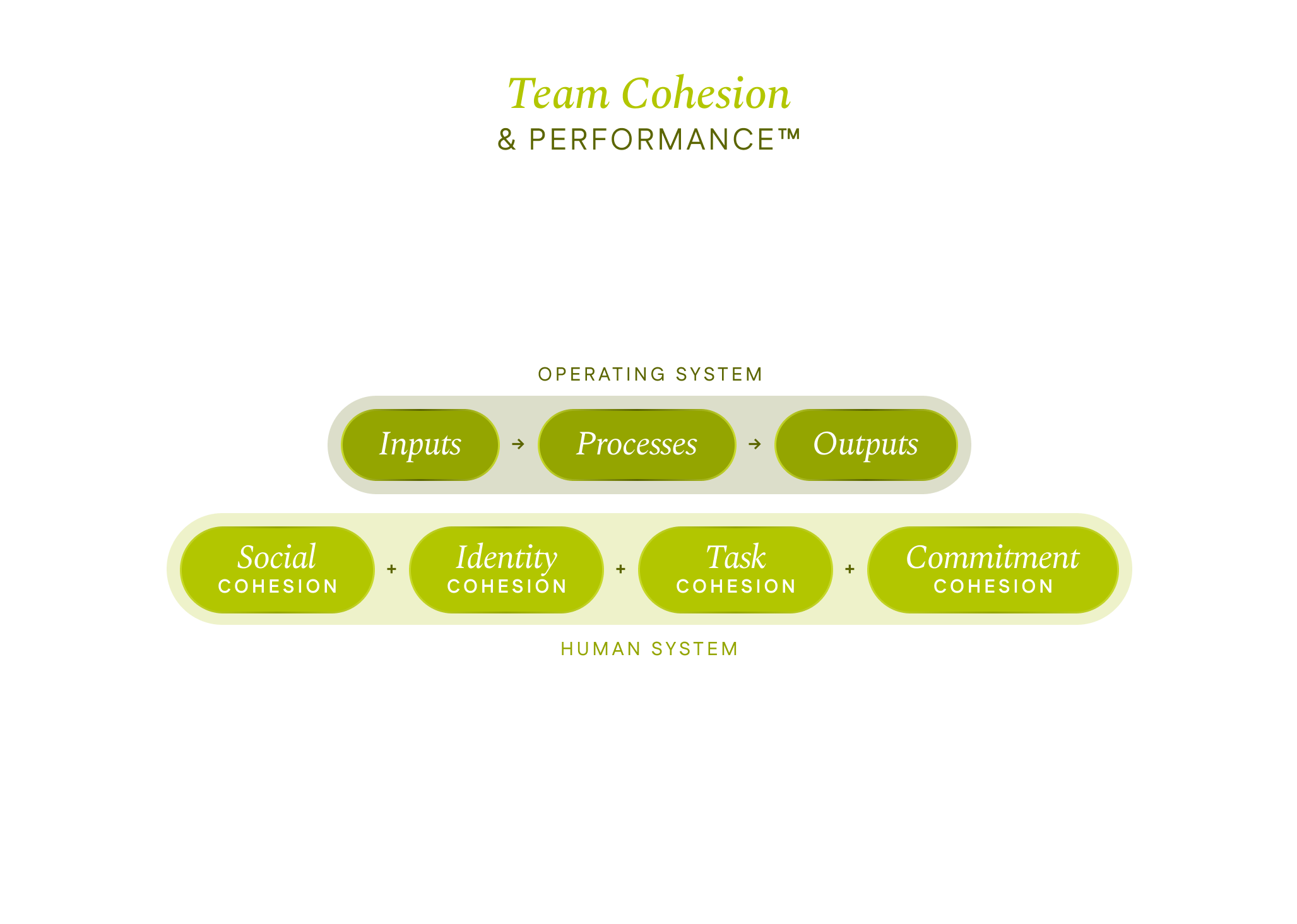
Every team runs two systems at once: how it feels and how it works. Performance leaks out of the gap between them.
The first is the cohesion system, and it has four dimensions:
- Social cohesion — the interpersonal foundation: care, trust, and the willingness to be open with each other.
- Task cohesion — shared clarity on what the team is for and how each person’s work fits together.
- Identity cohesion — a real sense of belonging and “we” that people carry into how they see themselves.
- Commitment cohesion — the voluntary choice to stay, persist, and give discretionary effort when the work gets hard.
The second is the work system: inputs (what the team starts with), process (how the work actually moves between people), and outputs (what the team produces). The rule that governs it is blunt: you cannot improve outputs by demanding better outputs. You change outputs by changing inputs or processes. Processes are the team’s points of leverage, and process problems are revealed in the handoffs: the decision nobody owned, the work done twice, the four-day delay nobody can explain.
Notice what this framing does to the usual characteristics list. “Trust” isn’t an abstraction anymore; it’s social cohesion, and it has behaviors attached. “Alignment” is task cohesion. “Engagement” is commitment cohesion, and low commitment is usually a symptom: the evidence that one of the other three dimensions has a deficit.
Build each dimension with behaviors, not events
An offsite is an event. A team is a system, and systems change through small behaviors repeated until they’re normal. Each cohesion dimension has moves a leader can start this week:
- Social: in 1, ask “how are you doing?” before any work topic, and mean it. Openness from the leader goes first.
- Task: end every meeting on “who’s doing what by when.” A low task-cohesion score is an alignment gap, not a motivation gap, so treat it with clarity rather than pep.
- Identity: write the one sentence “we exist to…” that captures the team’s actual purpose, and test whether every member would write roughly the same sentence.
- Commitment: when the work is hard, say so plainly, then state the path forward. Manufactured optimism erodes commitment; honesty plus direction builds it.
None of these moves is impressive on its own. That’s the point. High-performing teams are built out of unimpressive behaviors performed with unusual consistency.
Measure the gap before you work it
It’s a Tuesday in March at a freight logistics company in Memphis, and the director of operations is reading her team’s COHESIONindex™ results. She’d have bet on low social cohesion; the team is remote and new. Instead the gap is task cohesion: her people like each other fine and cannot say what the team is for this quarter. She’d been planning a team-building event to fix a clarity problem.
That’s what measurement buys you: you work on the actual weakest dimension instead of the one you’d have guessed. The COHESIONindex™ asks the whole team, which matters, because the gap between how a leader sees the team and how the team sees itself is often the most instructive data point available. Baseline, work the weakest dimension with the behaviors above, re-measure on a 30-60-90 rhythm.
Where to start
Pick the system you’ve been ignoring. If your team gets along and still misses, trace the last three misses to their handoffs and fix the process point they share. If the work system looks clean and the team still drags, baseline the four cohesion dimensions and work the lowest one first.
For the fuller picture of what you’re building toward, read what makes a good team and team cohesion, then look at the Team Performance skill for the instrument and the practice. And if you take one idea into your next leadership meeting, take this one: stop asking who on the team needs to be better, and start asking where the work leaks.
Frequently asked questions
- What is a high-performing team?
- A high-performing team produces quality outputs consistently, not occasionally. The consistency is the hard part: plenty of teams deliver in bursts. LeaderFactor defines team performance across two systems, how the team feels (cohesion) and how it works (coordination), because sustained performance requires both to function at the same time.
- What are the characteristics of high-performing teams?
- Research converges on trust, clear shared goals, honest feedback, and productive conflict. The useful move is treating these as outputs of a system rather than traits to recruit for. They show up when a team has social, task, identity, and commitment cohesion, and they fade when any of those four erodes.
- Why do teams full of talented people underperform?
- Because a team is a system, and most team problems are coordination problems rather than competence problems. Work leaks in the handoffs between strong individuals: unclear decisions, duplicated effort, delays, and friction. Adding more talent doesn't fix a coordination problem. Redesigning how the work moves between people does.
- How do you measure team performance?
- Measure both systems. The work system shows up in outputs you already track. The cohesion system needs an instrument: LeaderFactor's COHESIONindex™ asks the whole team agreement-scale questions across social, task, identity, and commitment cohesion, so leaders see the gap between how the team believes it's doing and what members actually experience.
- What is the leader's role in building a high-performing team?
- The leader designs and maintains the system. That means clarifying what the team is for, building the four dimensions of cohesion through small repeated behaviors, and fixing the process points where work leaks. Teams reflect their leaders over time, which makes the leader's own behavior the highest-leverage input.