





The 5 stages of team development (and how to lead a team through each one)
The stages of team development — forming, storming, norming, performing, adjourning — explained, plus how to tell which stage your team is in and what to do.
The stages of team development are the five phases a group predictably moves through as it becomes a working team: forming, storming, norming, performing, and adjourning. Proposed by psychologist Bruce Tuckman in 1965, the model says a team must negotiate belonging, then conflict, then shared norms, before it can do its best work — and that a leader’s job changes completely at each stage.
Most explanations stop there. This one covers the model in full, then adds what leaders actually need: how to tell which stage your team is in, why teams slide backward, and which behavior moves a team forward — through the four dimensions of team cohesion LeaderFactor uses to make the model actionable.
What are the 5 stages of team development?
The five stages of team development are forming (orientation and polite uncertainty), storming (conflict over roles, goals, and influence), norming (agreement on how the team will work), performing (fluid, high-output collaboration), and adjourning (closure and transition). Every team passes through them, though not always cleanly and rarely on a schedule.
| Stage | What’s happening | The question the team is asking | The leader’s job |
|---|---|---|---|
| Forming | Orientation, politeness, dependence on the leader | Do I belong here? | Create belonging and give direction |
| Storming | Friction over roles, priorities, and influence | Who decides? | Make the conflict safe and settle it |
| Norming | Norms, trust, and coordination take hold | How do we work? | Codify what’s working and step back |
| Performing | Autonomous, adaptive, high output | How do we get better? | Sustain effort and remove obstacles |
| Adjourning | The team disbands or reconfigures | What did this mean? | Close the loop and harvest learning |
Where the model came from — and what it actually claims
Bruce Tuckman published “Developmental Sequence in Small Groups” in Psychological Bulletin in 1965, after reviewing 50 studies of small-group behavior from therapy groups, human-relations training groups, and natural and laboratory groups. From that synthesis he named four stages: forming, storming, norming, performing.
One detail from the original paper rarely survives into the popular summaries, and it matters: Tuckman described each stage in two parallel tracks — an interpersonal one (testing and dependence → conflict → cohesion → functional role-relatedness) and a task one (orientation → emotional response to the task → open exchange of opinions → emergence of solutions). A team is always doing two things at once: working out its relationships and working out its work.
In 1977, Tuckman and Mary Ann Jensen revisited the model in “Stages of Small-Group Development Revisited,” examining 22 studies from the intervening decade — only one of which had set out to test the hypothesis directly. They added a fifth stage, adjourning, and called for more empirical work. That is the honest status of the model: a durable, useful description of how groups behave, not a validated law with fixed timings.
The four dimensions of cohesion underneath the stages
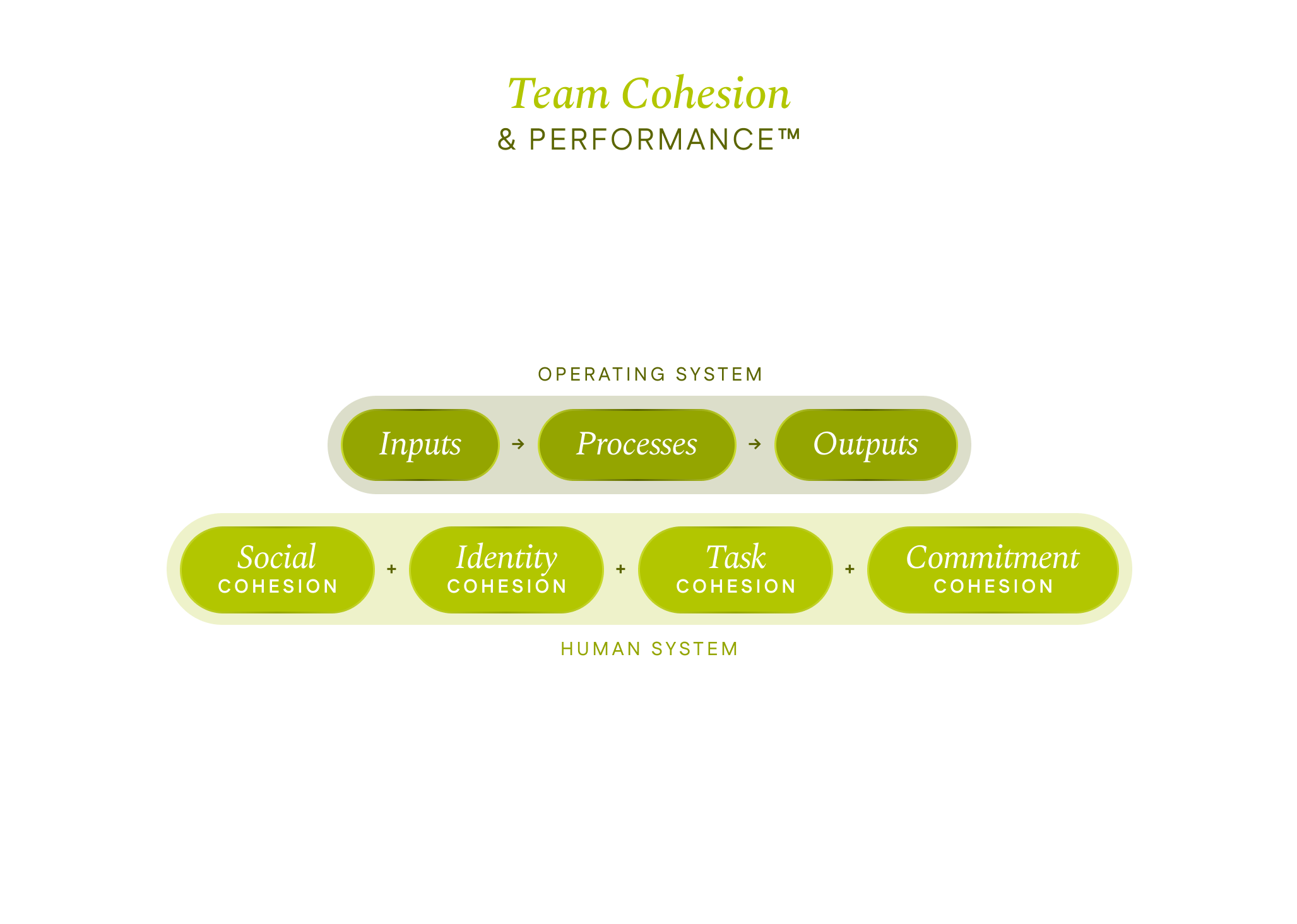
Tuckman’s two tracks are where LeaderFactor’s Team Cohesion and Performance™ model does its work. It treats cohesion as four measurable dimensions rather than one vague feeling:
- Social cohesion — members have real relationships and give each other encouragement and support.
- Task cohesion — the team is aligned on what it’s trying to accomplish and how the work fits together.
- Identity cohesion — people feel a sense of belonging and identify with the team.
- Commitment cohesion — people want to stay on this team and will give extra effort.
The dimensions line up with the stages. Social cohesion is what forming is for. Task cohesion is what storming fights over and norming settles. Identity cohesion consolidates as norms hold. Commitment cohesion is what keeps a performing team performing. Naming the dimension in play tells you which behavior the moment calls for.
Stage 1: Forming — testing whether you belong
In the forming stage, people are polite, tentative, and dependent on the leader. Output is low and questions are high, because nobody yet knows the answer to the question that matters to them privately: am I accepted here? The team is orienting, not executing.
How you know you’re here. Discussion stays on the surface. People direct comments to the leader rather than each other. Disagreement is avoided. Roles are described in job titles rather than real responsibilities.
The leader’s job. Supply the structure people can’t yet supply themselves, and build the relational floor. State the team’s mission in one sentence and put it where everyone can see it. Start meetings with one non-work update per person. Ask new members, “What would make you feel like part of this team?” — then act on the answer.
Cohesion in play: social. Skipping forming doesn’t save time; it makes storming worse, because a team with no relational credit has nothing to spend on its first real disagreement.
Stage 2: Storming — deciding who decides
The storming stage is when the politeness breaks down and real differences surface — over goals, priorities, methods, roles, and influence. It feels like a problem. It is the team doing necessary work: you cannot reach genuine alignment without first exposing the misalignment.
How you know you’re here. Meetings run long without decisions. The same issue resurfaces under different names. Side conversations carry the real opinions. People question the direction, the process, or the leader.
The leader’s job. Don’t suppress the conflict and don’t let it go personal. Make disagreement safe enough to be useful — this is where building psychological safety in the team pays for itself, because a team that can’t voice dissent doesn’t skip storming, it storms silently. Then convert friction into structure: map who decides, who implements, who advises, and who is informed.
Cohesion in play: task. Storming is an argument about task cohesion — what are we trying to achieve, and who owns what. Teams stuck here are usually missing role clarity or decision rights, not goodwill.
Stage 3: Norming — agreeing how we work
In the norming stage the team settles into shared expectations. Feedback lands without defensiveness, help is offered before it’s requested, and coordination happens without the leader brokering it. Output climbs noticeably.
How you know you’re here. People correct each other directly and it lands fine. Handoffs stop dropping. Ask each person to say back what they think the team is working on, and the answers match.
The leader’s job. Name and lock in what’s working so the new norms survive a busy quarter. Run regular retrospectives. Start attaching meaning to the work — tell the story of a team win and what made it possible, and connect what the team does to the larger mission.
Cohesion in play: task consolidating into identity. Norming is where “a group of people who work together” becomes “we.” Listen for the pronoun shift; it’s the cheapest identity-cohesion signal you have.
Stage 4: Performing — getting better on purpose
In the performing stage the team is largely self-directing. It adapts to shifting priorities as a unit, solves problems without escalation, and holds high standards without the leader enforcing them. This is what people mean by a high-performing team.
How you know you’re here. Decisions get made at the level where the information lives. Conflict is about the work and gets resolved in the room. People volunteer for the hard assignment. Turnover is low, and not because the market is bad.
The leader’s job. Get out of the way, then keep the conditions intact. Remove obstacles rather than direct traffic. Name discretionary effort when you see it: “You really stepped up.” Create stretch work people can volunteer for. Have explicit career conversations — the fastest way to lose a performing team is to care only about this quarter’s output.
Cohesion in play: commitment. Commitment can’t be mandated, which is what makes it both valuable and fragile. Performing teams decay quietly when no one tends the reasons people choose to stay.
Stage 5: Adjourning — closing the loop
The adjourning stage — added by Tuckman and Jensen in 1977 — is what happens when a project ends, a team dissolves, or its members move on. It carries real emotion for teams that reached performing, and it is routinely skipped.
How you know you’re here. Energy drops as the end date approaches. People orient toward what’s next. Loose ends linger because nobody wants to be the one to close them.
The leader’s job. Mark the ending deliberately: finish the deliverables and handoffs, run a final retrospective the team actually attends, and say specifically what this group did that others don’t. Done well, adjourning converts a finished project into identity and commitment members carry into their next team.
How long does each stage of team development last?
There is no standard duration, and that isn’t an oversight — Tuckman’s model specifies an order, not a timetable. The pace is set by how often the team interacts, how interdependent the work is, how stable membership is, and above all whether the team will have its storming conversations out loud.
The failure mode is predictable: teams that treat storming as a management failure suppress it, and a suppressed disagreement goes underground rather than resolving. The team then looks cooperative while avoiding the decisions that matter, sometimes for years. Time in existence is a poor proxy for team maturity.
How do you know which stage of team development your team is in?
Start with the question your team keeps returning to — Do I belong? Who decides? How do we work? How do we get better? The dominant question marks the stage more reliably than tenure does. Then check the four cohesion dimensions separately, because teams are rarely at the same stage on all of them. A team can be strong on social cohesion and weak on task cohesion (friendly, aligned on nothing) or the reverse (efficient, brittle, quietly disengaged).
That’s the diagnostic problem the COHESIONindex™ is built to solve. It’s a 20-item team assessment — five items per dimension, each rated on a 7-point agreement scale. A dimension score is the mean of its five items; the overall score is the mean of the four dimension scores, so one strong dimension can’t mask a weak one. Scores map to five bands, from Critical to Very Strong.
Its more useful feature is multirater mode: the leader completes it, and so do their manager, peers, and direct reports. Comparing the two surfaces a blind spot (the leader rates cohesion higher than the team experiences it), a hidden strength (the team rates it higher), or alignment. Blind spots on task cohesion are common — leaders assume the goal is obvious because it’s obvious to them, which is exactly how a team stays stuck in storming while its leader believes it’s performing.
Why teams move backward through the stages
Team development is not a one-way ratchet, and treating it as one is a common leadership mistake. A performing team can land back in forming or storming within a week. The usual triggers:
- Membership changes. One arrival or departure resets belonging for everyone. It’s not “mostly the same team” — it’s a new team with a head start.
- A new leader. Decision rights turn ambiguous again, which puts the team back into storming.
- A goal or priority change. Task cohesion was built around the old goal; a reorg dissolves it even when the people are unchanged.
- An unresolved conflict. A disagreement that was smoothed over rather than settled re-emerges attached to the next decision.
Regression isn’t the failure — interpreting it as failure is, because the response becomes pressure to “get back to performing” instead of re-running the earlier stage’s work. The fix is always the same: identify which cohesion dimension took the hit, and rebuild that one deliberately.
Where to go next
The stages tell you which phase your team is in. The four dimensions of cohesion tell you what to do about it, turning “we’re storming” into specific behaviors for a specific week.
- The model and the practices behind each dimension: Team Performance.
- The far end of the sequence: high-performance teaming and team cohesion.
- The practical build: how to build a strong team.
Teams don’t mature because time passes. They mature because someone does the work each stage requires — belonging in forming, clarity in storming, norms in norming, commitment in performing. Knowing your stage is how you know which work is yours right now.
Frequently asked questions
- What are the 5 stages of team development?
- The five stages of team development are forming, storming, norming, performing, and adjourning. Teams start out polite and uncertain, hit conflict over roles and goals, settle into working norms, reach peak effectiveness, and finally disband or reconfigure. Each stage calls for a different kind of leadership rather than the same management style throughout.
- Who created the stages of team development model?
- Psychologist Bruce Tuckman proposed the model in 1965 in 'Developmental Sequence in Small Groups,' published in Psychological Bulletin, after reviewing 50 studies of small-group behavior. He named four stages: forming, storming, norming, and performing. In 1977, Tuckman and Mary Ann Jensen added a fifth stage, adjourning, after reviewing later research.
- How long does each stage of team development last?
- Tuckman's model describes a sequence, not a schedule — it never assigned durations to the stages. In practice the pace depends on how often the team interacts, how interdependent the work is, how stable membership is, and whether conflict gets addressed. Teams that avoid the storming conversations stall there indefinitely.
- How do I know which stage of team development my team is in?
- Listen for the dominant question the team is asking. Forming teams ask 'Do I belong here?' Storming teams ask 'Who decides?' Norming teams ask 'How do we work?' Performing teams ask 'How do we get better?' The question the team keeps returning to marks its stage more reliably than how long it has existed.
- Can a team go backward through the stages of team development?
- Yes. Team development is not a one-way ratchet. A new member, a new leader, a reorganization, a change in goals, or an unresolved conflict can push a performing team back into forming or storming. Regression is normal; the risk is treating it as failure instead of re-running the work of the earlier stage.