







Team performance training for leaders.
Every team runs two systems at once: how it feels and how it works. Performance leaks out of the gap between what the team believes about itself and what is actually true. This program measures both, redesigns the system with the team inside it, and re-measures on a 30-60-90 rhythm.
 COHESIONindex™ results in the LeaderFactor platform
The learning platform at leaderfactor.app, sample data.
- Format
- Cohort-based with self-paced modules. Live-virtual, on-demand, or in person.
- Length
- Five weeks, closing with a 30-60-90 day plan built to the team's biggest gap.
- Instrument
- COHESIONindex™ team-level baseline and re-measure.
- Built for
- Teams that quietly underdeliver. On paper this should be your best team, and it isn't.
Team performance training teaches a leader to treat a team as a system, not a collection of individuals, and to fix the place in that system where performance leaks. A team is the basic unit of performance in human organizations. Teamwork is coordinated behavior, not effort, not goodwill, not talent. The training question is whether your leaders can see where the coordination breaks, and whether they have a method for repairing it that survives the next busy quarter.
This page covers what a program should teach, why the usual answer doesn’t move the scoreboard, which format fits an intact team versus a leader cohort, and how to tell before you buy whether anything will change.
Why team building doesn’t move the scoreboard
The usual program is an offsite. The team does something memorable together, feels closer, and comes back to the same handoffs, the same meetings without decisions, and the same two people doing the integration work nobody owns. The offsite felt great. The scoreboard didn’t move. An offsite is an event; team performance is a system, and a one-day morale bump does not change a system.
The misconception is that team performance is a people problem, so the fix is better people or better feelings. Team cohesion and performance problems are usually coordination problems. Not intelligence problems, not training problems, not competence problems. The work leaks in the handoffs between your strongest people, and no amount of liking each other repairs a handoff. Problems are revealed in the handoffs. Flow is the test of coordination.
So the program has to do what an offsite can’t: measure the team as a system, find the leak, and redesign the part of the system that produces it.
What the training should teach: two systems, read together
LeaderFactor’s program is built on Team Cohesion & Performance™, which reads every team across how it feels and how it works.
The cohesion side is structural, not sentimental. Team cohesion is the bond that enables high performance. Not camaraderie, not harmony, not likeability. The bond. It sits at the balance point between conflict on one end and conformity, the homogenization of thought, on the other. The program scores it in four dimensions. Social Cohesion is the anchor, the care and trust that support everything else. Task Cohesion is shared clarity on what the team is for and how each person’s work fits. Identity Cohesion is the sense of “we” that people carry into how they see themselves. Commitment Cohesion is the voluntary choice to persist when the work gets hard, and a low score there is usually a symptom of deficits in the other three.
The work side is a cycle, not a line: inputs, the conditions and constraints the team starts with; process, how the team actually does the work together, the operating system rather than the org chart; and outputs, what the team produces and how honestly it learns from them. You cannot improve outputs by demanding better outputs. You change outputs by changing inputs or process, and process is the team’s point of leverage.
One off-target output at a time
The method is the Team Performance Cycle. Diagnosis works backwards from the output that is off-target to the process that produced it. Action planning redesigns that process, with the team inside the redesign rather than receiving it. Implementation runs the change in the meetings the team already has. Then the team re-measures and picks the next output.
Consider a hospital pharmacy team whose medication turnaround time has missed target for three quarters. The leader’s instinct is to push harder on turnaround. The diagnosis says the output is produced by a handoff between verification and dispensing that nobody owns after 3 p.m., and the COHESIONindex™ shows a Task Cohesion gap: the team does not share a picture of how each person’s work fits. The redesign is one process change and one leader micro-behavior, ending every huddle with who is doing what by when. Turnaround is an output. The program never touched it directly.
The leader micro-behaviors are deliberately small and scheduled. In one-on-ones, ask how someone is doing before discussing any work. Write one sentence that captures what the team actually exists to do. When the work is hard, name it, then state the path forward. Each is pinned to a dimension and to a meeting that already exists.
Which format fits your rollout
- A leader cohort is the default: leaders of different teams work their own COHESIONindex™ results in parallel and build a shared vocabulary for diagnosing a team.
- An intact team is the right choice when one team’s results are the problem. The whole team takes the instrument, the leader and the team read the gap together, and the 30-60-90 plan is theirs.
- Live-virtual, on-demand, or in person are delivery choices. The framework, the instrument, and the plan are the same in each.
How you’ll know it worked
Measure the team, not the leader’s impression of the team. The COHESIONindex™ is a team-level assessment: agreement-scale items answered by the whole team, so leaders see the gap between how the team believes it is doing and what its members actually experience. It scores the four cohesion dimensions separately, then rolls them up, so “how the team feels” stops being a vibe and becomes four numbers you can move. The gap between how a leader sees the team and how the team sees itself is often the most instructive number in the course.
The cadence is baseline, work the weakest dimension first with behavioral practices in the flow of work, and re-measure on a 30-60-90 rhythm. The course ends with that plan written and the dates set.
Where to start
Start with the team everyone describes the same way: on paper it should be your best, and it isn’t. Run the baseline with the whole team, find the dimension with the widest gap between the leader’s view and the team’s, and give that leader the first cohort seat. The re-measure at day 90 tells you whether to run the next one.
What the program covers
Four cohesion dimensions, one work system, a plan to the biggest gap.
Team Cohesion & Performance™ reads a team across how it feels and how it works, then works backwards from the off-target output to the process that produces it.
-
Social Cohesion
The interpersonal foundation: care, trust, and the willingness to be open with each other. The anchor dimension that supports all the others.
-
Task Cohesion
Shared clarity on what the team is for and how each person's work fits together. A low score here is an alignment gap, not a motivation gap.
-
Identity Cohesion
A real sense of belonging, pride, and 'we' that people carry into how they see themselves. It drives discretionary effort and retention.
-
Commitment Cohesion
The voluntary choice to stay, persist, and give discretionary effort when the work gets hard. The evidence that the bond is real.
-
Inputs, process, outputs
The work system: what the team starts with, how it actually works together, and what it produces. You change outputs by changing inputs or process, never by demanding better outputs.
-
The Team Performance Cycle
Diagnose from the outputs backwards, redesign the system, implement, and re-measure. One off-target output at a time.
-
The leader micro-behaviors
Concrete moves per dimension, practiced in meetings the team already has: end every meeting with who is doing what by when; when work is hard, name it, then state the path.
-
The 30-60-90 plan
Built to the team's biggest gap, with the re-measure dates set before the course ends.
Assess, learn, apply, prove. One platform.
The program runs on leaderfactor.app: the baseline, the cohort and self-paced modules, the application tools, and the re-measure, with org-level reporting for the people who bought it.
COHESIONindex™ baseline 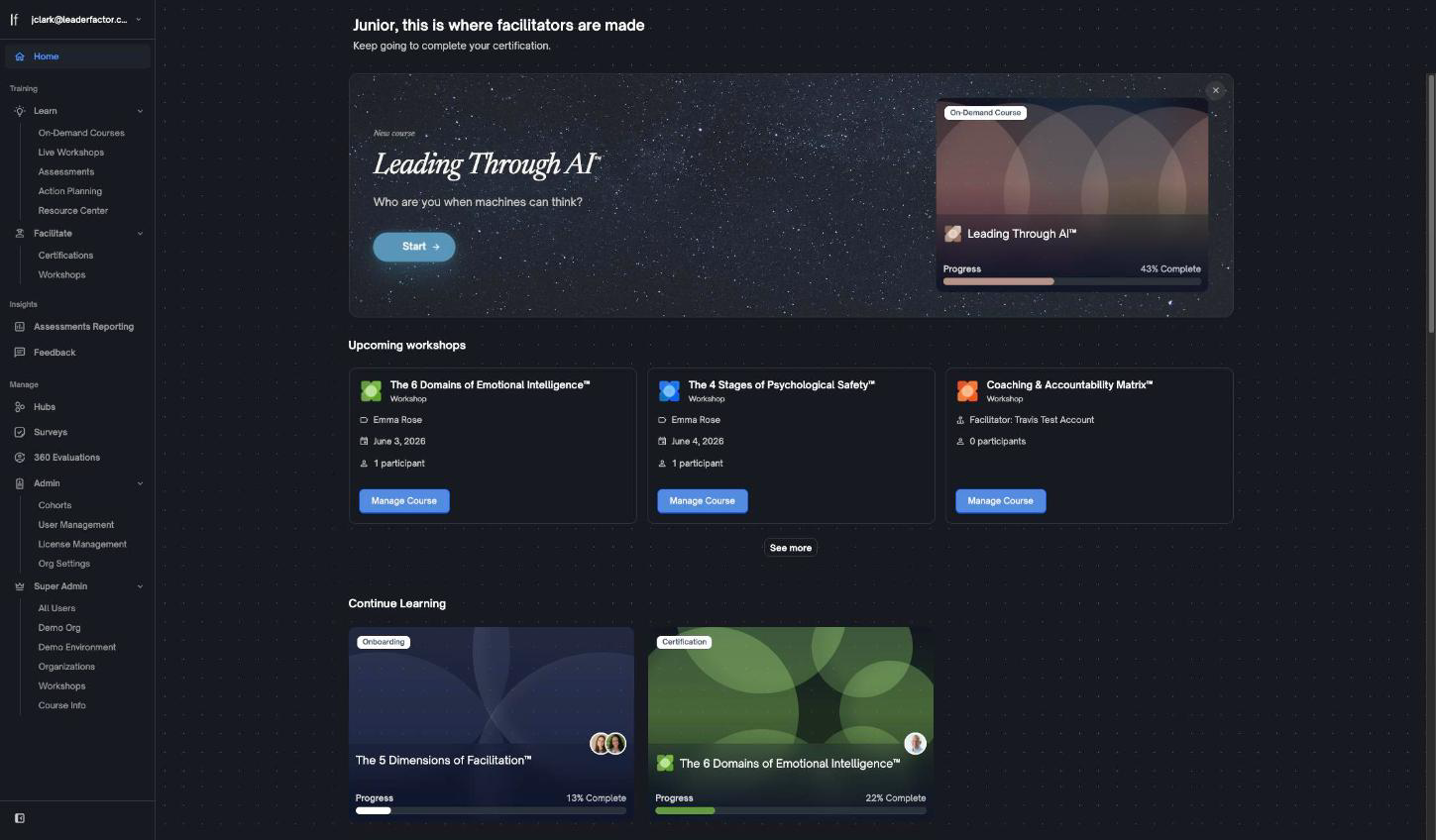 The learner home in the LeaderFactor platform
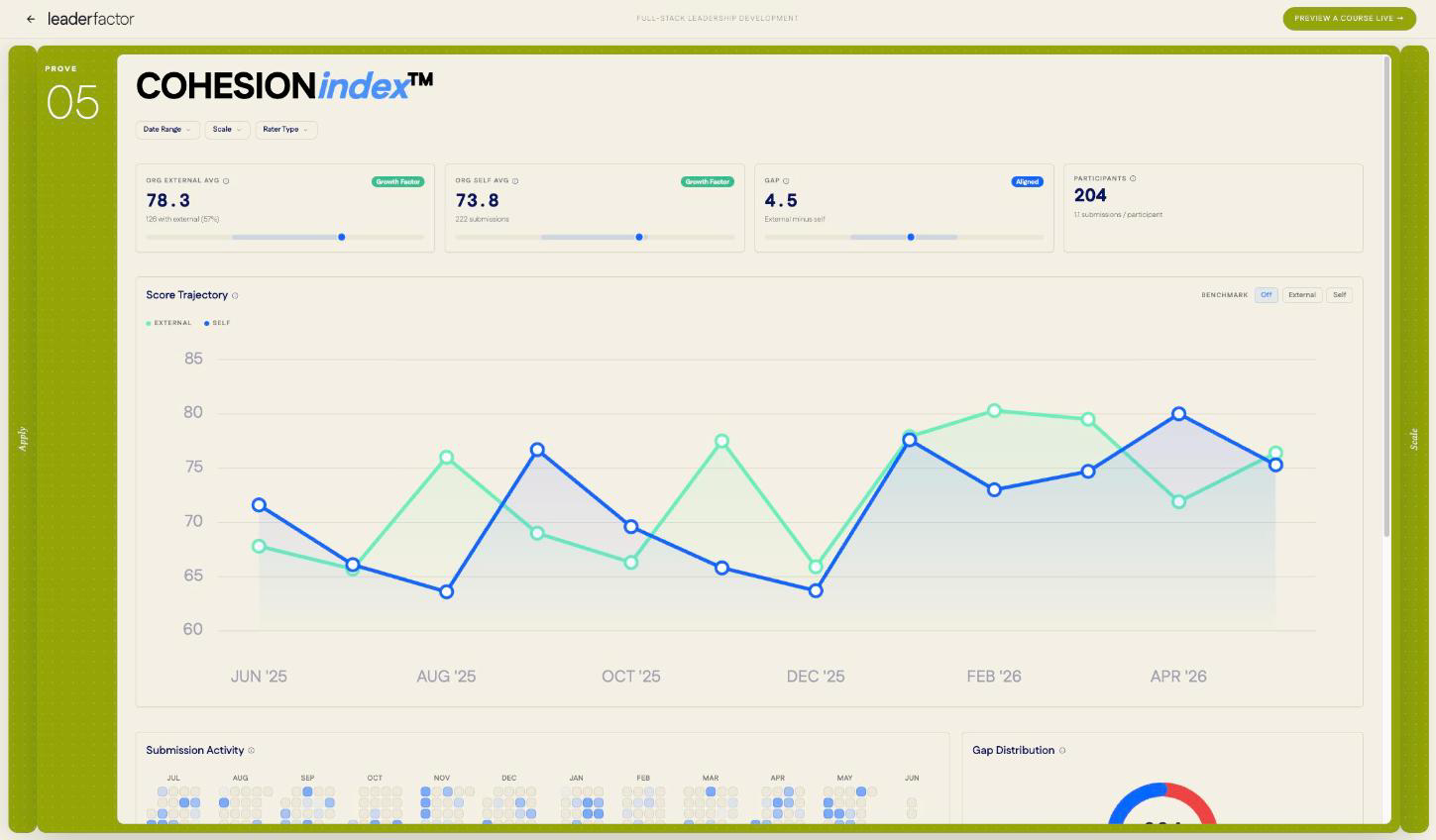 COHESIONindex™ re-measure
Screens from leaderfactor.app with sample data. Not client results.
Not sure this is the skill you need?
If the room goes quiet when the boss talks, that is Psychological Safety, not a team system problem. This program is for teams where people speak freely and the work still leaks between them.
See the Psychological Safety programFrequently asked questions
- What is team performance training?
- Team performance training teaches a leader to read a team as a system, diagnose where its results leak, and redesign how the team works together. Unlike team building, which aims at morale, it works backwards from the team's actual outputs to the inputs and processes that produce them, and measures the team before and after so the change is visible.
- What is the difference between team building and team performance training?
- Team building is an event that aims at how a team feels. Team performance training is a system that aims at how a team works, and treats how it feels as one of the measurable inputs. An offsite can lift morale for a week; a performance program changes the handoffs, decisions, and accountability that produce the scoreboard.
- What should a team performance program cover?
- Two things. The cohesion side: social, task, identity, and commitment cohesion, scored separately so 'how the team feels' becomes four numbers you can move. And the work side: inputs, process, and outputs, with a method for working backwards from an off-target result to the process that caused it. It should end with a dated plan.
- How long does team performance training take?
- LeaderFactor's program runs five weeks, cohort-based with self-paced modules, and closes with a 30-60-90 day plan built to the team's biggest gap. The COHESIONindex™ is taken at baseline and re-measured on that rhythm, so the leader sees whether the weakest dimension moved.
- How do you measure team performance training?
- At the team level, before and after. The COHESIONindex™ uses agreement-scale items answered by the whole team, so a leader sees the gap between how the team believes it is doing and what its members actually experience. It scores the four cohesion dimensions separately, then rolls them up, and the re-measure shows which dimension moved.
Redesign the system your results come from.
See the program run in a free one-hour Skill Preview, assessment included. Or talk with us about a cohort for your leaders.
or start with the free guide, The resilient team playbook →