





Team cohesion: the four dimensions that hold a team together
Team cohesion is how unified a team is across four dimensions — social, task, identity, and commitment. What it is, how it breaks, and how to measure it.
Team cohesion is the degree to which a team is unified — not only socially, but across everything that keeps a group together and pointed in the same direction. It is the difference between a set of capable people who share a calendar invite and a team that holds its shape under pressure.
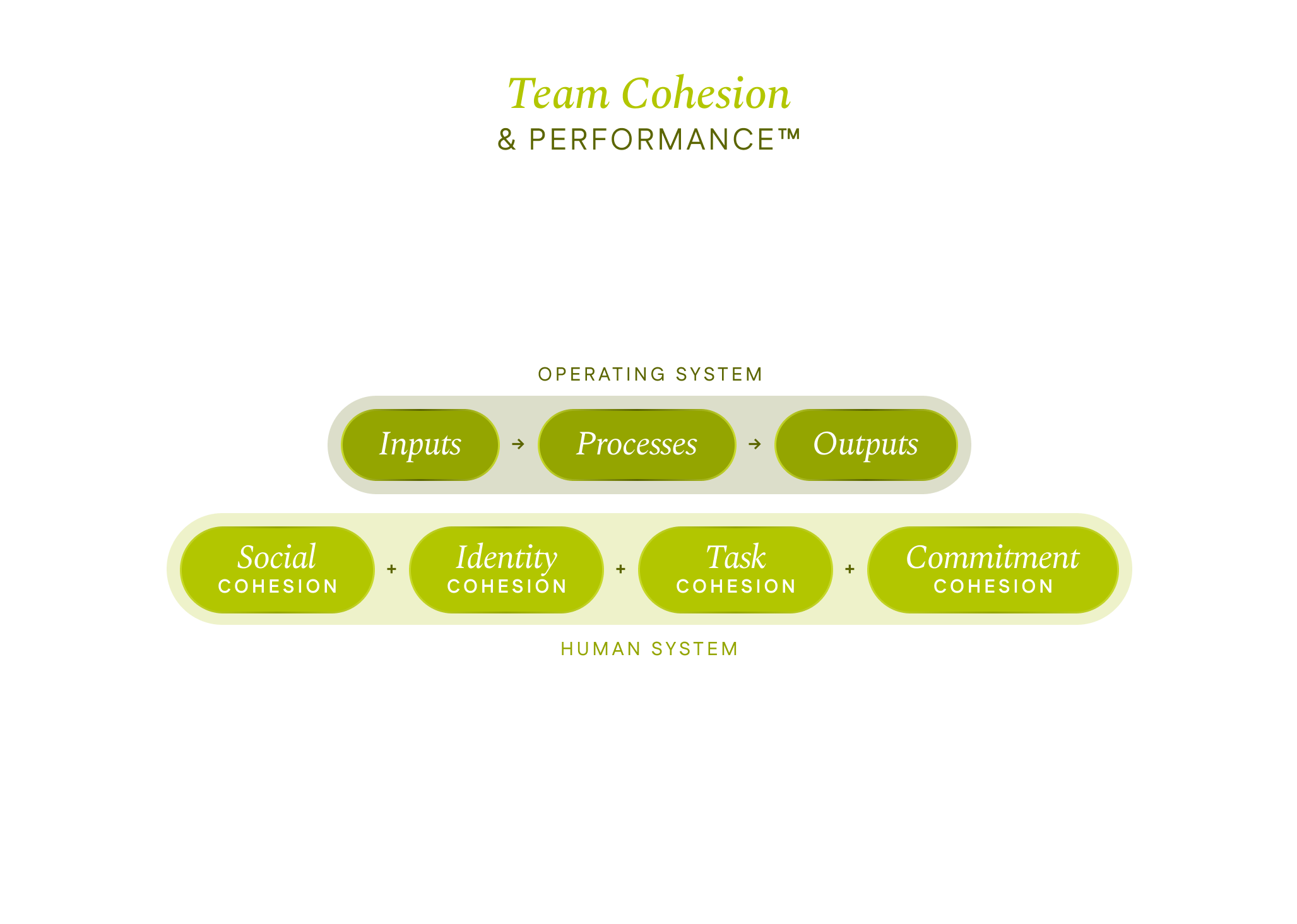
Most definitions stop at closeness, which is why most advice about cohesion stops at team dinners. LeaderFactor treats team cohesion as a multidimensional construct with four distinct dimensions: social, task, identity, and commitment. A team can be strong in one and hollow in another. The pattern across the four, not the average of them, is what tells a leader what to do next.
What is team cohesion?
Team cohesion is a property of the group, not a trait of the people in it. It describes how tightly a team is bound together in relationships, in understanding of the work, in identity, and in the willingness to stay and contribute effort. It is dynamic: it rises and falls with what the team goes through, and it can decay quietly while output still looks fine.
Two things follow. First, cohesion is not chemistry — not a lucky combination of personalities a manager either inherits or doesn’t. It is produced by repeated behavior, and it responds to changes in behavior. Second, cohesion is not performance. The two feed each other, but a team can post good numbers for a while on individual talent alone, and that is exactly the team most likely to come apart at its first real setback.
The four dimensions of team cohesion
Group-dynamics research has long recognized that cohesion is multidimensional. The best-known instrument in the field, the Group Environment Questionnaire, splits it into task and social components rather than treating it as a single score. That split is the floor, not the ceiling. Two more dimensions do independent work in real organizations: whether people identify with the team, and whether they choose to stay and give it their best effort.
LeaderFactor’s Team Cohesion and Performance model uses all four.
Social cohesion — the relational foundation
Definition: team members have strong interpersonal relationships and provide each other encouragement and emotional support.
What it’s not: social cohesion is not about being friends or having identical personalities. Teams do not need to socialize outside work or agree with each other to be socially cohesive.
What it is: mutual care, interpersonal trust, psychological openness, and a willingness to be vulnerable with colleagues.
You can see it in small behaviors. Colleagues check in on each other’s well-being. People offer help before being asked. Someone brings a problem to the team while it is still messy instead of after it has been polished. Relationships extend past the transaction.
Social cohesion matters because it is what lets a team communicate openly and absorb difficulty together. It is the dimension that determines whether bad news travels fast or travels late.
Task cohesion — alignment on the work
Definition: the team is aligned on what it is trying to accomplish and how the work fits together.
What it’s not: task cohesion is not the same as individual task competence. A team of excellent individual performers can have terrible task cohesion — that is, in fact, one of the most common patterns in high-talent organizations.
What it is: a shared understanding of the team’s mission, a clear line from each person’s role to that mission, unambiguous decision rights, coordinated workflows, and the ability to realign quickly when priorities shift.
The diagnostic question is simple and uncomfortable: if you asked five people on your team to write down the team’s top priority, how many answers would you get? Task cohesion is the prerequisite for execution. Without it, teams duplicate work, leave gaps between roles, and burn effort relitigating what was supposedly already decided.
Identity cohesion — belonging and “we”
Definition: people on the team feel a strong sense of belonging and identify with the team.
What it’s not: identity cohesion is not uniformity or conformity. This is the misconception that does the most damage, because leaders chasing a strong team identity often start filtering for sameness — same background, same working style, same opinions — and end up with a team that is homogeneous rather than unified.
What it is: belonging, pride in team membership, a real sense of “we,” team membership as a meaningful part of how people see themselves professionally, and a shared purpose.
Identity cohesion is audible. Listen for whether people say “we” or “they” when describing the team’s work, and whether they describe what the team does or only what they personally do. It drives retention, intrinsic motivation, and resilience through setbacks: when people believe the work matters and that they belong in it, they stay and they persist.
Commitment cohesion — the choice to stay and give more
Definition: team members want to remain part of the team and are willing to give extra effort.
What it’s not: commitment is not fear-based compliance, and it is not loyalty bought with money alone. Compliance produces the minimum. Commitment produces the extra.
What it is: a voluntary choice to stay, willingness to go above and beyond when the work demands it, persistence through difficulty, and demonstrated loyalty to the team’s mission.
Commitment cohesion is the dimension leaders have the least direct control over, because it cannot be mandated. It is given, not extracted, which is precisely what makes it valuable — and what makes it the first thing to disappear when people feel their effort goes unnoticed.
How team cohesion breaks down
Cohesion rarely collapses all at once. It erodes one dimension at a time, and the remaining dimensions mask the damage until performance drops. Four patterns account for most of what goes wrong:
- Friendly but directionless — high social, low task. The team genuinely likes each other, meetings are pleasant, and nobody can say what the team is actually accountable for. Because morale looks good, the problem gets diagnosed late.
- Efficient but disposable — high task, low identity. Work ships, roles are clear, and nobody feels attached to the team. This one looks healthy on every operational metric right up until a competitor makes an offer.
- Proud but misaligned — high identity, low task. The team has strong “we” language and real pride, but its energy is spread across work that doesn’t add up to anything.
- Compliant but not committed — everything present except discretionary effort. People do what is asked and nothing more, and the team has no surge capacity when something goes wrong.
Cohesion also decays under specific conditions: reorganizations, priority churn, rapid headcount growth, and distributed work. All four dimensions depend on repeated contact and restated goals, so anything that interrupts contact or leaves goals unstated erodes them — and each condition hits a different dimension first.
The warning signs are worth watching for: people stop volunteering for anything unassigned, questions in meetings drop to zero, “we” becomes “they,” handoffs start requiring escalation, and problems surface only after they are expensive.
The perception gap — why leaders are usually the last to know
The single most useful measurement in team cohesion is not the score. It is the gap between how the leader perceives the team and how everyone else experiences it.
That gap has a consistent direction. Leaders commonly rate social cohesion and task cohesion higher than their teams do — they have more context on the goals, they hear a filtered version of team relationships, and they mistake their own clarity for shared clarity. LeaderFactor’s assessment is built as a multirater instrument specifically to expose this, and it names three outcomes:
- Blind spot — the leader rates a dimension higher than the team does. The leader may be underestimating friction or overestimating alignment. The work is to listen and verify rather than defend.
- Hidden strength — the leader rates a dimension lower than the team does. The team is stronger than the leader realizes, and the strength is going unrecognized and unleveraged.
- Alignment — the leader and the team see the dimension the same way. Shared perception makes improvement a joint project rather than a correction.
A gap of 1.0 point or more on the seven-point scale is treated as meaningful enough to focus a coaching conversation on. That threshold is a practical heuristic, not a statistical test — it exists to direct attention, not to certify a finding.
How to measure team cohesion
Team cohesion is measured with a survey that scores each dimension separately instead of collapsing everything into one number, and ideally with more than one perspective, so that the leader’s view can be compared against the team’s.
LeaderFactor’s instrument is the COHESIONindex™, currently in beta. Its mechanics:
- 20 items, five per dimension, all positively worded, presented in dimension order without dimension labels so respondents aren’t primed.
- A seven-point agreement scale, from “strongly disagree” to “strongly agree,” with a genuine neutral midpoint. Agreement rather than frequency, because the items describe team states rather than countable behaviors.
- Dimension score = the mean of that dimension’s five items. Overall score = the mean of the four dimension scores, not the mean of all 20 items. That distinction matters: averaging the dimensions keeps each one equally weighted, so a badly broken dimension can’t be buried under three healthy ones.
- Five interpretation bands across the 1.00–7.00 range: Critical (1.00–2.49), Low (2.50–3.99), Moderate (4.00–5.24), Strong (5.25–6.24), and Very Strong (6.25–7.00).
- Self-assessment or multirater mode. In multirater mode, supervisors, peers, direct reports, and other stakeholders answer matched items. A minimum of three raters is required before a multirater report is generated, and category breakouts require at least two raters in a category — both thresholds exist to protect anonymity.
- Two optional open-ended questions, one strength-oriented and one developmental, asked of everyone so the qualitative feedback has the same self-versus-others structure as the scores.
The instrument is designed for coaching and development rather than as a validated psychometric test, and it should be read that way: a low band is diagnostic data pointing at a dimension, not a verdict on a team.
Cohesion, psychological safety, and performance
These three concepts are related and frequently confused. Psychological safety is a condition of the environment: whether it is safe to take interpersonal risks like asking a question, admitting a mistake, or challenging a decision. It is upstream of cohesion, especially social cohesion, because a team cannot build genuine mutual trust while people are managing their exposure. It is also distinct from trust in a specific person, a distinction worth getting right — see psychological safety vs. trust for why teams routinely have one without the other.
Cohesion sits between that condition and the result. Performance is the result. This is why high-performing teams tend to look similar from the outside while the mechanisms underneath them differ, and why generic advice about high-performance teaming so often fails to transfer: the visible practices of a cohesive team are downstream of dimensions that the practices alone don’t build.
Where to start
Pick the dimension, not the program. The 30-plus behavioral practices in LeaderFactor’s Team Cohesion and Performance solution are organized by dimension for exactly this reason — the ones that build social cohesion (checking in before diving into tasks, asking “what would help?”, modeling vulnerability) do almost nothing for task cohesion, which needs role clarity, restated priorities, and explicit realignment when things change.
So measure first, and work on the dimension that is actually weak rather than the one you are most comfortable working on. Then pick two or three practices and run them long enough for the team to notice a pattern. Cohesion is built the way it erodes: one dimension at a time.
Frequently asked questions
- What is team cohesion?
- Team cohesion is the degree to which a team is unified and pulls in the same direction. LeaderFactor measures it across four dimensions: social cohesion (relationships and support), task cohesion (alignment on the work), identity cohesion (belonging and shared purpose), and commitment cohesion (the choice to stay and give extra effort).
- What are the four dimensions of team cohesion?
- The four dimensions are social, task, identity, and commitment cohesion. Social cohesion is mutual care and support. Task cohesion is shared understanding of goals and roles. Identity cohesion is belonging and pride in the team. Commitment cohesion is the voluntary desire to stay and give discretionary effort. Teams are rarely equally strong in all four.
- How do you measure team cohesion?
- Team cohesion is measured with a survey that scores each dimension separately rather than producing one vague rating. LeaderFactor's COHESIONindex™ uses 20 items, five per dimension, on a seven-point agreement scale. It can be taken as a self-assessment or as a multirater assessment that compares the leader's view with the team's.
- What is the difference between task cohesion and social cohesion?
- Task cohesion is alignment on the work: shared goals, clear roles, and coordinated effort. Social cohesion is the relational side: mutual care, trust, and genuine support between people. The two are independent. A team can be close socially and badly misaligned on the work, or perfectly aligned and relationally cold.
- Why do teams lose cohesion?
- Teams usually lose cohesion one dimension at a time rather than all at once. Reorganizations and priority churn erode task cohesion, dispersed work erodes social cohesion, unclear purpose erodes identity, and unrewarded effort erodes commitment. Because the remaining dimensions mask the damage, leaders often notice only after performance drops.